
The greatest challenge in retirement isn’t managing your money, but managing your purpose; the solution lies in treating this new chapter not as an endless vacation, but as your next major project.
- The initial “honeymoon” phase of retirement often fades within six months, leading to a sense of loss and drift without a pre-existing structure.
- Building a balanced “Purpose Portfolio”—allocating time to Contribution, Health, Connection, and Play—is more effective than just finding random hobbies.
Recommendation: Start by auditing your current weekly activities and strategically redesign your schedule to align with these four pillars of a fulfilling post-career life.
The alarm clock is silenced. The daily commute is a distant memory. For the first few weeks, retirement feels like a well-deserved, endless vacation. The absence of the “Sunday night dread” is a liberation you’ve earned over decades of hard work. But what happens when the novelty wears off? For many highly-driven professionals, the unstructured freedom can slowly curdle into a disquieting sense of aimlessness and a loss of identity. The common advice—to travel, volunteer, or pick up a hobby—often feels too generic, failing to address the deep-seated need for structure, challenge, and meaning that defined your professional life.
This isn’t about simply filling time; it’s about reinvesting it. The transition from a highly structured career to the open frontier of retirement can cause a psychological “Structure Shock.” The very scaffolding that organized your days, validated your skills, and provided social connection is suddenly gone. The real task isn’t to retire *from* life, but to redeploy your expertise and energy *into* it with renewed intention. What if the key wasn’t to find a single, all-encompassing new purpose, but to build a diversified portfolio of meaningful activities that stimulates your mind, nurtures your health, and deepens your connections?
This article provides a new blueprint for purpose after 60. We will deconstruct the psychological phases of retirement, provide a framework for building a balanced daily life, and explore how to choose activities that offer the highest cognitive and emotional return on investment. It’s time to move beyond the clichés and engineer a retirement that is as intellectually stimulating and personally fulfilling as the career that preceded it.
To guide you through this strategic redeployment of your life, we’ll explore the critical pillars for building a meaningful and engaging retirement. The following sections offer a roadmap from understanding the initial challenges to implementing practical, purpose-driven solutions.
Summary: A Practical Blueprint for a Purpose-Driven Retirement
- Why the “Vacation Phase” of Retirement Often Leads to Depression After 6 Months?
- How to Create a Daily Routine That Balances Leisure and Productivity Without Stress?
- Consulting or Charity: Which Path Offers Better Mental Stimulation for Former Executives?
- The Sedentary Trap: How 4 Hours of TV Daily Accelerates Cognitive Decline by 20%
- How to Set 5-Year Life Goals When You Are No Longer Chasing a Promotion?
- Mentoring vs. Manual Labor: Which Volunteer Role Creates Deeper Bonds?
- Passive vs. Active Hobbies: Why Woodworking Beats Crosswords for Brain Health?
- How to Make New Friends After 60 When You Don’t Like Bingo or Bridge?
Why the “Vacation Phase” of Retirement Often Leads to Depression After 6 Months?
The initial euphoria of retirement is real and wonderful. It’s a phase of liberation, travel, and shedding responsibility. However, this “honeymoon” is often just the first of four distinct psychological stages. According to the widely recognized Four Phases of Retirement framework, this initial vacation is frequently followed by a difficult phase of “loss.” This is the point where the loss of routine, professional identity, and work-based social networks becomes acutely felt. Without the external structure of a career, a void can appear, leading to feelings of boredom, irrelevance, and even depression.
This transition is a form of psychological “Structure Shock”. Imagine moving from a world of deadlines, meetings, and clear objectives to one of complete, unstructured freedom. While appealing in theory, this lack of scaffolding can be profoundly disorienting for individuals accustomed to high-performance environments. The challenge isn’t a lack of things to do, but a lack of a “why” behind the doing.
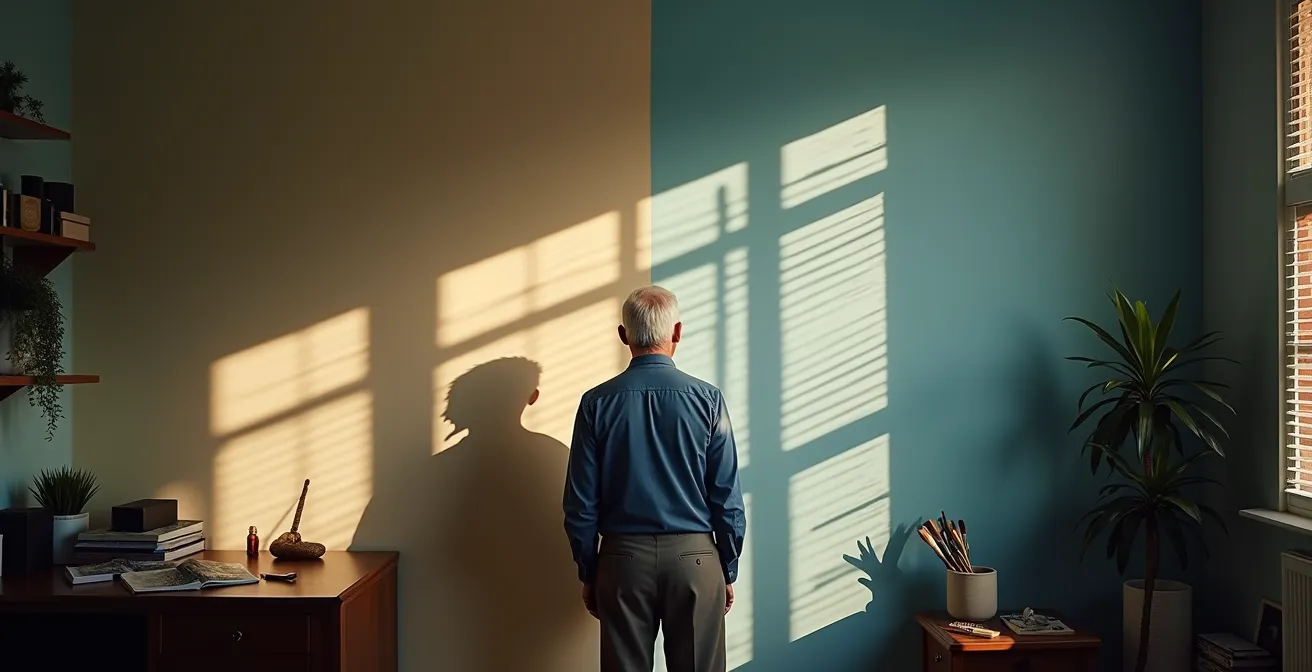
As the visual metaphor above suggests, you are standing at a threshold between two worlds. One is defined by the clear, predictable lines of a career; the other is a vast, open space of possibility that can feel overwhelming. Recognizing that this feeling of loss is a normal, predictable phase is the first step toward navigating it. The goal is to consciously move into the next phases—”trial and error” and ultimately “reinvent and rewire”—by actively building a new structure that aligns with your personal values, not just your old job title.
How to Create a Daily Routine That Balances Leisure and Productivity Without Stress?
The antidote to the “Structure Shock” of retirement isn’t to replicate the stressful, 9-to-5 grind. Instead, it’s to architect a new kind of routine—one that intentionally balances purpose with play. The most effective framework for this is the Purpose Portfolio Model. This isn’t about filling a calendar; it’s about allocating your time and energy into distinct categories that together create a rich, fulfilling life. Research confirms the power of this approach, with experts citing WebMD findings that show routines reduce stress, improve sleep, and enhance overall health.
A balanced Purpose Portfolio might look like this:
- 30% Contribution: Activities where you give back, such as volunteering in a strategic role, mentoring younger professionals, or serving on a board. This pillar directly addresses the need for purpose and legacy.
- 30% Health: Pursuits focused on physical and mental well-being. This includes exercise routines, but also learning new skills, which is a powerful tool for maintaining cognitive sharpness.
- 20% Connection: Dedicated time for social activities and family engagement. This pillar is about nurturing the relationships that provide emotional support and joy.
- 20% Play: Pure leisure and hobbies pursued without pressure or goals. This is the space for unstructured fun, creativity, and simple enjoyment.
To implement this, consider using “Theme Days” like ‘Mastery Monday’ (focused on learning a skill) or ‘Wellbeing Wednesday’ (dedicated to health appointments and exercise) to provide a gentle, non-stressful structure. This model replaces the rigid, externally imposed schedule of work with a flexible, internally motivated framework that ensures all aspects of a well-lived life are nurtured.
Consulting or Charity: Which Path Offers Better Mental Stimulation for Former Executives?
For former executives, the drive for cognitive challenge doesn’t disappear with the final paycheck. The question then becomes: how best to channel that intellectual energy? The two most common paths, consulting and charity work, offer vastly different types of mental stimulation. Choosing the right one depends on the kind of “Cognitive ROI” (Return on Investment) you’re seeking. Consulting often involves applying proven skills to familiar problems, a form of convergent thinking. Charity work, particularly in a leadership or strategic role, frequently demands novel solutions to complex social issues, fostering divergent thinking.
One path reinforces a pre-existing professional identity, while the other helps forge a new one based on legacy and impact. Neither is inherently better, but understanding their fundamental differences is key to making a fulfilling choice. The following table breaks down the key aspects:
| Aspect | Consulting | Charity Work |
|---|---|---|
| Cognitive Type | Convergent Thinking (applying known models) | Divergent Thinking (novel solutions) |
| Identity Impact | Status Continuation | Legacy Creation |
| Social Rewards | Professional network maintenance | New intergenerational connections |
| Financial Benefit | Paid engagement | Intrinsic rewards only |
| Flexibility | Project-based commitments | Ongoing volunteer schedules |
As the table illustrates, consulting can be an excellent way to maintain your professional network and identity, offering project-based flexibility and financial reward. However, charity work often provides deeper, more diverse social rewards through intergenerational connections and the profound satisfaction of legacy creation. Many find a powerful middle ground in mentoring. As the Due.com Editorial Team highlights, organizations like SCORE connect experienced retirees with individuals seeking business guidance, directly translating a lifetime of expertise into tangible impact for the next generation.
The Sedentary Trap: How 4 Hours of TV Daily Accelerates Cognitive Decline by 20%
One of the most insidious dangers of an unstructured retirement is the “sedentary trap”—specifically, the passive consumption of media. While relaxing, excessive television viewing is metabolically and cognitively passive. Studies have shown a stark correlation between hours spent in front of the TV and accelerated cognitive decline. The challenge isn’t to eliminate television, but to counterbalance its passive nature with deliberately engaging mental activities. The principle is simple: your brain, like a muscle, needs resistance and novelty to stay strong. It’s a “use it or lose it” scenario, and researchers have found that engaging in mentally stimulating activities is strongly associated with slower cognitive decline and may reduce the risk of neurodegenerative diseases.
To avoid the trap, you must become an active manager of your cognitive diet. This means consciously swapping passive consumption for active engagement. This could involve switching from a soap opera to a documentary that sparks a new interest, or from a game show to an online course. The goal is to introduce challenge and novelty into your daily routine. The “Activity Antidote” framework below provides a practical plan to turn passive screen time into a springboard for cognitive fitness.
Your Action Plan: The Activity Antidote to Passive Screen Time
- Audit Your Hours: For one week, track your daily “passive screen time” (e.g., watching TV, scrolling social media). This is your baseline.
- Implement the 4:1 Rule: For every hour of passive screen time you logged, commit to 15 minutes of an active “cognitive snack.” This creates a direct trade-off.
- Build Your “Snack” Menu: Create a list of engaging, short-duration activities. Examples include: doing a sudoku during commercial breaks, reading a challenging article, or spending 15 minutes on a language learning app.
- Schedule a “Main Course”: Plan one larger, complex cognitive project per month. This could be researching your family genealogy, planning a complex garden renovation, or learning a new piece of software.
- Measure Your Progress: At the end of the month, review your log. Has the ratio of active to passive engagement improved? Do you feel more mentally alert? Adjust your plan accordingly.
By treating cognitive health with the same intentionality as physical fitness, you transform a potential risk into an opportunity for growth and resilience. It’s not about restriction; it’s about strategic enrichment.
How to Set 5-Year Life Goals When You Are No Longer Chasing a Promotion?
After decades of career-oriented goals—promotions, bonuses, project completions—the concept of setting a “5-Year Plan” in retirement can feel both daunting and pointless. The old metrics of success no longer apply. The solution is to radically redefine what a “goal” means, shifting from achievement-based targets to experience-based projects. This is the essence of the Project-Based Living Framework. Instead of an endless to-do list, you structure your life around engaging, finite personal projects that last from 3 to 6 months.
This approach breaks down the overwhelming question of “what to do with the rest of my life” into manageable, exciting chapters. These projects can be categorized to ensure a balanced life:
- Mastery Goals: Projects focused on learning a new skill. Examples: ‘The Conversational Italian Project’ or ‘The Digital Photography Mastery Project’. The goal is the process of learning itself.
- Legacy Goals: Projects that contribute to others or the community. Examples: ‘The Young Entrepreneur Mentorship Project’ or ‘The Community Garden Launch Project’.
- Exploration Goals: Projects centered on travel, discovery, or new experiences. Examples: ‘The National Parks of the West Project’ or ‘The Local History Explorer Project’.
This framework shifts the focus from “states of achievement” (e.g., becoming a VP) to “states of being” (e.g., being a creator, a teacher, an explorer). It aligns with what many retirees, especially women, discover: after a lifetime of meeting obligations, retirement is the time to finally ask, “What do I want?”. It’s about creating a life that reflects your current values and curiosities, not your old responsibilities. This is your time to define success on your own terms.
Mentoring vs. Manual Labor: Which Volunteer Role Creates Deeper Bonds?
Volunteering is a cornerstone of a purposeful retirement, but not all volunteer roles are created equal when it comes to fostering deep human connection. While manual labor, like building a house or cleaning a park, creates a sense of shared accomplishment, it often involves parallel work. Mentoring, on the other hand, is inherently relational. It is built on dialogue, trust, and mutual vulnerability, which are the foundational elements of deep bonds.
The deepest connections often form when the relationship is reciprocal. A fascinating and powerful model for this is “Reverse Mentoring.” In this scenario, the retiree’s role is not just to impart wisdom but also to receive it. For example, a retired executive might mentor a young entrepreneur on business strategy while being mentored in return on social media or new technologies. This shatters the traditional age hierarchy and builds powerful bonds based on mutual respect and shared curiosity. It turns the interaction from a one-way transfer of knowledge into a two-way partnership.
This approach creates a powerful synergy. The retiree feels valued for their lifetime of experience, while also staying relevant, learning new skills, and seeing the world through a younger person’s eyes. This is where purpose finds its deepest meaning: not just in giving back, but in growing together. It’s about using what energizes you to make a difference for others, creating a life that feels both fulfilling and purposeful.
Passive vs. Active Hobbies: Why Woodworking Beats Crosswords for Brain Health?
Not all hobbies are created equal in the fight against cognitive decline. To maximize your “Cognitive ROI,” you must choose activities that are neurologically demanding. A crossword puzzle, for example, primarily relies on crystallized intelligence—accessing knowledge you already have. While enjoyable, it’s like a mental filing clerk retrieving old files. A truly neuroprotective activity, however, builds fluid intelligence—the ability to solve novel problems, learn new processes, and adapt. This is where an active, multi-sensory hobby like woodworking, playing a musical instrument, or learning a new language dramatically outperforms a passive one.
The Cognitive ROI Framework below compares three popular retirement hobbies across key neuroprotective factors. It clearly shows why complex, hands-on activities provide a superior brain workout. They engage multiple cognitive systems at once: novelty, focused challenge, creativity, and physical movement (kinesthetics).
| Neuroprotective Factor | Crosswords | Woodworking | Musical Instrument |
|---|---|---|---|
| Novelty (learning new) | Low | High | High |
| Challenge (focused effort) | Medium | High | High |
| Creativity (problem-solving) | Low | High | Medium |
| Kinesthetics (physical movement) | None | High | High |
| Intelligence Type Built | Crystallized | Fluid | Both |
This isn’t to say you should abandon your Sunday crossword. But it should be considered the “light stretch” in your cognitive fitness routine, not the main workout. For a truly robust brain, you need to lift heavier weights. The evidence is compelling, with research showing that language learning and music are among the most effective ways for older adults to build cognitive reserve and maintain mental sharpness. The key is to challenge your brain to build new neural pathways, not just travel down old, familiar ones.
Key Takeaways
- Retirement’s biggest challenge is not financial but the “Structure Shock” from losing your professional identity and routine.
- Actively build a “Purpose Portfolio” by dedicating time to four key areas: Contribution, Health, Connection, and Play.
- Maximize cognitive health by choosing active, challenging hobbies that build new skills (like woodworking or learning a language) over passive ones (like crosswords or watching TV).
How to Make New Friends After 60 When You Don’t Like Bingo or Bridge?
When your primary social circle was built around your career, retirement can bring a surprising wave of loneliness. The typical advice—join a club—often points to activities like bingo or bridge that may not resonate with a former executive’s sensibilities. The secret to building a new, vibrant social life after 60 is to shift from interest-based groups to mission-based groups. Friendships forged in the trenches of a shared goal are often deeper and more resilient than those formed over a card game.
Instead of looking for people who share your hobbies, look for people who share your values and drive. This is where your “Purpose Portfolio” pays a double dividend: the activities you choose for contribution and mastery are also the most fertile ground for new, meaningful friendships. Consider these mission-based strategies:
- Join a Non-Profit Board or Community Action Committee: You’ll work alongside other driven, intelligent individuals to solve complex problems. The shared mission becomes the bedrock of your connection.
- Create a “Personal Board of Directors”: Identify 4-5 diverse, interesting individuals and invite them to a regular “mastermind” meeting to discuss challenges, ideas, and goals. You become the convener of a high-level peer group.
- Host Modern Salons: Revive the art of conversation by hosting small gatherings in your home focused on a specific intellectual or cultural topic. You attract curious minds and position yourself as a social hub.
- Use Skill-Swap Platforms: Offer to teach a skill you’ve mastered (e.g., public speaking, financial modeling) in exchange for learning something new. This creates an immediate, reciprocal relationship based on mutual value.
Cultivating and keeping social connections is important for your overall well-being at all times, but especially during retirement when you may feel lonely. Engaging in social activities not only helps with feelings of isolation but exposes you to new experiences and perspectives. Friendships formed during this phase of life can be particularly fulfilling.
– Greater Good Health, How to Find Purpose in Retirement
By focusing on shared purpose rather than just shared pastime, you will attract the kind of peers who will challenge, support, and inspire you through the next exciting chapter of your life.
The time for passive living is over. The blueprint is clear: treat your retirement as the most important project of your life. Start by auditing your time, identify where you can shift from passive consumption to active contribution and creation, and begin building your personal Purpose Portfolio today. Your next great chapter is waiting to be written.