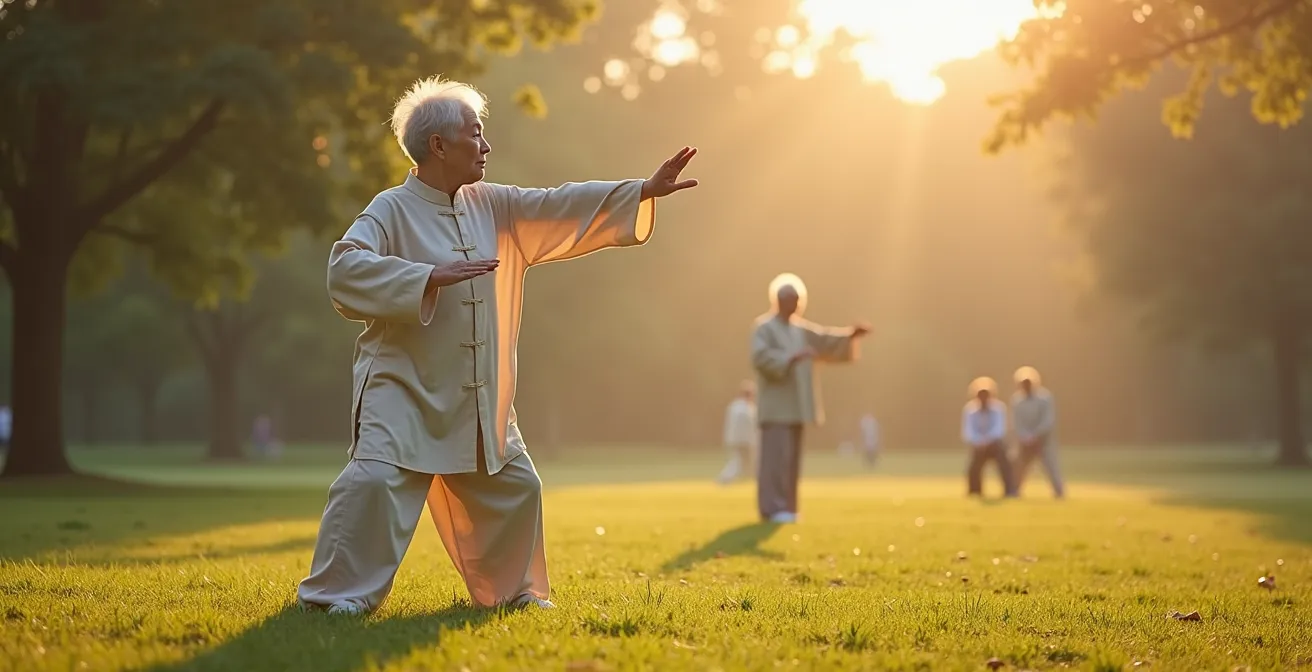
Contrary to the belief that it’s just “slow waving,” Tai Chi is a clinical powerhouse for fall prevention because it systematically retrains your brain’s connection to your muscles.
- It’s not about muscle strength alone, but about improving the body’s internal GPS (proprioception) through deliberate, controlled movements.
- The practice creates “dynamic stability,” teaching your body to automatically correct imbalances before a fall can even begin.
Recommendation: Instead of viewing exercise as a chore, approach it as a skill-building practice to reclaim your body’s innate balance, starting with just five minutes a day.
For many older adults, the fear of falling is a constant, background anxiety. A simple misstep on a rug or an unexpected patch of ice can transition from a minor stumble to a life-altering event in an instant. The common advice—be careful, use handrails, walk more—is well-intentioned but fundamentally incomplete. It treats the symptom, not the cause. Many believe that general fitness or even other gentle practices are the answer, often dismissing Tai Chi as little more than “slow, gentle waving.” This is a profound and dangerous misunderstanding.
As a balance rehabilitation specialist, I can state unequivocally: Tai Chi is not simply an exercise. It is a sophisticated form of neuromuscular recalibration. While walking improves cardiovascular health, Tai Chi specifically targets and retrains the complex systems that govern your stability: your brain, your nerves, your joints, and your muscles, all working in concert. It’s the difference between driving a car and taking a high-performance driving course. Both involve being behind the wheel, but only one systematically teaches you how to handle the vehicle in a crisis.
This article will deconstruct that very system. We will move beyond the platitudes and delve into the specific mechanics that make Tai Chi statistically superior for fall prevention. We will explore how to start safely, what to look for in an instructor, how to measure your own progress, and why even the smallest details, like your choice of socks, play a critical role in your stability. This is your clinical guide to turning “slow waving” into a powerful tool for a confident, stable, and independent life.
To help you navigate this comprehensive guide, we’ve broken down the key components of a successful balance improvement journey. The following sections will provide actionable advice and evidence-based insights to help you build a solid foundation for stability.
Summary: The Clinical Guide to Tai Chi for Unmatched Fall Prevention
- Chair Yoga vs. Mat Yoga: How to Get the Full Stretch Benefit Without Getting on the Floor?
- How Simple One-Legged Stands While Brushing Teeth Can Save You from a Fracture?
- Community Center vs. Specialized Studio: Where to Find Instructors Trained for Seniors?
- The Hyper-Extension Error: Why Locking Your Knees During Stretches Is Dangerous?
- How to Measure Balance Improvement When the Scale Doesn’t Change?
- Socks with Grips vs. House Shoes: Which Provides Better Stability on Hardwood?
- Push-Down vs. Loop Brakes: Which Is Easier for Arthritic Hands to Engage?
- How to Start an Exercise Routine at 65+ If You Haven’t Worked Out in Decades?
Chair Yoga vs. Mat Yoga: How to Get the Full Stretch Benefit Without Getting on the Floor?
Before diving into a standing practice like Tai Chi, many individuals find value in building foundational strength and flexibility from a seated position. The fear of getting down on the floor—and more importantly, getting back up—is a significant barrier. Chair yoga masterfully bypasses this obstacle, offering a highly effective alternative to traditional mat yoga without sacrificing core benefits. The key is understanding that stability starts with the core, and a strong core can be built without ever leaving your seat.
The effectiveness of chair yoga lies in its ability to isolate and engage key muscle groups safely. For example, seated knee lifts and torso twists effectively engage core stabilizers without placing any strain on the lower back or hips, a common issue with floor-based exercises. This builds the foundational strength necessary for the more dynamic movements of Tai Chi. It’s not a lesser form of exercise; it’s a smarter, more accessible starting point for many.
To get the most out of this practice, focus on proper form and targeted movements. These modifications ensure you’re building functional strength and flexibility that translates directly to better balance in daily life:
- Start with a Solid Base: Sit in a sturdy, armless chair with your feet flat on the floor to ensure proper spinal alignment.
- Use the Chair for Support: During standing poses performed behind the chair, such as modified Warrior poses, use the chair back as a reliable support to maintain balance.
- Mobilize the Spine Safely: Practice seated cat-cow stretches to enhance spine flexibility without the pressure of being on your hands and knees.
- Isolate the Core: When performing seated twists, keep your hips stationary and square to the front. This isolates the rotational movement in your torso, maximizing core engagement.
- Modify for Safety and Benefit: A seated eagle pose allows you to get the full upper back and shoulder stretch without the significant balance challenge of the standing version.
Think of chair yoga as the prerequisite course for your balance journey. It builds confidence, strength, and body awareness in a safe, controlled environment, preparing you for the next level of stability training. Mastering these movements first can make your transition to practices like Tai Chi smoother and far more effective.
How Simple One-Legged Stands While Brushing Teeth Can Save You from a Fracture?
The most powerful balance training doesn’t always happen in a class; it happens in the small, consistent moments you integrate into your daily life. The concept of “movement snacking”—or incorporating brief, targeted exercises into existing routines—is a cornerstone of modern balance rehabilitation. The simple act of standing on one leg while brushing your teeth is a perfect example of this. It may seem insignificant, but it is a potent form of neuromuscular recalibration.
Each time you lift one foot, you force your body’s balance system—your eyes, inner ear, and proprioceptive nerves in your joints—to work together to keep you upright. Your ankle and hip make dozens of micro-adjustments per second to maintain your center of gravity. Doing this for two minutes, twice a day, adds up to over 24 hours of dedicated, single-leg balance training per year. This consistency builds “unconscious competence,” where your body learns to stabilize itself automatically, without conscious thought. This is the very skill that activates during an unexpected slip or trip.
The real-world impact of this type of training is profound. It’s not a theoretical benefit; it’s a functional, life-saving adaptation, as illustrated by a common experience among Tai Chi practitioners.
Case Study: The Unconscious Save
A woman in her early 50s had been attending one hour of Tai Chi class per week for six months. One day, she slipped while getting out of the shower. In the past, this would have certainly resulted in a fall and potential injury. This time, however, she found herself instantly balanced on one leg, stable and unhurt. She described it as if her body had reflexively “jumped straight into her Tai Chi posture,” with her knee and hip soft and her muscles engaged. Her body reacted correctly before her brain even had time to process the danger, demonstrating the power of consistent practice in building an automatic, protective response.
This is the ultimate goal of balance training: to make stability a reflex, not an effort. The one-legged stand is not just an exercise; it’s a daily drill that hardwires the correct response into your nervous system, ensuring it’s there for you when you need it most.
Community Center vs. Specialized Studio: Where to Find Instructors Trained for Seniors?
Once you’ve decided to explore a practice like Tai Chi, the next critical question is *where* to practice. The choice between a local community center and a specialized Tai Chi or martial arts studio can significantly impact your experience, safety, and progress. Neither is inherently better, but they serve different needs, and the key is to find an instructor specifically trained and experienced in working with older adults and their unique physiological considerations.
Community centers often offer classes that are more affordable, accessible, and socially engaging. They can be a fantastic entry point, providing a supportive environment with peers who share similar goals. However, the instructor’s background can vary widely. It’s crucial to inquire if they hold certifications in senior fitness or have specific training in programs like “Tai Chi for Arthritis and Fall Prevention.” A general fitness instructor teaching Tai Chi may not be equipped to provide the necessary modifications for conditions like osteoporosis, joint replacements, or vertigo.
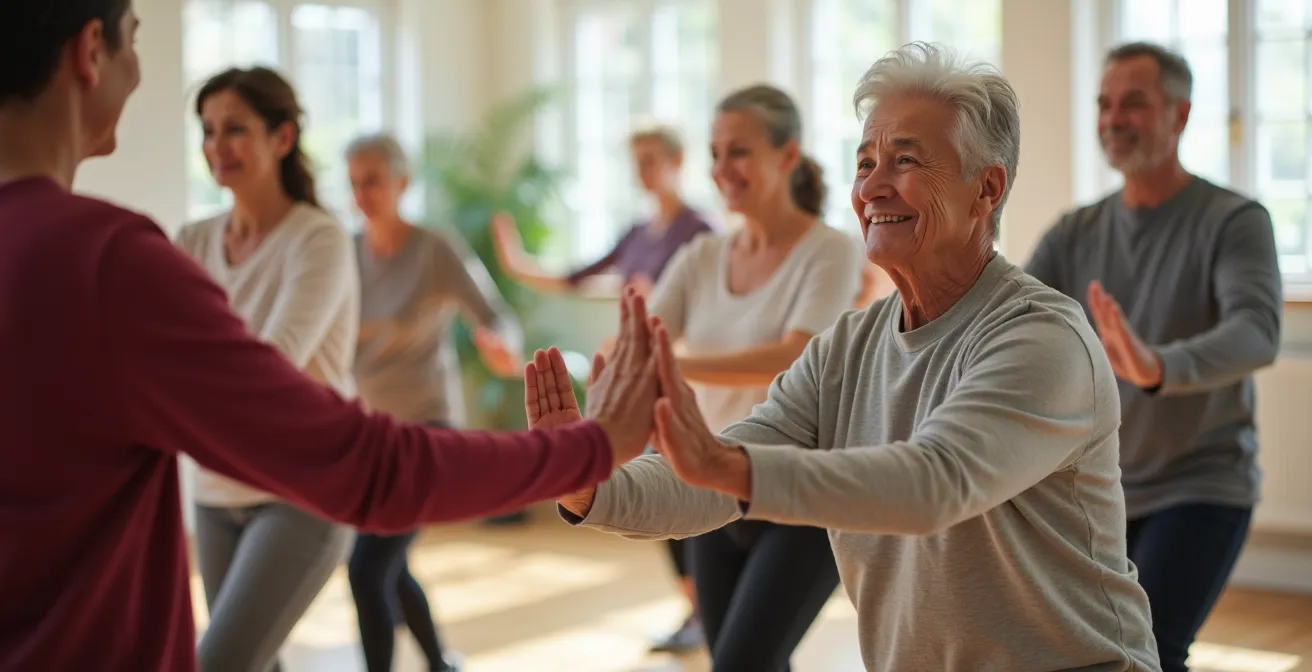
This image captures the ideal community center environment: a group of peers engaged in mindful movement together, fostering both physical and social well-being.
Specialized studios, on the other hand, typically offer a deeper, more technical dive into the art form. Instructors are often highly experienced practitioners, but their focus might be on the martial or performance aspects of Tai Chi rather than the health and balance components. When considering a studio, ask directly about their experience with seniors and fall prevention. A great sign is an instructor who conducts an individual assessment or asks about your health history before you begin. The best instructor for you is not the most advanced practitioner, but the one most skilled at adapting the practice to your body.
Ultimately, your decision should be based on the instructor’s expertise with your demographic. Call ahead, ask about certifications (like those from the Tai Chi for Health Institute), and if possible, observe a class. Look for an instructor who offers modifications, emphasizes safety, and fosters a non-competitive, welcoming atmosphere.
The Hyper-Extension Error: Why Locking Your Knees During Stretches Is Dangerous?
One of the most critical and counter-intuitive principles in Tai Chi and balance training is the concept of maintaining “soft” or slightly bent knees. For many, the instinct during a stretch or while standing is to lock the knees straight, a position known as hyper-extension. From a balance rehabilitation perspective, this is a dangerous error. Locking your joints turns your legs into rigid stilts, eliminating their ability to act as shock absorbers and destroying your proprioceptive feedback loop.
When your knees are locked, the muscles around the joint disengage. Your body’s ability to make the rapid, subtle micro-adjustments needed for stability is severely compromised. A locked knee cannot absorb the force of a stumble; instead, it transfers that force directly up to the hip or down to the ankle, increasing fracture risk. Furthermore, hyper-extension places immense stress on the ligaments and cartilage of the knee itself, leading to long-term joint damage. Tai Chi’s insistence on a “soft knee” stance is a core safety principle that actively retrains this harmful habit. This principle is central to the practice’s effectiveness.
Tai chi movements are slow, smooth and continuous, helping to strengthen internal muscles, like the deep stabilisers that support and strengthen the spine. Additionally, tai chi practitioners move against a gentle resistance to build full muscular strength. Tai chi practitioners focus, calm their minds, and loosen and relax their joints and ligaments.
– Dr. Paul Lam, Tai Chi for Health Institute
This focus on continuous, controlled movement with relaxed joints is precisely what makes the practice so effective. It’s not just about doing an exercise; it’s about re-patterning your fundamental posture and movement habits for greater safety and stability. The consistency of this practice is what yields results. Evidence clearly shows that frequency matters, with exercising ≥3 times per week showing a 33% reduction in fall risk. Each session reinforces the lesson: stability comes from engaged muscles and mobile joints, not from rigid, locked-out limbs.
Learning to maintain a slight bend in your knees at all times—while standing, walking, and stretching—is perhaps the single most important physical adjustment you can make to improve your balance and protect your joints. It transforms your legs from stilts into responsive, intelligent springs.
How to Measure Balance Improvement When the Scale Doesn’t Change?
One of the biggest frustrations when starting a new exercise program is the feeling of putting in the work without seeing results. When it comes to balance, the bathroom scale is a useless metric. Your weight has little to do with your stability. True progress is measured not in pounds, but in seconds and in confidence. As a balance specialist, I rely on functional tests that provide clear, objective data on your improvement.
The Four-Stage Balance Test is a simple, standardized tool used in clinics worldwide that you can easily perform at home. It assesses your static balance—your ability to remain still and stable. All you need is a stopwatch and a sturdy chair or countertop nearby for safety. Tracking your time in each position weekly provides tangible proof of your neuromuscular recalibration. Seeing your ability to hold a one-legged stand go from two seconds to ten seconds is a powerful motivator that the scale can never offer. The goal is to hold each of the first three positions for 10 seconds before moving to the next.
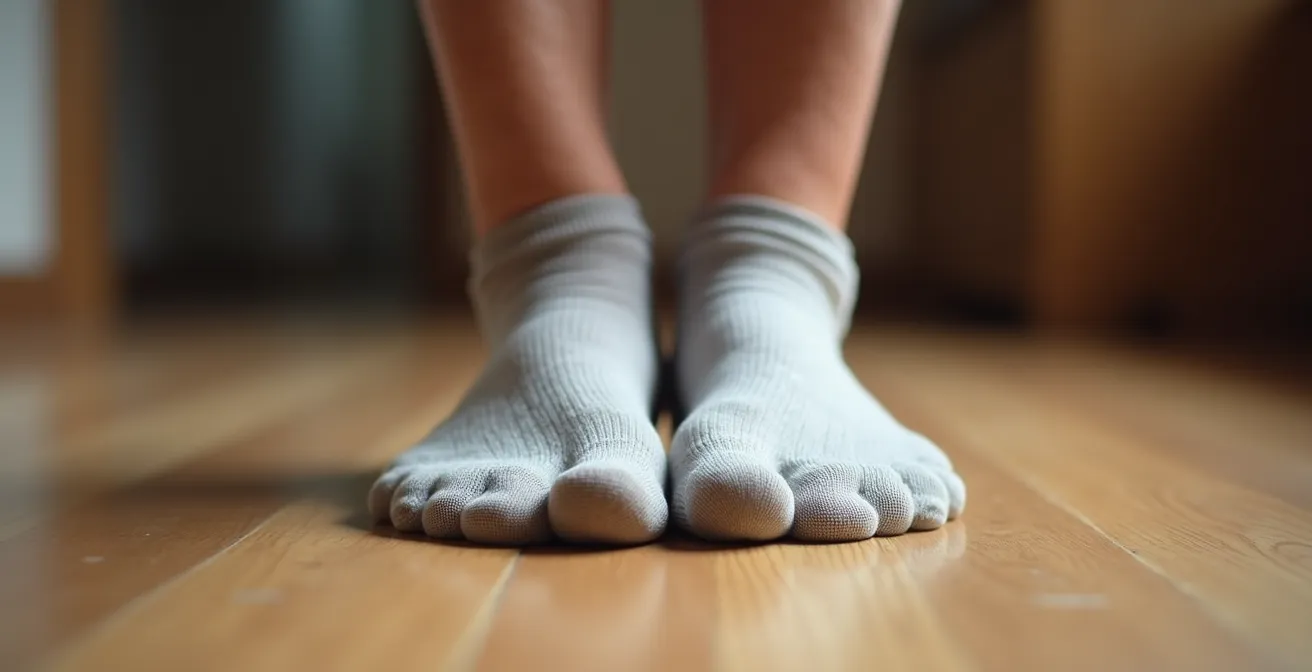
This close-up view shows the tandem stance, a key part of assessing and training your balance.
This kind of measurable improvement is not just a feeling; it’s backed by robust clinical data. A landmark study highlighted the superior effectiveness of Tai Chi in a direct comparison. The research, published after studying older adults, is encouraging, showing that a targeted Tai Chi program reduces falls by 58 percent compared to stretching exercises and 31 percent compared to a general multimodal exercise intervention. This demonstrates that the specific, mindful movements of Tai Chi provide a level of proprioceptive training that other forms of exercise simply do not match.
To track your own progress effectively, use this simple protocol:
- Stage 1: Stand with your feet side-by-side for 10 seconds.
- Stage 2: Place the instep of one foot so it is touching the big toe of the other foot (semi-tandem stance) and hold for 10 seconds.
- Stage 3: Place the heel of one foot directly in front of the toes of the other foot (tandem stance) and hold for 10 seconds.
- Stage 4: Stand on one leg for as long as you can, up to 10 seconds.
- Record and Repeat: Perform the test on both sides and record your time for each position. Track your progress weekly to see your stability improve.
Socks with Grips vs. House Shoes: Which Provides Better Stability on Hardwood?
Your connection to the ground is the first line of communication for your balance system. What you wear on your feet can either enhance or muffle this crucial dialogue. For indoor practice like Tai Chi and general safety on smooth surfaces like hardwood or tile, the choice between grip socks and traditional house shoes is not a matter of preference—it’s a matter of proprioception and stability. While house shoes may feel supportive, they often create more problems than they solve.
The primary advantage of grip socks is that they allow for maximum proprioceptive feedback. The thin material lets the thousands of nerve endings in your feet sense the floor’s texture, temperature, and angle, sending a rich stream of data to your brain. This allows for faster, more accurate micro-adjustments to maintain balance. In contrast, the thick, rigid sole of a house shoe or slipper acts as a buffer, dulling this sensation. Furthermore, the edge of a shoe’s sole presents a significant trip hazard, easily catching on the edge of a rug or a threshold.
This direct comparison highlights the clinical advantages of choosing the right footwear for maximizing your stability. Research confirms the importance of this choice; a 2019 review found a 19% reduction in fall rate associated with participants making appropriate footwear choices, a significant improvement from a single, simple change.
| Feature | Grip Socks | House Shoes |
|---|---|---|
| Proprioceptive Feedback | Maximum – thin material allows floor sensing | Reduced – thick sole blocks sensation |
| Slip Prevention | Excellent on smooth surfaces | Good with rubber soles |
| Trip Risk | Minimal – no edge to catch | Higher – sole edge can catch on rugs |
| Balance Exercise Suitability | Optimal for tai chi practice | Less suitable – reduces ground connection |
| Support Level | Minimal ankle support | Better arch and ankle support |
For dedicated balance practice and general indoor movement, grip socks are the superior choice. They provide the necessary slip prevention without compromising the sensory feedback that is essential for dynamic stability. While a supportive shoe has its place for outdoor walking, when you are indoors and actively working on balance, feeling the ground is non-negotiable.
Push-Down vs. Loop Brakes: Which Is Easier for Arthritic Hands to Engage?
For individuals who use a walker, the device is an extension of their body and a critical component of their stability system. However, if its core safety feature—the brakes—is difficult to engage, the walker can become a liability. This is particularly true for those with arthritis, where hand pain and weakness can make operating standard loop brakes challenging or impossible. The choice between push-down brakes and loop brakes is therefore a crucial safety decision that must be tailored to the individual’s specific condition.
Loop brakes, which function like those on a bicycle, require significant grip strength and dexterity to squeeze. For someone with rheumatoid arthritis characterized by a weak grip, this can be extremely difficult. Push-down brakes, conversely, are activated by applying downward pressure through the palms onto the handles. This uses body weight rather than grip strength, making them an ideal solution for individuals with limited hand strength. The response is also instantaneous, providing a more secure and immediate stop.
The right choice of braking system depends heavily on the type and severity of arthritis, as well as the user’s reaction time and potential for fatigue. This table breaks down the key considerations for each system based on common arthritic conditions.
| Arthritis Type | Push-Down Brakes | Loop Brakes |
|---|---|---|
| Rheumatoid (weak grip) | Superior – uses palmar pressure | Challenging – requires squeeze strength |
| Osteoarthritis (painful joints) | Good for instant response | Better with padded grips |
| Reaction Time | Instant – weight shift activation | Slower – requires hand squeeze |
| Long-term Use Fatigue | Lower – passive engagement | Higher – active grip needed |
When selecting a walker, the braking mechanism should be a primary consideration, not an afterthought. The safest walker is the one whose brakes you can engage reliably and without pain, every single time. Consulting with a physical therapist or a medical equipment specialist is essential to try different models and find the system that best matches your physical abilities and ensures your mobility aid truly supports your safety.
Key Takeaways
- Tai Chi is a powerful form of neuromuscular training that recalibrates your body’s balance system, not just a gentle exercise.
- Building stability is a skill developed through consistent practice of micro-habits, which creates an automatic, unconscious ability to prevent falls.
- Safety and effectiveness depend on proper form, such as maintaining soft knees, and using appropriate gear, like grip socks, to enhance proprioception.
How to Start an Exercise Routine at 65+ If You Haven’t Worked Out in Decades?
The thought of starting an exercise routine after years or even decades of inactivity can be overwhelming. The gym culture of “no pain, no gain” is deeply intimidating and, for older adults, entirely inappropriate and unsafe. The key to successfully re-engaging with physical activity is to completely reframe the goal. You are not trying to become a “gym person.” You are embarking on a journey of reclaiming movement that your body was designed for.
The most effective method is the “Movement Experiment” approach. It discards the idea of long, grueling workouts in favor of short, consistent, and curious explorations of movement. The goal of a 5-minute session is not to burn calories or build massive muscle, but simply to practice a single, foundational movement with focus and precision. This could be something as simple as practicing getting up from a chair without using your hands. Mastering this one skill has a far greater impact on your daily independence than an hour of aimless walking on a treadmill.
Consistency is exponentially more important than intensity. Three separate 5-minute “movement snacks” spread throughout the day are more effective for neuromuscular learning than one 15-minute session where fatigue can lead to poor form. This approach removes the psychological barrier of the “workout” and builds confidence with each small, successful experiment. The feeling of mastering a movement you thought was lost is the most powerful motivation to continue.
This plan is your starting point. It’s not a workout regimen; it’s a practical guide to reintroducing movement into your life safely and sustainably, making it a habit that sticks.
Your Action Plan: The ‘Movement Experiment’ Approach
- Start with 5-minute ‘movement experiments’ rather than committing to full workouts.
- Focus on mastering one foundational movement per week (e.g., a perfect sit-to-stand without using your hands).
- Practice ‘movement snacking’ by incorporating three 5-minute sessions into your daily routine.
- Prioritize consistency over intensity; a short, daily practice is more valuable than a long, infrequent one.
- Reframe your objective as ‘reclaiming movement’ and exploring your body’s capabilities, not ‘becoming an exerciser’.
By adopting this mindset, you shift the focus from pressure and expectation to curiosity and accomplishment. Every step, every balanced moment, is a victory that builds a foundation for a more active and stable future. The journey begins not with a leap, but with a single, mindful step.
The first step is always the most challenging, but with the right approach, it is entirely achievable. Evaluate your current situation, choose one small movement experiment, and begin the process of reclaiming your balance and confidence today.
Frequently Asked Questions About Walkers and Stability Aids
Should handle diameter affect my walker choice?
Yes, ergonomic handles with a 1.5-2 inch diameter reduce hand fatigue significantly compared to standard straight handles.
Can I switch brake types on my existing walker?
Some models allow brake conversion, but you must consult a medical equipment specialist to ensure compatibility and safety before making any changes.
How often should walker brakes be tested?
For optimal safety, you should test your walker’s brakes daily before use and have them professionally inspected every 6 months or sooner if you notice any change in performance.