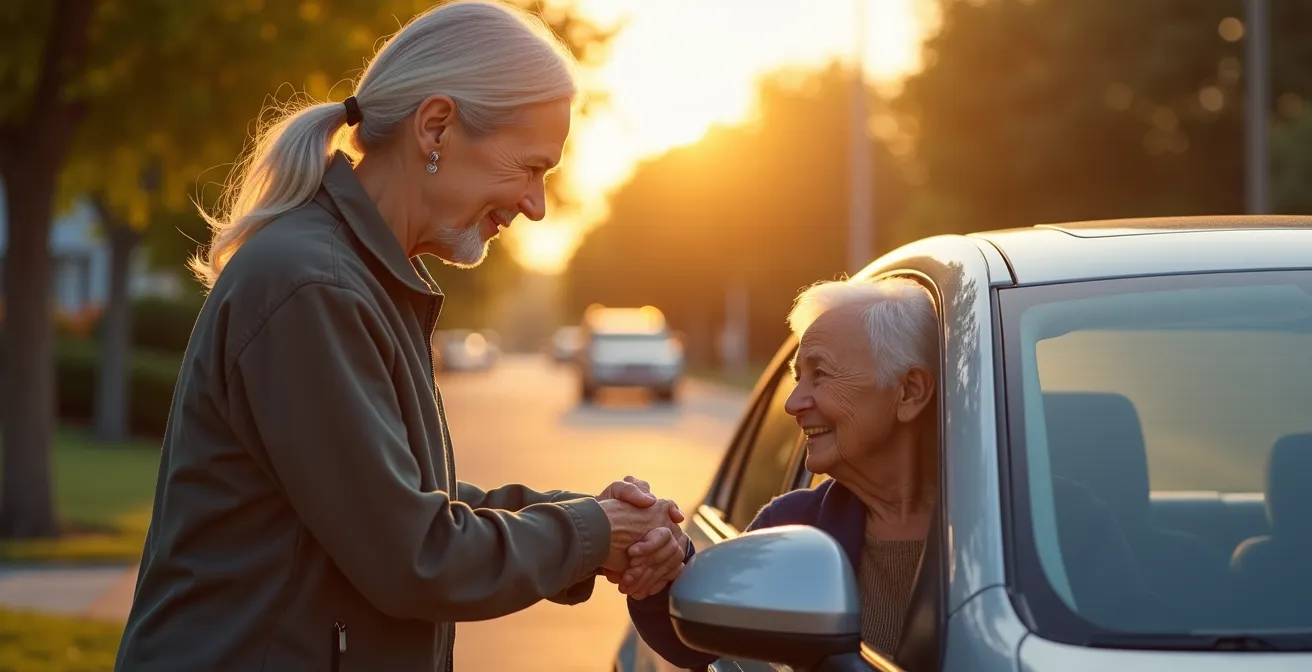
The safest transport for a dementia patient isn’t determined by the service’s name (Uber, volunteer), but by its verifiable level of ‘hand-to-hand’ assistance and logistical oversight.
- “Curb-to-curb” services, including standard rideshares, pose significant risks by leaving the most critical parts of the journey—from the front door to the car—unsupervised.
- True safety lies in “door-to-door” or, ideally, “hand-to-hand” protocols that manage the individual’s well-being throughout the entire trip.
Recommendation: Always ask a provider to define their exact level of assistance and confirm they can manage the ‘first and last 50 feet’ of the journey before booking any ride.
The moment a loved one with dementia can no longer drive safely is a difficult turning point for any family. The conversation is dreaded, and the logistical puzzle that follows is daunting. You worry about isolation, but the thought of putting your confused parent in a stranger’s car is terrifying. The default options often seem to be modern rideshares like Uber Health or community-based volunteer driver programs. But this comparison misses the most critical safety factor.
Most families focus on the driver or the vehicle, debating the merits of a background-checked professional versus a well-meaning volunteer. These are important, but they are not the primary point of failure. The real risk for a person with dementia is not during the ride itself, but in the transitions: the journey from the front door to the curb, and from the car into the doctor’s office. This is where disorientation can lead to a fall, a wrong turn, or a missed appointment.
The true measure of a transport service’s safety is its “chain of custody”—the continuous, verifiable responsibility for your loved one from the moment they leave their home until they are safely inside their destination. This article shifts the focus from “who is driving?” to “what is the protocol?”. We will provide a logistical framework to evaluate any transportation service, enabling you to make a genuinely safe choice that preserves both independence and peace of mind.
To help you navigate this complex decision, we will explore the critical differences in service levels, the hidden cognitive benefits of certain outings, and practical strategies for budgeting, planning, and ensuring safety in all conditions. This guide is your logistical map to maintaining community access when driving is no longer an option.
Summary: A Logistical Guide to Safe Transportation for Dementia Patients
- The “Driving Retirement” Talk: How to frame it as a Gain, Not a Loss?
- Door-to-Door vs. Curb-to-Curb: Why You Must Know the Difference Before Booking?
- Delivery vs. Accompanied Shopping: Which Is Better for Cognitive Stimulation?
- Budgeting for Taxis: Is $300/Month Cheaper Than Owning and Insuring a Car?
- Ice and Snow: When to Cancel the Outing Even If You Have a Ride?
- How to Start a “Check-In Buddy” System with a Friend to Ensure Daily Safety?
- How to Manage a Shopping Trip When You Can Only Walk 50 Feet?
- Solo Travel at 65+: How to Overcome the Fear of Dining Alone?
The “Driving Retirement” Talk: How to frame it as a Gain, Not a Loss?
The conversation about stopping driving is often met with resistance because it’s perceived as a loss of freedom. The key to a successful transition is to reframe it not as an end, but as an upgrade. You are not taking away the keys; you are providing a personal chauffeur service that enhances safety and comfort. Presenting a well-researched, funded “Personal Mobility Plan” changes the narrative from one of limitation to one of continued, and even improved, access to the community.
This approach shifts the focus from the negative (losing the car) to the positive (gaining a new way to stay active). By calculating the real cost of car ownership and showing how that money can be repurposed into a “mobility budget,” you make the change feel logical and financially sound. As real cases from the Alzheimer’s Association show, many families find success by proactively planning these transitions together. Frank, in early-stage Alzheimer’s, collaborated with his wife on a new transport plan, while Janet, with younger-onset, took the lead in discussing her future needs with her family. This collaborative approach fosters a sense of control and dignity.
Case Study: Proactive Transition Planning
The Alzheimer’s Association shares stories of families who successfully navigate driving cessation. One individual, Frank, who had early-stage Alzheimer’s, worked collaboratively with his non-driving spouse to identify and implement alternative transportation solutions before it became a crisis. Another, Janet, diagnosed with younger-onset Alzheimer’s, proactively initiated conversations with her family about her future transportation needs while she was still fully capable of participating in the decision-making process. These examples highlight the power of framing the transition as a shared, forward-thinking plan rather than a restrictive measure.
Your Action Plan: Creating a Personal Mobility Plan
- Schedule the conversation during a calm moment when your loved one is well-rested and receptive, not immediately after a driving incident or stressful event.
- Start by calculating the total annual cost of car ownership (insurance, maintenance, gas, registration) and present this figure as a potential “mobility budget” for the new plan.
- Co-create a weekly transportation schedule that maps directly to their current activities and social connections, demonstrating that nothing will be lost.
- Frame the transition as upgrading from the stressful role of ‘driver’ to the relaxing role of ‘passenger,’ emphasizing the ability to enjoy the scenery and arrive without parking hassles.
- Implement a trial period using alternative transportation while still keeping the car, allowing for a gradual adjustment and reducing the fear of immediate, irreversible loss.
By focusing on the tangible benefits—no more worrying about car maintenance, insurance costs, or navigating traffic—you can help your loved one see this change as a logical and positive step forward.
Door-to-Door vs. Curb-to-Curb: Why You Must Know the Difference Before Booking?
The single most important question you can ask a transportation provider is not about their cars or their prices, but about their service protocol. The terms “curb-to-curb,” “door-to-door,” and “hand-to-hand” are not interchangeable; they represent vastly different levels of care and risk. For a person with dementia, who may have mobility challenges or become easily disoriented, this difference is paramount. A standard rideshare or taxi is a curb-to-curb service. The driver arrives at the curb and expects the passenger to be there, leaving the critical journey from the house to the car entirely unmanaged.
This unsupervised gap, often called the “first 50 feet,” is where the majority of problems occur. A door-to-door service is a step up, with the driver assisting the passenger from the building’s entrance to the vehicle. However, the gold standard for dementia care is hand-to-hand service. Here, the driver takes custody of the passenger from inside their home or room and personally ensures they are safely handed over to the responsible party at the destination, like a receptionist or family member. This eliminates any chance of the person being left alone or getting lost.
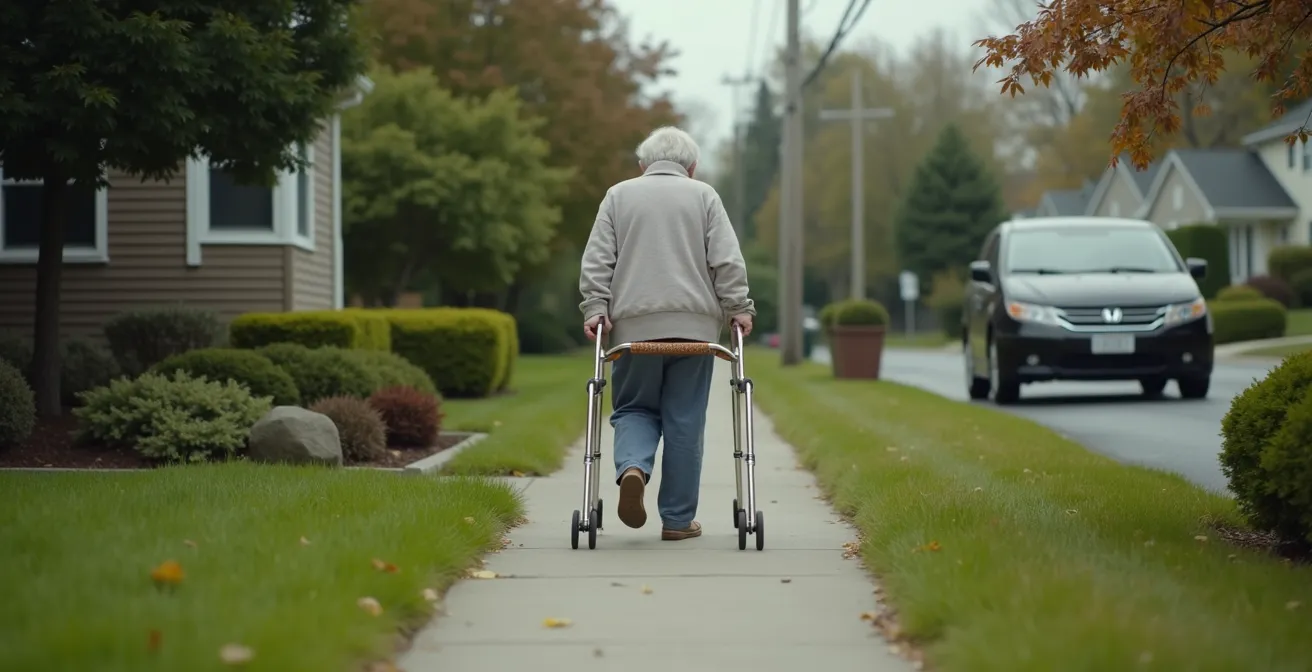
The image above perfectly illustrates the challenge. A curb-to-curb service ends where the car is parked, but the journey for the passenger begins at their front door. Before booking any service, you must get a clear, unambiguous answer on where their responsibility begins and ends. Never assume a service provides more assistance than they explicitly state.
This table breaks down the fundamental differences, which is essential information for your decision-making process. As a detailed analysis of dementia transportation highlights, matching the service level to the patient’s specific needs is the cornerstone of safety.
| Service Type | Level of Assistance | Best For | Risk Level |
|---|---|---|---|
| Curb-to-Curb | Driver stays in vehicle | Mobile, cognitively aware seniors | High for dementia patients |
| Door-to-Door | Driver assists to/from building entrance | Mild dementia, mobility issues | Moderate |
| Hand-to-Hand | Driver assists from inside origin to inside destination | Moderate to severe dementia | Low |
Understanding this hierarchy of care allows you to move beyond brand names like Uber Health or local volunteer groups and instead evaluate them based on the tangible level of logistical support they actually provide.
Delivery vs. Accompanied Shopping: Which Is Better for Cognitive Stimulation?
In the quest for convenience and safety, it’s tempting to switch all errands to delivery services. While grocery and pharmacy delivery can be a valuable part of a mobility plan, eliminating accompanied outings entirely can inadvertently remove a significant source of cognitive and social stimulation. An accompanied shopping trip is not just about acquiring goods; it is a complex, multi-sensory experience that actively engages the brain in ways that clicking on a website cannot.
The simple act of going to a store involves a wealth of mental exercises. Navigating the aisles requires spatial processing and planning. Remembering items from a list, even a short one, engages episodic memory. Making choices between products, handling money, and interacting with a cashier all utilize executive function and social skills. These are not trivial tasks; they are gentle, real-world cognitive workouts that help maintain brain function.
As research into multisensory engagement shows, everyday activities provide crucial stimulation across multiple cognitive domains. The goal is not to make life effortless, but to provide the right level of support to make challenging activities manageable and beneficial. An accompanied shopping trip, where a caregiver or a trained “hand-to-hand” driver can assist with the heavy lifting and navigation, strikes an ideal balance. It allows the person with dementia to remain an active participant in their own life, benefiting from the social interactions, physical movement, and mental engagement that a trip to the store provides.
Therefore, a balanced approach is best. Use delivery services for bulk items or during bad weather, but preserve the accompanied shopping trip as a regular, valuable activity for both mental and social health.
Budgeting for Taxis: Is $300/Month Cheaper Than Owning and Insuring a Car?
The initial cost of specialized transportation or even frequent taxi use can seem high, leading to sticker shock. However, this perception often changes when compared directly against the true, and often underestimated, cost of car ownership. A monthly transportation budget of $300, or $3,600 per year, may actually be a significant saving. The cost of owning a vehicle goes far beyond the monthly car payment or a tank of gas.
When you factor in all associated expenses, the numbers become clear. These include insurance premiums, annual registration fees, regular maintenance like oil changes and tire rotations, and inevitable repairs. Furthermore, you must account for the gradual depreciation of the vehicle’s value over time. According to AAA, the combined financial burden can be surprisingly high. Many analyses find that the average annual car ownership cost is $9,122, which translates to over $760 per month. This figure provides a realistic benchmark for creating a “mobility budget.”
Framed this way, spending $300-$500 a month on safe, reliable, hand-to-hand transportation is not an expense, but a strategic reallocation of funds. You are trading the costs and headaches of car ownership for a service that provides not just transport, but also safety, reliability, and peace of mind. Research with older adults confirms this perspective, finding that rideshare services were often considered less expensive precisely because of the high, fixed costs of insurance and maintenance associated with owning a car.
By liquidating the asset (the car) and canceling its associated recurring costs, you unlock a substantial budget that can be dedicated to ensuring your loved one continues to travel and participate in their community, but in a much safer, stress-free manner.
Ice and Snow: When to Cancel the Outing Even If You Have a Ride?
Securing a reliable ride is only half the battle during winter months. Inclement weather, especially ice and snow, introduces a new set of risks that even a professional driver cannot completely eliminate. The greatest danger is often not on the road, but on the very sidewalks, stairs, and driveways that must be navigated to get to the vehicle. For a person with dementia, who may have an unsteady gait or impaired judgment about slippery surfaces, a fall is a significant risk.
As a transport coordinator, my advice is to have a clear “Go/No-Go” decision matrix in place before the winter season begins. The decision to cancel an outing should not be made in the heat of the moment but should be based on a pre-agreed set of criteria. This removes emotional pressure and ensures safety is the top priority. The purpose of the trip is a key factor; a critical medical appointment like dialysis may warrant taking a calculated risk, whereas a social visit or routine errand should be immediately postponed.

Your decision matrix should also consider the specific conditions and resources available. An all-wheel-drive vehicle is safer than a standard sedan, and a driver with extensive winter driving experience provides more confidence. It’s also vital to consider the patient’s own anxiety levels, as weather-related stress can exacerbate confusion and agitation. Always have a backup plan, such as a pre-arranged video call, to substitute for the canceled outing, so the social connection is not completely lost.
- Assess the Path: Is the walkway from the door to the curb completely clear of ice and snow? This is a non-negotiable first check.
- Evaluate Trip Purpose: Is the appointment absolutely essential (e.g., critical medical treatment) or can it be rescheduled (e.g., social visit, routine shopping)?
- Check Vehicle & Driver: Is the vehicle equipped for the conditions (AWD/4WD)? Have you confirmed the driver’s confidence and experience in winter driving?
- Consider Patient Anxiety: Will the stress of traveling in poor weather outweigh the benefit of the outing, potentially increasing confusion or agitation?
- Have a Virtual Backup: Have the technology ready for a video call with family or a virtual consultation with a doctor as an alternative.
Ultimately, when in doubt, the safest decision is always to cancel. A missed social outing is a minor inconvenience; a fall on the ice can be a life-altering event.
Key Takeaways
- The crucial difference between curb-to-curb, door-to-door, and hand-to-hand service is the primary safety determinant for dementia patients.
- Reframe driving cessation as a “mobility budget” reallocation, using the significant savings from car ownership to fund safer, chauffeured transport options.
- Maintaining community engagement through accompanied trips provides vital cognitive stimulation that delivery services alone cannot replace.
How to Start a “Check-In Buddy” System with a Friend to Ensure Daily Safety?
While transportation services manage safety during outings, ensuring daily well-being at home requires a different approach. A “Check-In Buddy” system is a simple yet powerful strategy to create a lightweight, non-intrusive safety net. This system formalizes the natural tendency of friends to look out for one another, adding a layer of structure and clear escalation protocols to ensure that a missed call is never overlooked.
The core of the system is a scheduled, predictable point of contact. This could be a daily “good morning” text, a brief phone call at a set time, or even a signal like opening the blinds. The key is consistency. When the check-in is missed, it triggers a pre-defined escalation plan. This is not about being nosy; it’s about having a clear, agreed-upon procedure that removes ambiguity and ensures a swift response when needed.
Setting up the system requires a direct conversation where both buddies agree on the terms. The protocol should be written down and shared with at least one other person, typically a primary family caregiver. This document should detail the check-in schedule, the time window for a response, and the specific steps to take if contact is not made. This might be to call the person, then call a neighbor, and finally, call the designated caregiver or emergency services if there’s still no response. Sharing essential information, such as doctor’s contacts and caregiver numbers, with the buddy is also a critical step in making the system effective in a real emergency.
- Establish a Schedule: Agree on a specific time and method for a daily check-in (e.g., a text message at 9 AM).
- Create an Escalation Plan: Define what happens if there’s no response. For example: “If no reply by 11 AM, call. If no answer, call my daughter.”
- Share Essential Information: The buddy should have contact numbers for primary caregivers, family members, and a list of key medical contacts.
- Use Technology: Program a “Call my buddy” voice command on a smart speaker to make the check-in process effortless.
- Define Emergency Protocols: Clearly outline the difference between a situation that requires a call to family versus one that requires a call to 911.
This system empowers seniors to maintain their independence and social connections, secure in the knowledge that someone is reliably looking out for them every day.
How to Manage a Shopping Trip When You Can Only Walk 50 Feet?
For individuals with severe mobility limitations, the prospect of a shopping trip can seem impossible. The distance from a parking spot to the store entrance alone can be an insurmountable barrier. This is where strategic planning and the right type of transportation service become absolutely essential. The goal is to break the journey down into manageable “chunks” and use available resources to bridge the gaps. This is the “Leapfrog Method.”
The first “leap” is handled by a true door-to-door or hand-to-hand transportation service. As experts in mobility challenges note, these services are designed to address the critical transition points, providing assistance getting in and out of the vehicle and ensuring the person is safely delivered to the store entrance. This single step eliminates the most challenging part of the journey for many. Once inside, the next step is to use the store’s own environment for support. A shopping cart can serve as a makeshift walker, providing stability throughout the store.
The key to success is “store reconnaissance.” Before the trip, a little bit of planning can make all the difference. This proactive strategy involves mapping out the store’s layout to minimize walking and maximize rest.
- Call the store ahead: Ask about the locations of benches or seating areas (like the pharmacy or shoe department) to plan resting spots along the route.
- Inquire about electric carts: Check for availability and see if one can be reserved in advance. This is the single most effective tool for in-store mobility.
- Identify low-traffic times: Shopping during off-peak hours (typically mid-morning on weekdays) reduces the stress of navigating crowds.
- Plan your route: Use a shopping cart for stability from the moment you enter, and plan your path through the aisles to be as efficient as possible.
- Break up large trips: Consider single-purpose shopping days, such as a “Dairy & Produce Day” versus a “Pantry Items Day,” to keep each trip short and manageable.
This combination of specialized transportation and in-store strategy makes it possible to maintain the crucial cognitive and social benefits of shopping, even when mobility is severely limited.
How to Overcome the Fear of Dining Alone on Solo Outings?
As mobility solutions open up new possibilities for independence, a new, more subtle fear can emerge: the social anxiety of doing things alone, especially dining. After years of having a partner or family, the thought of sitting at a “table for one” can be intimidating enough to prevent someone from venturing out. Overcoming this fear is not about a single act of bravery, but about a gradual process of re-acclimation.
The most effective method is a “Graduated Exposure Challenge.” This clinical-sounding term simply means starting small and building confidence through a series of low-stakes, manageable steps. The goal is to slowly expand the comfort zone at a pace that feels safe and achievable. Instead of jumping straight to a formal dinner, the process begins in a familiar, casual environment where being alone is common and unremarkable.
A successful challenge involves a clear, week-by-week plan that systematically reduces the perceived social pressure. It’s about building a new habit and proving to oneself that dining alone is not only possible but can even be enjoyable. Bringing a “prop” like a book, tablet, or journal can be an excellent tool, providing both an activity and a social shield in the initial stages. The final step is to reflect on the experience, noting the successes and reframing any awkward moments as learning opportunities.
- Week 1: The Coffee Shop. Order a solo coffee at a familiar neighborhood cafe during a quiet morning. The environment is casual, and many people are there alone.
- Week 2: The Counter-Service Lunch. Have a solo lunch at a casual, counter-service restaurant. Bring a book or tablet as a comfortable companion.
- Week 3: The Bar Seat Dinner. Try sitting at the bar of a friendly local restaurant for an early dinner. It’s a more social setting where solo diners are common and conversation with the bartender is possible.
- Week 4: The Table with a View. Request a table for one at a nice restaurant, preferably with a view or near a window, which provides a natural focus for people-watching.
- Week 5: The Destination Dinner. Choose a restaurant you’ve always wanted to try and go for it. Bring a journal to document the experience and savor the accomplishment.
Start today by identifying your loved one’s specific assistance needs and evaluating potential transport services based on their ‘chain of custody’ protocol. This foundational step is the key to building a tailored and truly secure mobility plan that fosters independence and ensures peace of mind.