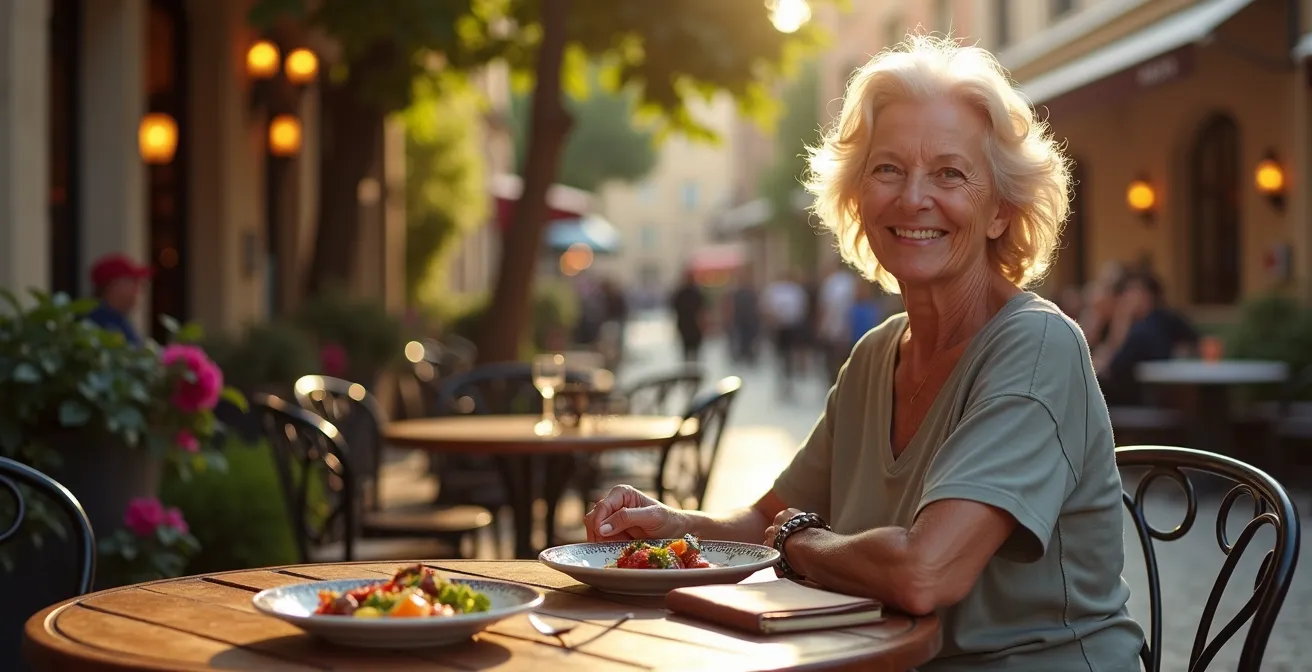
The fear of dining alone is not about food; it’s a fear of invisibility. This guide reframes it as the final, empowering step in building a new, purposeful identity through solo travel.
- Build a “Confidence Infrastructure” with smart packing, health management, and tech to eliminate practical anxieties.
- Conquering this small fear unlocks a larger sense of purpose, serving as an antidote to post-retirement listlessness.
Recommendation: Stop seeing solo dining as a challenge to endure and start treating it as the ultimate celebration of your newfound freedom and self-reliance.
The travel brochures paint a perfect picture: a blissful retirement filled with exotic destinations. Yet for many, especially those who have lost a partner, a daunting question casts a long shadow over these dreams: “But what about dinner?” The thought of sitting at a table for one, under the perceived gaze of others, can be paralyzing. It’s a fear so potent it keeps bucket lists gathering dust. You’ve raised a family, navigated a career, and managed a life. So why does this one simple act feel like an insurmountable hurdle?
Conventional advice often misses the point. You’re told to “bring a book” or “sit at the bar,” tactics that treat solitude as something to be hidden or distracted from. These are merely coping mechanisms. They don’t address the root of the anxiety, which is rarely about the food. It’s tied to a much deeper fear that emerges in this new chapter of life: the fear of being unseen, of being out of place, of navigating a world that suddenly feels built for pairs.
But what if the solution wasn’t to hide from the experience, but to reframe it entirely? This guide proposes a different approach. The fear of dining alone is a symptom, not the disease. The true journey is about Identity Architecture: consciously building a new, vibrant sense of self after a major life change. Solo travel, with all its logistical and emotional challenges, becomes the blueprint. Each step—from packing a bag to navigating a foreign city—is a brick in this new foundation. Conquering the solo dinner is not just a meal; it’s the capstone of this new identity, a powerful declaration of self-reliance and purpose.
In this guide, we’ll dismantle the practical and emotional barriers one by one. We will explore how to build your personal “Confidence Infrastructure” so that you arrive at your destination not just with luggage, but with the mental and emotional readiness to embrace every moment, including that table for one.
Summary: Your Guide to Confident Solo Dining
- Portugal or Japan: Which Countries Are Safest for Senior Solo Travelers?
- Carry-On Only: How to Pack Medications and Walking Shoes Without Checking a Bag?
- East vs. West: Why Recovery Takes Longer After 60 and How to Fix It?
- eSIM vs. Carrier Plan: How to Have Data Instantly Upon Landing?
- Economy Plus or Business: When Is the Extra Legroom a Medical Necessity?
- Why the “Vacation Phase” of Retirement Often Leads to Depression After 6 Months?
- Why Online Interest Groups Can Be More Fulfilling Than Local Small Talk?
- River Cruise vs. Ocean Liner: Which Is Better for Travelers with Walkers?
Portugal or Japan: Which Countries Are Safest for Senior Solo Travelers?
Choosing the right destination is the first step in building your solo travel confidence. It’s not just about physical safety, but about cultural comfort. You’re part of a growing movement; according to a recent survey, 85% of Road Scholar’s solo travelers are women, with a significant portion being seniors. Your destination choice should support, not challenge, your goal of comfortable solo dining. Let’s compare two popular, safe countries through this specific lens.
Portugal is beautiful, affordable, and generally safe. However, its dining culture is deeply communal and family-oriented. While you won’t be unsafe, you might feel more conspicuous as a solo diner in restaurants filled with large, boisterous groups. Japan, on the other hand, has a cultural concept called “hitori-meshi”—the art of eating alone. It is completely normalized and catered to, with ramen shops, sushi bars, and many other establishments designed around counter seating. This environment removes the social friction and allows you to simply enjoy the experience.
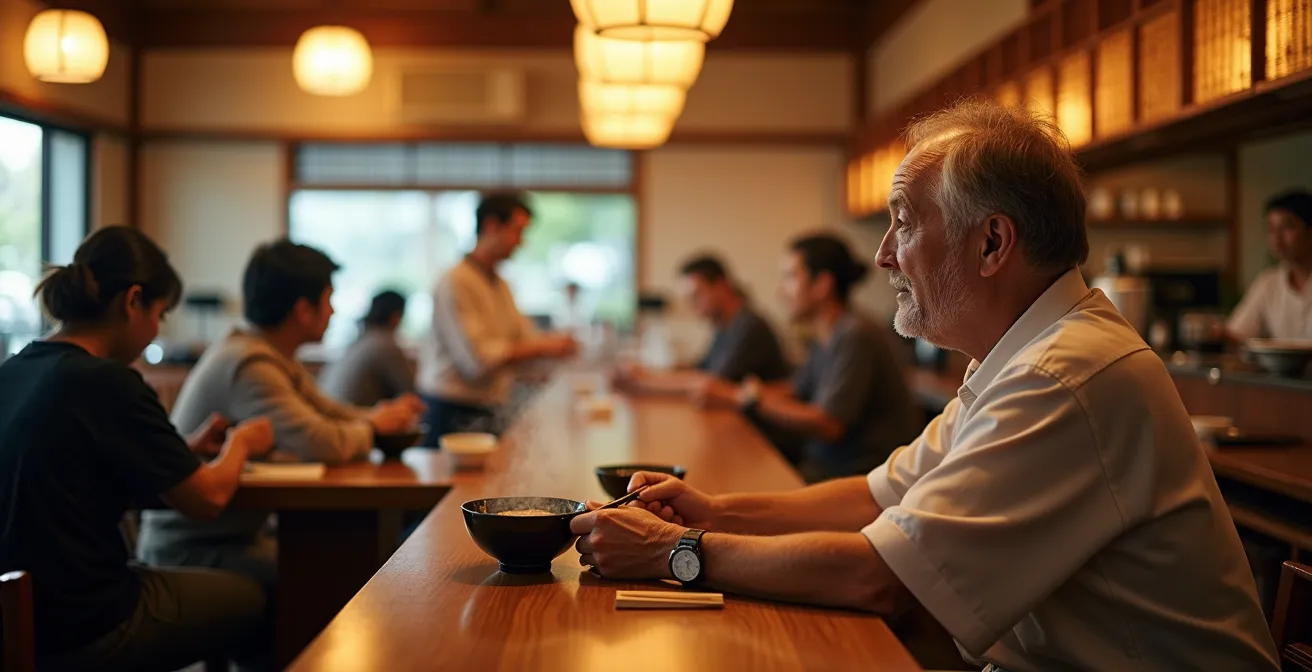
This single cultural difference can dramatically impact your confidence. Choosing a destination where solo dining is built into the social fabric, like Japan, is a strategic move. It’s not about avoiding a challenge, but about setting yourself up for an early, easy victory. The following comparison highlights key factors for a solo traveler focused on a comfortable dining experience.
| Safety Factor | Portugal | Japan |
|---|---|---|
| Solo Dining Culture | Communal, family-oriented dining may feel less welcoming for solo diners | Hitori-meshi culture embraces solo dining, especially at counter restaurants |
| Language Barrier | English widely spoken in tourist areas | Limited English, but excellent visual menus and translation apps |
| Public Transport Accessibility | Good in cities, limited in rural areas | Exceptional accessibility features, priority seating for seniors |
| Evening Safety | Generally safe, well-lit tourist areas | Extremely safe, low crime rates even at night |
| Healthcare Access | EU healthcare standards, many English-speaking doctors | World-class healthcare, language barrier may be challenging |
Carry-On Only: How to Pack Medications and Walking Shoes Without Checking a Bag?
The fear of losing luggage—especially a bag containing essential medications—can create a huge cloud of anxiety over a trip. Embracing a carry-on-only philosophy isn’t about minimalism; it’s about control and confidence. Knowing that everything you need is with you eliminates a major variable and frees up mental energy. This is a core component of your Confidence Infrastructure. It ensures you land ready to explore, not waiting anxiously at a carousel.
The key is a zonal packing system. Think of your carry-on not as a jumble of clothes, but as a mobile support system. Zone 1 contains what you need for the first 24 hours: medications, a change of clothes, and basic toiletries. Zone 2 is for health and comfort in transit, like compression socks. But the most crucial zones for solo dining confidence are 3 and 4. Zone 3 holds your “social confidence” outfit—one elegant, wrinkle-resistant ensemble that makes you feel put-together for that first dinner out. A simple scarf or accessory can instantly elevate a comfortable travel outfit.
As solo traveler Clare, 82, discovered, the right gear is transformative. She travels through Southeast Asia with only a carry-on, and her secret weapon is a single pair of shoes.
Solo Senior Travel Packing Success Story
Clare shares her approach: “My secret is one pair of comfortable walking shoes that look elegant enough for dinner – I chose leather loafers with good arch support. For medications, I use a weekly pill organizer plus original prescription bottles in a clear bag for security. This system has taken me through Thailand and Cambodia comfortably.”
This practical approach of selecting versatile, high-quality items builds a foundation of security, allowing you to focus on the experience rather than logistics.
Your Confidence-Boosting Carry-On Audit
- Essentials First: List all absolute must-haves for the first 24 hours (medications in original bottles, prescriptions, key documents, emergency contacts).
- Inventory Versatility: Collect clothing items that serve multiple purposes (e.g., shoes for walking and dining, a scarf to elevate an outfit) and lay them out.
- Assess Coherence: Does each item contribute to comfort, health, or social confidence? Discard anything that is “just in case” but doesn’t serve a clear purpose.
- Check the Confidence Factor: Identify your one “go-to” outfit that makes you feel poised and ready for a nice restaurant. Is it wrinkle-resistant and easy to pack?
- Plan Your Zones: Use packing cubes to physically separate items into zones (First 24 Hours, In-Flight Comfort, Social Outfits, Digital Safety Net) to build your travel-ready infrastructure.
East vs. West: Why Recovery Takes Longer After 60 and How to Fix It?
Managing your energy is paramount for a successful solo trip. The physical challenge of travel, particularly long-haul flights, is a real concern. An AARP report reveals that for 21% of travelers over 60, health issues are a primary barrier to travel. Jet lag isn’t just a minor inconvenience; after 60, its effects are amplified. Your body’s internal clock (circadian rhythm) is less flexible, and the production of the sleep hormone melatonin decreases. This means recovery can take significantly longer, turning your first few days into a battle against exhaustion.
This physical depletion has a direct impact on your emotional resilience. When you are tired, your capacity to handle social anxiety plummets. The idea of navigating a new restaurant alone can feel ten times more intimidating. Therefore, a strategic jet lag recovery plan is a non-negotiable part of your Solo-Readiness. The direction of travel matters immensely. Traveling eastbound (e.g., USA to Europe) is often harder as you “lose” hours, forcing your body into an earlier bedtime. For these trips, a smart first-night strategy is crucial.
Instead of pushing yourself to find a restaurant, give yourself permission to ease in. Opting for high-quality room service or the hotel’s own restaurant on the first night is not a defeat; it’s a strategic move. It conserves precious mental and physical energy, allowing you to be rested and more confident for your dining adventures on day two. This is about playing the long game, ensuring the entire trip is enjoyable, not just enduring the first 48 hours. Proper nutrition and supplementation can also play a key role in accelerating your recovery and boosting your energy levels from the moment you land.
eSIM vs. Carrier Plan: How to Have Data Instantly Upon Landing?
In today’s world, a reliable internet connection is not a luxury; it’s a fundamental part of your travel safety and confidence toolkit. Landing in a new country and immediately having data on your phone eliminates a huge source of stress. You can summon a ride, check a map, or let family know you’ve arrived safely. For the solo diner, it’s even more critical. It’s your tool for transforming anxiety into empowerment. The choice between an international plan from your home carrier and a modern eSIM (embedded SIM) is a key decision in your preparation.
While carrier plans are familiar, they can be expensive and sometimes require a call to activate. An eSIM, on the other hand, can be purchased and installed before you even leave home. The moment your plane’s wheels touch the tarmac, you can switch it on and be instantly connected. This seamless connectivity is the bedrock of modern solo travel confidence. It turns your phone into a powerful research tool and a social lifeline, directly addressing the fears associated with dining alone.
With instant data, the restaurant across the street is no longer an unknown. You can:
- Research on the fly: Read reviews and look at photos of a restaurant’s interior to find a spot with comfortable seating, like a counter or a quiet corner.
- Communicate with confidence: Use translation apps to decipher menus and express dietary needs without fumbling.
- Stay connected and safe: Share your live location with a family member or friend for an added layer of security.
- Find your tribe: Tap into a solo travel Facebook group for a last-minute boost of encouragement from people who get it.
- Navigate without fear: Download offline maps of the area so you’re never truly lost, even if you lose signal.
This is not about being glued to your phone during dinner. It’s about using technology proactively to remove uncertainty and build a sense of control before you even walk through the door.
Economy Plus or Business: When Is the Extra Legroom a Medical Necessity?
The decision to upgrade your airline seat is often viewed as a luxury. However, for a senior solo traveler, it should be reframed as a strategic “arrival readiness investment.” The physical toll of being cramped in a standard economy seat for 8+ hours can be immense, leading to stiffness, swelling, and deep fatigue. This isn’t just about comfort; it’s about arriving in a state where you are physically capable and mentally energized to begin your adventure, including that first solo meal.
For individuals with certain pre-existing conditions, extra legroom transcends comfort and becomes a medical necessity. Conditions like a risk of Deep Vein Thrombosis (DVT), arthritis, sciatica, or recent joint surgery can be severely aggravated by prolonged immobility in a confined space. In these cases, securing an upgrade to Economy Plus or Business Class is a critical health and safety measure. A formal letter from your doctor detailing your condition and the need for extra space can sometimes be used to request consideration from airlines.
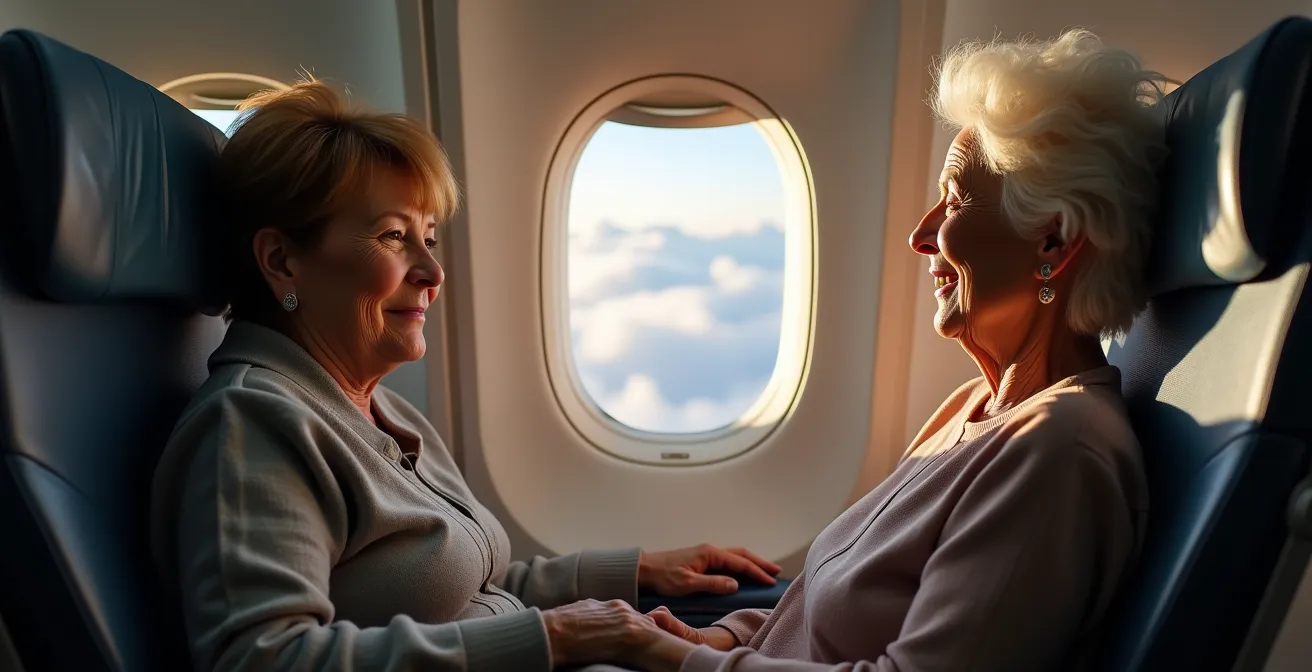
Beyond the legroom itself, the hidden benefits of a premium cabin are vital for solo traveler confidence. Priority boarding reduces the stress of standing in long lines, and easier access to restrooms helps prevent dehydration, a key contributor to fatigue and jet lag. Calculating the “confidence cost” can put the price in perspective. If exhaustion from the flight costs you the first full day of your trip—a day you paid for in hotel and activity costs—the price of the upgrade can suddenly seem like a very wise investment in your overall experience.
- Document medical conditions like DVT risk, arthritis, or recent surgery that require movement.
- Obtain a doctor’s letter specifying why extra legroom is necessary.
- Consider the hidden benefits: reduced stress from priority boarding and easier restroom access.
- Frame the upgrade cost as an investment in arriving refreshed and ready to explore.
Why the “Vacation Phase” of Retirement Often Leads to Depression After 6 Months?
Retirement often begins with a “honeymoon phase”—a giddy sense of freedom from the daily grind. But after the novelty wears off, a void can appear. The structure, social connections, and sense of purpose that work provided are gone. This is where the risk of depression can creep in. The endless vacation suddenly feels empty. This is precisely why reframing your travel is so critical. It must become more than a vacation; it needs to be an act of Identity Architecture.
Solo travel, undertaken with intention, offers a powerful antidote. It forces you to be self-reliant, to problem-solve, to navigate, and to connect with the world on your own terms. Each successful step, no matter how small, rebuilds a sense of competence and purpose that may have been lost. As one experienced traveler puts it, this is the core value of the journey.
Solo travel is not another vacation, but a powerful antidote to post-retirement depression by building a new identity based on purpose, self-reliance, and lifelong learning.
– Laurie, Senior Solo Traveler, Senior Solo Travel Website
In this context, the fear of dining alone is revealed for what it truly is: a microcosm of the larger fear of a purposeless, solitary retirement. It’s the ultimate test of this new identity. Conquering it isn’t just about having a meal; it’s about proving to yourself that you are complete on your own, capable and worthy of enjoying life’s pleasures independently.
From Retirement Depression to Solo Travel Purpose
A 67-year-old retiree shared his transformation: “After my wife died and I retired, I sat in that empty house for almost a year. Then I decided to start traveling solo. I’ve traveled outside of the country, which I never thought I would do, and I am living my best life. The fear of dining alone was a micro-version of my larger fear of a purposeless retirement – conquering it changed everything.”
This powerful shift in perspective—from seeing travel as a pastime to seeing it as a purpose—is the key to unlocking a fulfilling and exciting new chapter of life.
Why Online Interest Groups Can Be More Fulfilling Than Local Small Talk?
One of the biggest paradoxes of loneliness is that it can persist even when you’re surrounded by people. Casual small talk with neighbors or local groups can sometimes feel superficial, lacking the depth of connection you crave. This is where the power of Digital Companionship comes in. Online communities, especially those built around a shared passion like solo travel, offer a different kind of connection—one based on shared identity and enthusiasm.
For solo travelers, these groups have become an essential part of the journey. In fact, recent research shows Facebook groups are now the most trusted source for solo travel recommendations, even more so than friends and family. Why? Because the advice and support come from people who are living the same experience. They understand the specific anxieties and triumphs. This isn’t just about asking for hotel recommendations; it’s about finding your people.
These groups provide a safety net and a cheering squad. The “Shared Experience Strategy” is a powerful tool you can use right before facing a challenge like dining alone. As one traveler demonstrated, the support is real and immediate.
Digital Travel Companion Strategy in Action
Monique, a solo traveler, demonstrates the ‘Shared Experience Strategy’: ‘Before dining alone in Vietnam, I posted in my solo travel Facebook group asking for encouragement. Within minutes, I had dozens of supportive messages from others who had been there. One member was actually in the same city and we ended up meeting for coffee the next day. These passion-based connections are deeper than surface-level small talk because we share the same love for solo adventure.’
This sense of belonging to a tribe of like-minded adventurers is incredibly empowering. It transforms a solitary act into a shared victory, proving that “alone” doesn’t have to mean “lonely.” Finding and engaging with these online communities before and during your trip is a key strategy for building the emotional resilience needed for solo travel.
Key Takeaways
- Reframe the fear of dining alone as an opportunity to build a new, self-reliant identity in retirement.
- Build a “Confidence Infrastructure” through smart packing, health planning, and tech readiness before you leave.
- Choose destinations and travel styles (like specific cruises or countries) that align with and support your goal of comfortable solo experiences.
River Cruise vs. Ocean Liner: Which Is Better for Travelers with Walkers?
Cruising is an incredibly popular and accessible way for seniors to travel, but the choice between a river cruise and an ocean liner has significant implications, especially for a solo traveler with mobility needs and dining anxieties. Each offers a completely different environment that can either support or hinder your confidence. Your choice should be a strategic one, aligned with your physical comfort and social preferences.
Ocean liners are massive floating cities. For a traveler with a walker, their wide corridors and numerous elevators are a major advantage. They also offer a vast array of dining options, from huge, anonymous buffets to specialty restaurants. This anonymity can be a blessing for a nervous solo diner; you can easily blend in without feeling watched. However, their sheer size can be overwhelming, and they often dock at industrial ports, requiring buses or long excursions to reach city centers.
On a river cruise, you often have assigned seating with the same people, which can be great for forced community but intimidating for an introvert. Ocean liners offer more anonymous options like buffets and specialty restaurants.
– Senior Travel Expert, AARP Travel Tips
River cruises, in contrast, are intimate. With fewer passengers, the environment is much quieter and less overwhelming. Their key advantage is docking right in the heart of a city, allowing for easy, independent exploration right off the boat. However, this intimacy can be a double-edged sword. Corridors can be narrower, and the common practice of assigned dinner seating can feel like forced socialization, which might be intimidating if you’re not ready for it. The choice depends on what you want to prioritize: the social anonymity of an ocean liner or the port independence of a river cruise.
| Aspect | River Cruise | Ocean Liner |
|---|---|---|
| Solo Dining Options | Assigned seating, forced socialization | Multiple restaurants, anonymous buffets |
| Mobility Navigation | Narrow corridors, smaller spaces | Wide corridors, elevators abundant |
| Stability for Walkers | Very stable, minimal motion | More motion, stabilizers help |
| Port Independence | Dock in city centers, easy solo exploration | Industrial ports, require organized tours |
| Energy Management | Relaxed pace, predictable schedule | Can be overwhelming with activities |
Frequently Asked Questions on Senior Solo Travel
Why does jet lag hit harder after 60?
After 60, the body’s circadian rhythm becomes less flexible, melatonin production decreases, and the body takes longer to adjust to time changes. Recovery can take 1.5 days per time zone crossed, compared to 1 day for younger travelers.
What’s the best first-night dining strategy for eastbound travel?
For eastbound travel (shorter days), opt for room service or the hotel restaurant on arrival night. The exhaustion amplifies social anxiety, so conserve mental energy for solo dining when you’re rested.
Which supplements help seniors recover from jet lag faster?
Beyond melatonin (0.5-3mg), magnesium glycinate (200-400mg) helps muscle relaxation and sleep quality. Vitamin B12 supports energy levels, while protein-rich meals upon arrival stabilize blood sugar and reduce fatigue.