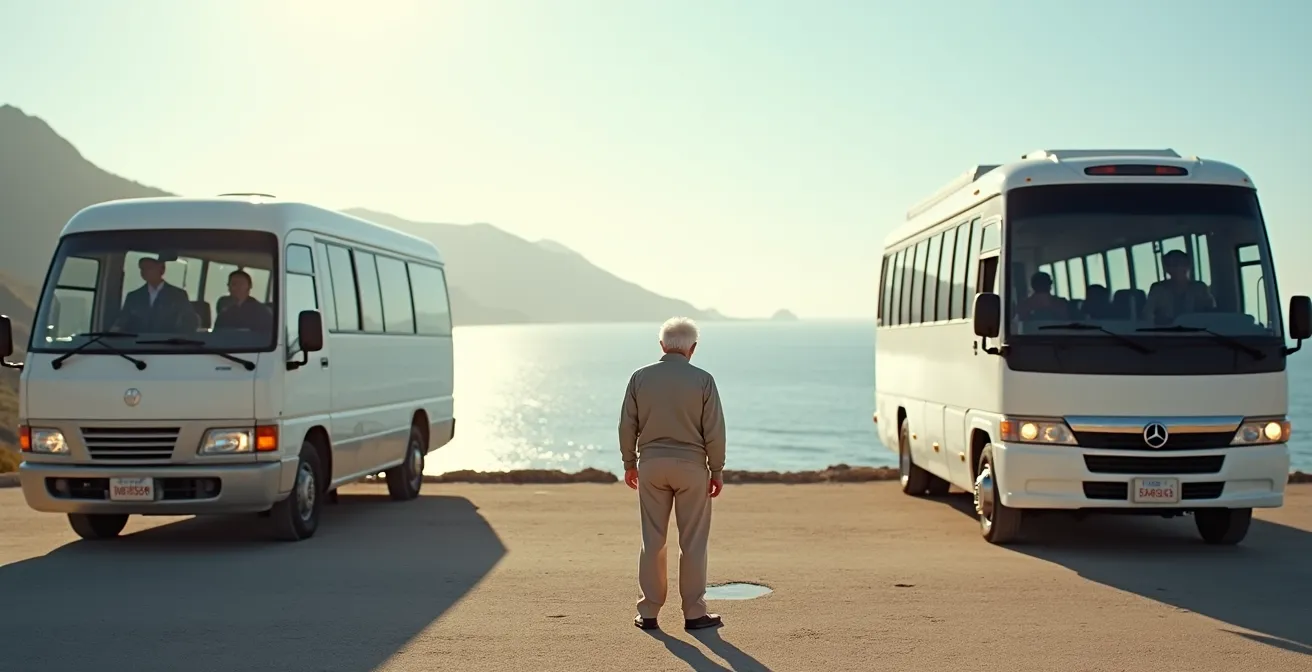
The best tour for a solo senior isn’t defined by its size, but by its ‘social architecture’—the hidden structures that dictate interaction and comfort.
- Small group tours offer personalized care and easier bonding but come with high social visibility and less anonymity.
- Large bus tours provide the freedom to be anonymous but can lead to feelings of isolation and make personalized support more difficult.
Recommendation: Choose the tour style whose structure minimizes your personal ‘interaction overhead’ and aligns with your need for privacy versus connection.
The dream of exploring a new corner of the world is exhilarating. For many single seniors, the appeal of a guided tour offers a perfect blend of adventure and security. Yet, a quiet fear often accompanies the excitement: the social dynamic. The thought of being “trapped” with 50 strangers on a bus, navigating forced conversations at every meal, can be more daunting than any travel logistics. This anxiety is real and can be the single barrier between staying home and embarking on a life-changing journey.
Common advice often misses the point, suggesting you simply “put yourself out there” or “find a buddy.” But what if the solution isn’t about changing your personality, but about choosing the right environment for it? The debate between a small, intimate group tour and a large, bustling bus tour is more than a question of numbers. It’s about understanding the underlying social architecture of each travel style and how it impacts everything from dining arrangements to handling a personal emergency.
This guide moves beyond the surface-level comparison. We will dissect the very mechanics of group travel to reveal how each format either alleviates or amplifies social anxiety for the solo traveler. Instead of focusing on which is universally “better,” we will equip you with a framework to decide which is better *for you*. By analyzing key moments of a trip—the first dinner, a request for a special diet, the decision on a single room—you’ll gain the clarity to choose an adventure that feels both exciting and genuinely comfortable.
To help you navigate this important decision, this article breaks down the critical differences between small and large group tours across several key scenarios. The following summary provides a roadmap to the detailed analysis in each section, empowering you to make an informed and confident choice for your next solo adventure.
Summary: A Solo Senior’s Guide to Choosing the Right Tour for Social Comfort
- The “Single Supplement”: Is It Worth Paying Extra for Privacy or Should You Match?
- Activity Level 3:How to Build a Medical “Dream Team” Before You Actually Get Sick?
- Buffet or Set Menu: How to Ensure Your Low-Salt Diet Is Respected on Tour?
- The First Dinner: How to Break the Ice with Strangers You’ll Be With for 10 Days?
- Quarantine or Continue: What Happens If You Get Sick While the Bus Moves On?
- Mentoring vs. Manual Labor: Which Volunteer Role Creates Deeper Bonds?
- East vs. West: Why Recovery Takes Longer After 60 and How to Fix It?
- Solo Travel at 65+: How to Overcome the Fear of Dining Alone?
The “Single Supplement”: Is It Worth Paying Extra for Privacy or Should You Match?
The “single supplement” is often the first financial and social hurdle for a solo traveler. It feels like a penalty for traveling alone, but it’s more useful to frame it as a strategic choice. Are you paying for privacy or paying to avoid the stress of an incompatible roommate? The decision hinges on your personal Anxiety-Reduction ROI (Return on Investment). For some, the guaranteed personal space to decompress each night is priceless and essential for managing social energy. For others, the cost savings and instant companionship of a roommate match are more valuable.
Small groups and large bus tours handle this differently. Large tours often have a vast, impersonal pool for matching, which can feel like a lottery. Smaller groups may offer more thoughtful matching processes, as they understand that group harmony is key to their intimate experience. It’s a growing consideration, as a recent Road Scholar survey revealed 20-30% of their annual travelers go solo, highlighting a significant demand for flexible and comfortable solo options. Ultimately, the choice is not just financial; it’s a calculated decision about securing your peace of mind.
Action Plan: Deciding on Your Room Strategy
- Contact Points: Identify your key decision factors—cost of the supplement, anxiety about sharing, and desire for guaranteed privacy.
- Information Gathering: Research the tour company’s specific roommate matching process. Do they consider age, habits, or is it random?
- Coherence Check: Compare the potential stress of a bad match against the financial cost. Is the price of the supplement a worthy investment in your well-being?
- Strategic Options: Evaluate a ‘hybrid strategy’—requesting a private room for the first few nights to ease in before deciding if you’re comfortable sharing.
- Integration Plan: Based on your analysis, make a firm decision and communicate it clearly to the tour operator before booking.
Activity Level 3:How to Build a Medical “Dream Team” Before You Actually Get Sick?
For any senior traveler, health is a primary concern. The fear of falling ill far from home can be a major source of anxiety. Creating a “medical dream team” before you depart is a powerful antidote. This team isn’t just about packing a first-aid kit; it’s a proactive network of support. It starts at home with your primary physician, who can provide a summary of your medical history and necessary prescriptions. The next layer is comprehensive travel insurance with excellent medical evacuation coverage. The final, and perhaps most crucial, member of this team is your tour operator and guide.
This is where the tour’s social architecture reveals its importance. In a small group setting, the guide is more likely to notice if you seem unwell. The connection is personal; they know your name and your baseline demeanor. They can act as your on-the-ground advocate, liaising with local clinics and keeping the group informed. On a large bus tour, you are one of many. While they have corporate protocols, the response can be less personal. You may need to be more self-reliant in communicating your needs. Building this support network transforms a source of anxiety into a well-managed plan, creating a robust social safety net no matter where you are.
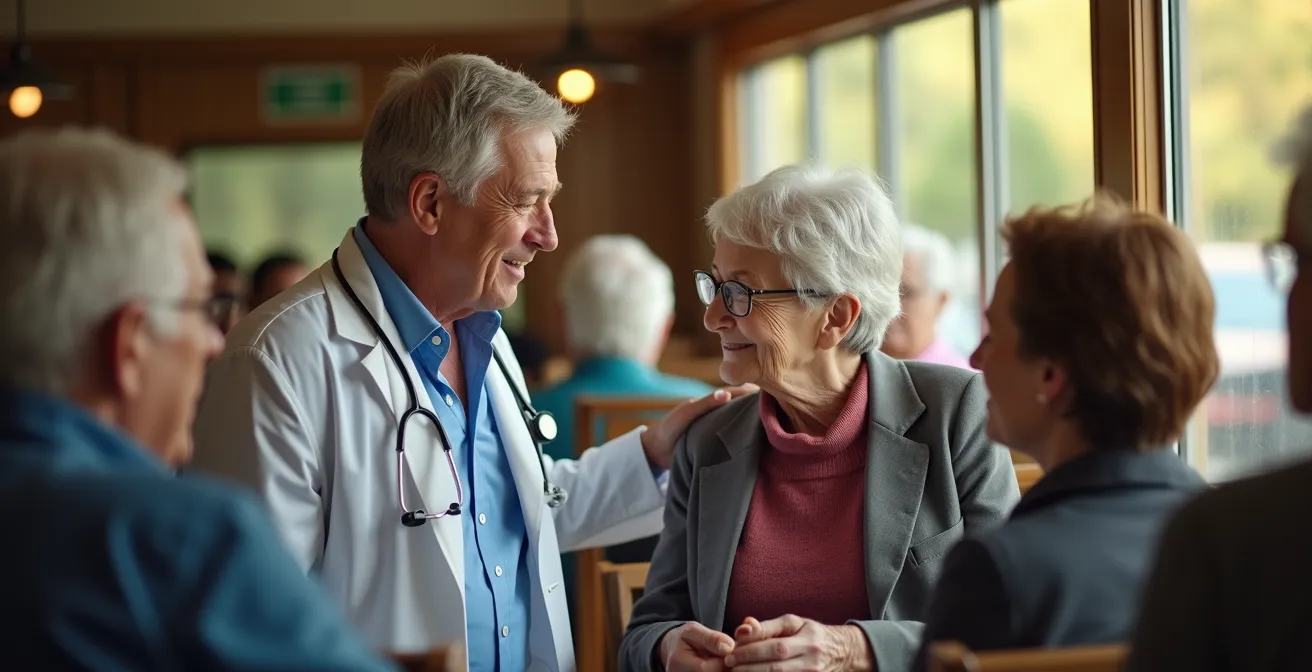
The image above captures the essence of this safety net—the personal, attentive care that a smaller group dynamic can facilitate. This level of personalized attention is a key factor when considering how a tour structure can mitigate health-related anxieties.
Buffet or Set Menu: How to Ensure Your Low-Salt Diet Is Respected on Tour?
Managing a dietary restriction like a low-salt diet while traveling can be a constant source of low-grade stress. The way meals are handled on a tour offers a clear window into the differences between large and small group dynamics. Large bus tours often rely on large-scale buffets. This offers variety and anonymity—you can quietly select what works for you without drawing attention. However, it also puts the onus entirely on you to identify safe options, often with little information about ingredients or preparation.
Small group tours, by contrast, frequently dine at smaller, local restaurants with set or family-style menus. This might seem more restrictive, but it presents a significant advantage for dietary needs. Your requirements can be communicated in advance by the tour operator directly to the chef. Your meal is prepared for you, removing the guesswork and anxiety of the buffet line. The guide often provides direct, personal assistance, confirming your meal with the kitchen. As noted by travel experts, the curated nature of these trips provides a more comfortable experience. As Insight Vacations highlights in their guide, small group tours for seniors go at a relaxed pace, which extends to a less stressful and more accommodating dining environment.
| Aspect | Small Group (10-15) | Large Bus Tour (40-50) |
|---|---|---|
| Meal Format | Set menus, family-style | Buffets, multiple options |
| Special Diet Handling | Pre-arranged, personalized | Self-selection required |
| Social Pressure | Higher visibility | Anonymous choices |
| Guide Support | Direct, personal assistance | General announcements |
| Flexibility | Can adjust for individuals | Standard offerings only |
The First Dinner: How to Break the Ice with Strangers You’ll Be With for 10 Days?
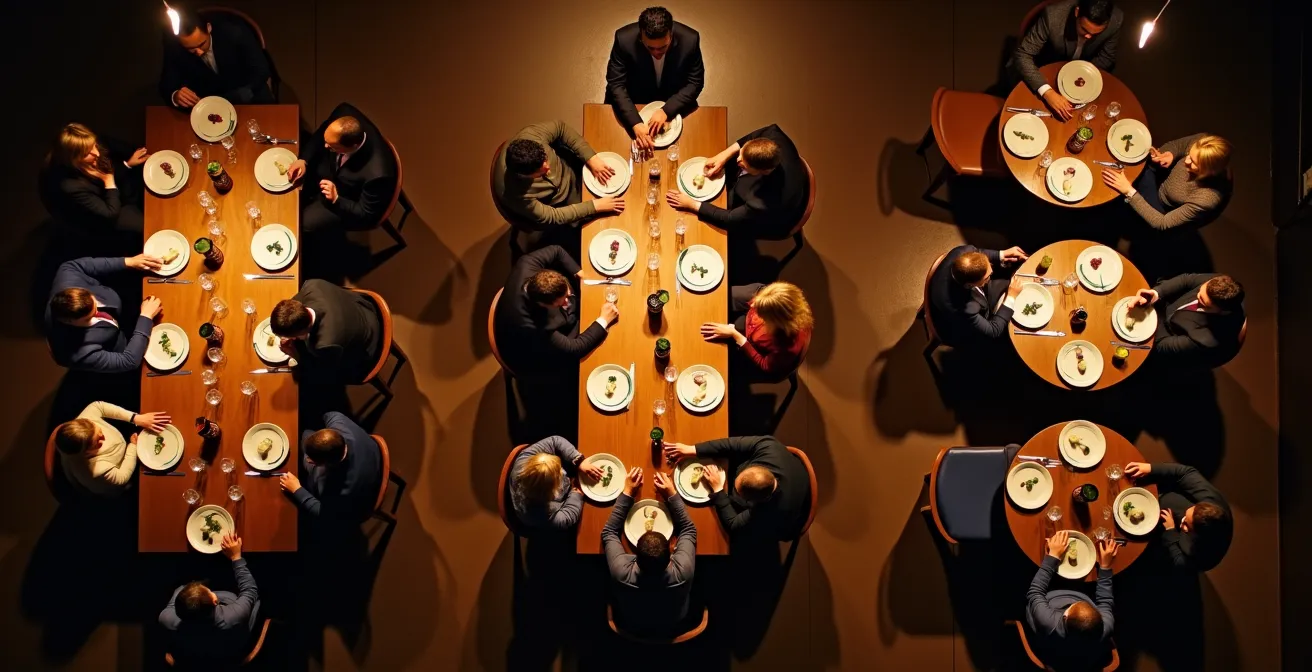
The first group dinner can feel like the first day of high school all over again. The pressure to make a good impression and find “your people” can be immense. Here, the physical layout of the dining space—a core part of the tour’s social architecture—plays a massive role in shaping the experience. Large bus tours often mean dining in large hotel restaurants with multiple round tables. This allows you to choose your seat and control your initial interactions, but it can also lead to cliques forming early on, making it harder to mingle later.
Small groups, on the other hand, often gather around a single long table. This might seem intimidating, as there’s nowhere to hide, but it forces interaction in a structured way. It eliminates the anxiety of choosing a table and ensures everyone is part of the same conversation. This shared experience can be a powerful icebreaker. It fosters a sense of immediate community, a phenomenon observed even among anxious travelers.
Case Study: The Power of Shared Vulnerability
A traveler on a Flash Pack solo trip to Morocco provides a perfect example. At the welcome drinks, she admitted her social anxiety to the group. To her surprise, this opened the floodgates. As they went around the table, traveler after traveler confessed to feeling nervous. According to the account, this realization that anxiety was a common thread helped the group become vulnerable together, bonding them from the very first night. This demonstrates how a structured group setting can transform individual anxiety into a collective strength.
Quarantine or Continue: What Happens If You Get Sick While the Bus Moves On?
The logistical nightmare of getting sick while the tour moves on is a significant, if often unspoken, fear. What happens if you need to stay behind? How do you rejoin the group? The answer depends heavily on the tour’s scale and itinerary. This scenario is becoming more relevant as guided tours see a massive influx of solo travelers; some operators report single bookings are up 300 percent over other demographics, making robust health protocols essential.
A large bus tour, covering hundreds of miles daily across different cities or even countries, has a rigid, forward-moving momentum. If you fall ill, their corporate structure may provide a standardized support protocol (e.g., contacting a local agent), but rejoining the group can be complex and expensive. You might have to arrange your own transport to catch up, or in some cases, forfeit the rest of the tour. The social safety net is more corporate than personal.
A small group tour, especially one focused on a single region or country, offers greater flexibility. Because the travel distances are shorter and the pace is slower, the logistics of a temporary separation are far simpler. The guide, having a personal connection with you, can often help coordinate a plan for you to rest and rejoin the group a day or two later. The itinerary is less of an unstoppable machine and more of an adjustable framework, which can dramatically reduce the anxiety associated with a potential health issue.
Mentoring vs. Manual Labor: Which Volunteer Role Creates Deeper Bonds?
For many, travel is enriched by giving back or sharing a skill. If your tour includes a volunteer or community element, the role you play can significantly impact your social experience and help you find a natural place within the group. The size of the tour group determines how these roles are perceived and valued, creating different opportunities for connection. Shared activities are a proven way to build bonds; some studies suggest that participating in group activities can increase feelings of social connectedness by over 35%.
In a small group of 8-15 people, your unique contributions are highly visible. If you have expertise to share, you can naturally fall into a “Mentor” role, which is often valued and creates deep, respect-based connections. Even a quieter “Helper” role is noticed and appreciated, fostering a sense of being an integral part of the team. In a large bus tour of 40 or more, individual contributions can get lost. A mentor’s voice may not reach everyone, and a helper’s quiet work can go unnoticed. While you can still contribute, the social feedback loop is much weaker, making it harder to form bonds through these actions.
| Role Type | Small Group (8-15) | Large Bus (40+) | Best For |
|---|---|---|---|
| The Mentor | High visibility, valued expertise | Limited reach, gets lost | Confident sharers |
| The Helper | Noticed & appreciated | Anonymous but useful | Introverted givers |
| The Photographer | Becomes group documentarian | One of many | Creative connectors |
| The Listener | Deep 1-on-1 connections | Surface interactions | Anxious travelers |
East vs. West: Why Recovery Takes Longer After 60 and How to Fix It?
The “East vs. West” in the title isn’t about geography; it’s a metaphor for the two poles of social energy: engagement (“East,” where the sun rises on social activity) and recovery (“West,” where it sets for quiet time). As we age, the need for social recovery time becomes more pronounced. Constant interaction, no matter how pleasant, can be draining. The key to a sustainable and enjoyable trip is mastering Personalized Pacing—strategically budgeting your social energy and building in recovery time. The structure of your tour heavily influences your ability to do this.
On a large bus tour, finding solitude is paradoxically easier. The sheer scale of the hotels and the anonymity of the group allow you to slip away to a café, museum, or simply your room without your absence being particularly noted. You can create your own bubble with a podcast or a phone call home. In a small group, your absence is immediately felt, which can create social pressure to always be “on.” The solution here is not to disappear, but to practice “gentle disengagement.” This means being physically present with the group (e.g., reading a book in the common area) while signaling that you are in recovery mode. This allows you to recharge without creating social distance.
- For Large Bus Tours: Actively use the anonymity. Seek out solo-friendly spaces like cafes or libraries during free time. Don’t feel guilty about skipping an optional group dinner.
- For Small Group Tours: Communicate your needs subtly. Practice ‘gentle disengagement’ by remaining in common areas while enjoying a quiet activity.
- Universal Strategy: Remember that social rest is as important as physical rest. It is perfectly acceptable to spend an evening in your room to recharge your batteries for the next day.
Key Takeaways
- The ideal tour is not about size, but about its ‘social architecture’ and how it matches your personality.
- Evaluate tour costs, like the single supplement, in terms of ‘Anxiety-Reduction ROI’—is the price worth the peace of mind?
- A tour’s structure, from meal formats to guide accessibility, forms a ‘social safety net’ that is critical in managing health and logistical anxieties.
Solo Travel at 65+: How to Overcome the Fear of Dining Alone?
After all the analysis of group dynamics, there often comes a moment on any tour—a free evening, a lunch break—where you are faced with a simple but profound fear: dining alone. This single act can feel like a spotlight on your solo status. The first step to overcoming this is normalization. You are not alone in being alone. In fact, solo senior travel is booming, with some data showing that 25% of women travelers aged 65-plus are going solo. Seeing it as a common, even empowering, act rather than a social failure is a powerful mental shift.
Beyond mindset, practical strategies can transform the experience from intimidating to enjoyable. Experienced solo travelers recommend sitting at the bar. Bartenders are often great conversationalists who can read your social cues, and watching them work is a form of entertainment. It provides a focal point other than your own solitude. Another strategy is to reframe it as a luxury: you get to choose exactly what and where you want to eat, on your own schedule. For those still seeking connection, staying at women-only guesthouses or hostels can provide a built-in community of fellow solo travelers to meet up with for dinner. The fear is real, but the freedom on the other side of it is a core reward of solo travel.
Ultimately, choosing the right tour is an act of self-knowledge. By using this framework to analyze the social architecture of your options, you empower yourself to select an adventure that honors your social comfort levels. To put these insights into practice, the next logical step is to start researching specific tour operators with these criteria in mind.
Frequently Asked Questions About Tour Group Dynamics
What happens if I need to stay behind for medical reasons?
The response varies significantly. Large tour operators typically have rigid logistics but may offer corporate support structures to assist you. Small group operators often provide more personal flexibility and can make it easier to handle a temporary separation, but may have fewer ground resources in a major crisis.
How do I rejoin the group after recovery?
Rejoining is generally easier on a small group tour, especially one exploring a single region, as the daily travel distances are shorter. Catching up to a large bus tour that covers 200+ miles per day across multiple destinations can be logistically complex and may require you to arrange and pay for your own transportation.