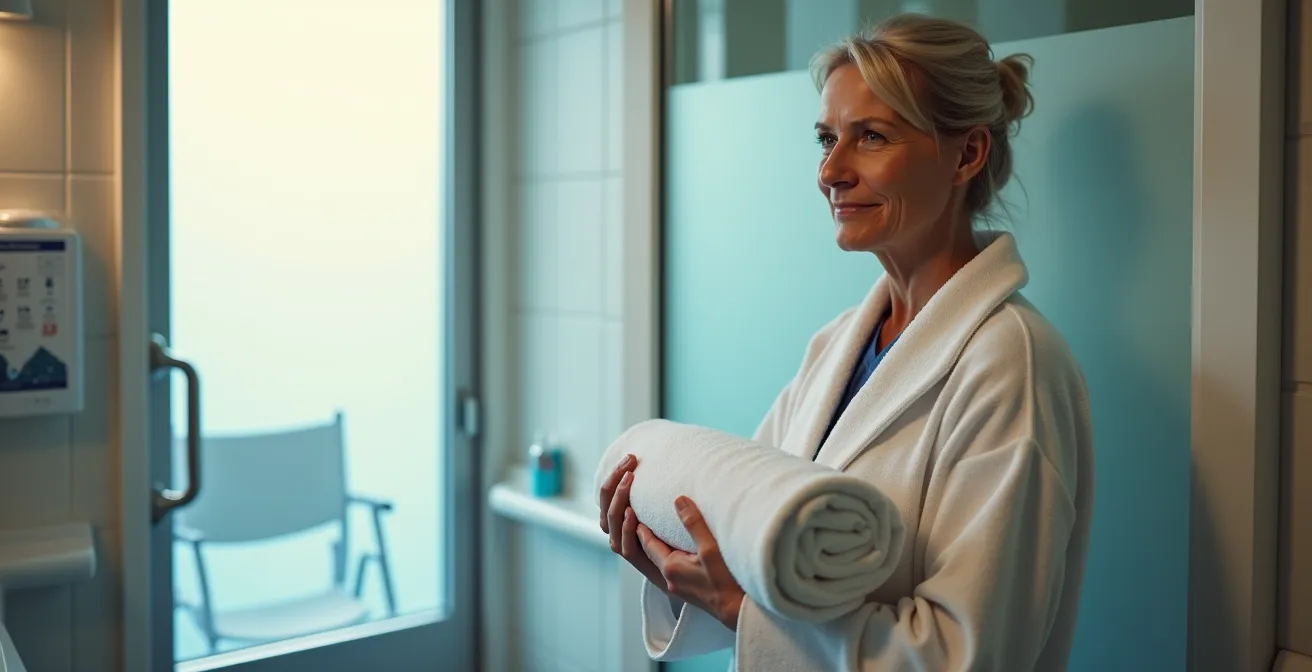
Hiring a professional aide for bathing is not a sign of failure; it is a strategic act of love that preserves the parent-child relationship.
- Professionals use specific techniques and clinical knowledge that maintain dignity and ensure safety in ways a family member cannot.
- Using an agency creates a legal and liability shield, protecting your family from the risks associated with in-home care.
Recommendation: Reframe the conversation from “needing help” to “protecting our relationship” by outsourcing the clinical task of bathing to a trained expert.
The quiet tension before a shower. The awkward silence while navigating the intimate task of bathing a parent. For many families, this role reversal is one of the most challenging aspects of aging. Your daughter or son loves you, and their instinct is to help. But when help crosses the boundary into profoundly personal care, it can strain the very relationship it’s meant to support. The dynamic shifts from parent and child to caregiver and patient, introducing embarrassment and eroding the familiar roles you’ve known for a lifetime.
Many people believe that handling care within the family is the most loving option. They focus on installing grab bars and buying non-slip mats, thinking safety is the only concern. What is often missed, however, is the immense emotional labor and the specialized skill required to provide care that is not only safe but also dignified. The core issue isn’t just about getting clean; it’s about how the process makes you feel. What if the most supportive choice wasn’t to do it yourself, but to protect your relationship by entrusting the task to someone trained for it?
This article, from the perspective of a family dynamics psychologist, will explore why hiring a professional is a superior choice for preserving your bond. We will examine the specific techniques, knowledge, and legal protections a professional brings, demonstrating how this decision allows you to remain a son, a daughter, a spouse—not just a caregiver.
To understand this better, this guide breaks down the critical aspects of assisted bathing that highlight the difference between amateur help and professional care. The following sections detail the nuanced skills and considerations that a trained aide brings to the home.
Summary: Why Professional Shower Assistance Preserves Family Bonds
- The “Towel Technique”: How Aides Maintain Your Privacy While Bathing You?
- Adult Briefs vs. Pads: Which Product Is Easier to Change with Limited Mobility?
- Morning or Evening: When Is the Safest Time to Shower if You Have Low Blood Pressure?
- Why You Need a “Skin Check” Routine Every Time You Bathe?
- Is There Enough Room? Why Small Bathrooms Make Assisted Showering Dangerous
- Built-In Bench or Teak Stool: Which Is More Flexible for Caregiver Assistance?
- Companion vs. CNA: Why You Shouldn’t Ask a Companion to Do Wound Care?
- Agency vs. Private Hire: Who Is Liable If the Caregiver Gets Injured in Your Home?
The “Towel Technique”: How Aides Maintain Your Privacy While Bathing You?
The fear of being exposed is often the biggest barrier to accepting help. A family member might try their best, but a professional caregiver is trained in what is known as procedural dignity. This isn’t just about being nice; it’s a specific, methodical approach to bathing that minimizes exposure and maximizes comfort. The cornerstone of this is the “towel technique,” or therapeutic draping. It turns an intimate process into a clinical and respectful procedure.
The aide uses a system of bath blankets or large towels to ensure only the part of the body being actively washed is exposed at any given moment. As soon as one area is cleaned and dried, it is immediately re-covered before moving to the next. This creates a predictable, secure experience that reduces anxiety. For example, a professional may recommend a terry cloth wrap, which provides coverage and warmth but can be easily maneuvered for washing underneath. This demonstrates a level of forethought that goes beyond simply “helping someone shower.”

This method requires practice and a degree of clinical distance that can be emotionally difficult for a family member to maintain. A professional’s training allows them to perform these tasks with a calm, matter-of-fact efficiency that normalizes the experience. They announce each step in advance, so there are no surprises, transforming a potentially embarrassing moment into a structured, dignified process.
Adult Briefs vs. Pads: Which Product Is Easier to Change with Limited Mobility?
Choosing an incontinence product seems straightforward, but the decision has significant implications for dignity, skin health, and the physical strain on the person providing assistance. A family member might choose based on absorbency alone. A professional, however, conducts a more holistic assessment, considering the individual’s mobility, the caregiver’s physical strength, and the client’s own perception of the product.
For someone who is bed-bound, changing an adult brief requires significant rolling and lifting, which demands proper body mechanics to be done safely for both parties. In contrast, for a person who can stand even briefly, a pad might be changed with far less movement, preserving energy and a greater sense of independence. A professional understands that the “best” product is the one that best fits the specific physical context. They also know that many older adults prefer pads because they feel less like a “diaper,” a psychological factor that is crucial for self-esteem but easily overlooked.
This clinical decision-making is where a professional’s value shines. They can weigh the pros and cons based on experience with hundreds of clients. The following table illustrates the kind of analysis a trained aide performs when recommending a product, something a family member learns only through trial and error.
| Factor | Adult Briefs | Pads |
|---|---|---|
| Physical Effort Required | Requires rolling person side to side | Less movement needed if ambulatory |
| Standing Ability Needed | Can be changed lying down | Easier if person can stand briefly |
| Dignity Perception | May feel more ‘diaper-like’ | Often preferred for sense of normalcy |
| Skin Protection | Full coverage, better for overnight | Targeted protection, requires proper positioning |
| Caregiver Strength Needed | Higher – requires lifting/rolling | Lower – minimal lifting required |
Morning or Evening: When Is the Safest Time to Shower if You Have Low Blood Pressure?
“When do you want to shower?” seems like a simple question. But for a senior, especially one with health conditions like orthostatic hypotension (a drop in blood pressure upon standing), the timing of a shower is a critical safety decision. A warm shower can dilate blood vessels, potentially lowering blood pressure further and increasing the risk of dizziness or falls. With falls being a major concern—indeed, 1 in 4 Americans aged 65 and older report falling each year—this is not a minor detail.
A professional caregiver is trained to think in terms of energy budgeting and risk management. They won’t just ask when you’re free; they’ll consider your medication schedule, your typical energy peaks and troughs, and your meal times. For example, showering immediately after a meal can be risky due to postprandial hypotension, where blood rushes to the digestive system. For a person with dementia, late afternoon can be a period of increased agitation (“sundowning”), making it the worst time for a potentially stressful activity like bathing.
This strategic planning transforms bathing from a simple chore into a carefully managed part of a health plan. It’s a level of clinical foresight that a family member, no matter how loving, is unlikely to possess without specific training. A professional helps you work with your body’s rhythms, not against them.
Action Plan: Scheduling Showers for Maximum Safety
- Schedule showers when energy levels are typically highest.
- Avoid showering immediately after meals to prevent postprandial hypotension.
- Consider medication peak times and coordinate with your blood pressure medication schedule.
- For individuals with dementia, avoid “sundowning” hours in the late afternoon or early evening.
- Plan for rest periods both before and after showering to conserve energy.
Why You Need a “Skin Check” Routine Every Time You Bathe?
The skin is the body’s largest organ and often the first place where underlying health issues become visible. For a family member, the goal of a shower is cleanliness. For a professional caregiver, bathing is also a crucial opportunity for a routine health assessment. They are trained to perform a visual skin check every single time, looking for signs that a layperson would almost certainly miss.
The Professional’s Observational Advantage
Professional caregivers are trained to identify early warning signs that may first appear on the skin. While bathing a client, they are alert for pressure sores (especially on bony areas like heels and the tailbone), new rashes, unusual bruises, or signs of poor circulation. This proactive observation can lead to early intervention for serious conditions that family members, focused on the task of washing, might not notice until they become more severe.
This isn’t an abstract concern. A small red spot on an elbow or heel might seem trivial, but a trained aide knows it could be the first stage of a dangerous pressure ulcer. They know to check skin folds for moisture-related irritation and to document any changes in a log for the family or a visiting nurse. This observational skill requires specific knowledge:
- What to look for: Redness that doesn’t fade when pressed, changes in skin color or temperature, blisters, or broken skin.
- Where to look: Bony prominences like the tailbone, hips, shoulders, and heels, as well as friction-prone areas.
- What not to do: Never rub or massage a red area, as this can cause further tissue damage.
This turns the bath into a preventative health measure, providing a layer of protection that goes far beyond simple hygiene. It’s a skill that directly translates to better health outcomes, and it’s a standard part of a professional’s duty of care.
Is There Enough Room? Why Small Bathrooms Make Assisted Showering Dangerous
A small bathroom isn’t just an inconvenience; it’s a significant safety hazard during an assisted shower. A family member might try to “make it work,” contorting their body in cramped quarters. A professional caregiver is trained to assess the environment for risk, and they know that adequate space is non-negotiable for performing their duties safely. The primary danger is the caregiver’s inability to use proper body mechanics.
When helping someone transfer to a shower bench or stand up, a caregiver must be able to bend at the knees, keep their back straight, and maintain a wide base of support. In a tight space, they are often forced to bend at the waist and twist, putting them at high risk for a back injury. An injury to the caregiver mid-transfer could lead to a fall for both people. A professional will assess the space before even starting, because their safety is integral to your safety.
An agency will often perform a home safety evaluation that includes measuring doorways and clear floor space. They view the environment through a clinical lens, identifying risks you may not see. This formal assessment protects everyone involved.
| Safety Factor | Red (Unsafe) | Yellow (Caution) | Green (Safe) |
|---|---|---|---|
| Doorway Width | Less than 28 inches | 28-31 inches | 32+ inches |
| Clear Floor Space | Less than 30×48 inches | 30×48 inches minimum | 36×60+ inches |
| Grab Bar Installation | None or towel bars only | 1-2 grab bars | Multiple properly anchored bars |
| Flooring | Loose rugs, slippery tiles | Fixed mats, some traction | Non-slip surfaces throughout |
| Caregiver Maneuvering Space | Cannot bend knees properly | Limited movement possible | Full range for proper body mechanics |
Built-In Bench or Teak Stool: Which Is More Flexible for Caregiver Assistance?
Choosing shower seating is another decision that benefits from professional expertise. A built-in bench seems like a stable, permanent solution. A stylish teak stool looks great. But a professional aide considers the choice from a functional standpoint: which option best facilitates a safe transfer and allows the caregiver adequate access for washing? The answer often depends on the individual’s specific mobility and the bathroom’s layout.
For many, the most flexible and safe option is neither a fixed bench nor a small stool, but a transfer bench. This specialized piece of equipment straddles the edge of the tub or shower curb, allowing a person to sit down outside the wet area and then slide or swing their legs over into the shower. This minimizes the risk of a fall during the most dangerous part of the process—getting in and out.
The Transfer Bench Solution
A transfer bench provides a stable, seated surface that bridges the gap between the dry bathroom floor and the wet shower basin. The individual can sit securely on the bench and then pivot their legs into the tub. This hybrid approach offers the stability needed for a safe transfer while still allowing the caregiver to reach the person’s back and lower body for thorough washing, combining safety with functional access.
A professional caregiver can recommend the right type of seating after assessing your specific needs, strength, and balance. They have seen what works and what doesn’t in countless different scenarios. This practical experience prevents costly and potentially unsafe purchases, ensuring the solution is tailored to you, not just to the bathroom’s aesthetics.
Companion vs. CNA: Why You Shouldn’t Ask a Companion to Do Wound Care?
When seeking help, it’s easy to think all caregivers are the same. This is a dangerous misconception. The terms “companion” and “Certified Nursing Assistant (CNA)” represent vastly different levels of training and legal authority. Asking a companion to perform a medical task like bathing, especially if wound care or skin assessments are involved, can be inappropriate and unsafe. This is a critical reason why hiring through a professional agency is so important—they ensure the person sent to your home has the right credentials for the job.
A companion’s role is primarily social and supportive. They can help with meals, light housekeeping, and provide company. They are not trained or licensed to provide “hands-on” care. A CNA, on the other hand, has completed state-approved medical training and passed a competency exam. They are qualified to assist with activities of daily living (like bathing), monitor vital signs, and perform non-sterile wound care. The distinction is not just a matter of skill, but of scope of practice, as defined by industry standards.
As Home Care Industry Standards clarify in their guidelines, the difference is fundamental:
Companions provide non-medical support like companionship and light housekeeping, while CNAs have medical training and legal permission for hands-on care including wound care, medication assistance, and vital signs monitoring.
– Home Care Industry Standards, Caregiver Scope of Practice Guidelines
Entrusting intimate care to a professional CNA ensures that the person helping you is not only skilled but is also operating legally within their trained capacity. This protects you from substandard care and protects the caregiver from being asked to perform tasks they are not qualified for. It removes the guesswork and ensures a standard of professionalism that a casual hire cannot guarantee.
Key Takeaways
- Hiring a professional preserves the parent-child relationship by avoiding role reversal in intimate situations.
- Professionals use specific, trained techniques for dignity, safety, and health assessment that family members lack.
- Working with an agency provides a critical liability shield, protecting the homeowner from legal and financial risks.
Agency vs. Private Hire: Who Is Liable If the Caregiver Gets Injured in Your Home?
This final point is one that families rarely consider until it’s too late. When you hire a caregiver privately, you often become their legal employer. This means if that person slips and falls in your bathroom while assisting you—a significant risk, as falls are one of the leading causes of injuries for all adults in this setting—you could be held personally liable for their medical bills and lost wages. Your homeowner’s insurance may not cover employees in the home, leaving you financially exposed.
Working with a reputable home care agency provides a crucial liability shield. The agency is the legal employer. They handle payroll taxes, conduct background checks, and, most importantly, carry workers’ compensation and liability insurance. If an aide is injured on the job, the agency’s insurance covers it, not you. This protection is one of the most significant, yet least discussed, benefits of professional hire.

The peace of mind that comes from this legal and financial protection cannot be overstated. It allows you to focus on the care being provided, not the potential for catastrophic financial consequences. As this comparative analysis from a leading professional care agency shows, the homeowner’s responsibilities differ dramatically.
| Aspect | Agency Hire | Private Hire |
|---|---|---|
| Workers’ Compensation | Covered by agency | Homeowner must provide |
| Liability Insurance | Agency’s insurance applies | Homeowner’s policy may exclude |
| Payroll Taxes | Agency handles | Homeowner responsible |
| Background Checks | Agency conducts | Homeowner must arrange |
| Replacement if Injured | Agency provides backup | Homeowner must find replacement |
| Legal Employer Status | Agency is employer | Homeowner becomes employer |
Ultimately, the decision to bring in a professional is an act of profound care—not just for the parent’s physical needs, but for the health and sanctity of the family relationship. It allows a daughter to be a daughter, a son to be a son, and a parent to be a parent. By outsourcing the clinical task, you preserve the priceless bond that defines your family. For your next family discussion, consider framing the conversation not around frailty, but around a shared goal: protecting your relationship for all the years to come.