
Choosing the right chair for swelling isn’t just about lifting your legs; it’s about correcting a ‘postural cascade’ that impacts your entire body.
- Zero gravity chairs offer superior circulatory decompression by achieving a state of gravitational neutrality.
- Slouching in traditional recliners can compress internal organs, directly affecting digestion and comfort.
Recommendation: Prioritize a chair that promotes whole-body alignment to address not just swelling, but also associated issues like acid reflux and neck strain.
After a long afternoon of reading or watching television, you glance down and notice it: the familiar puffiness in your ankles and lower legs. For many seniors, this edema is a frustratingly common part of a sedentary lifestyle. The conventional wisdom is simple—put your feet up. A standard recliner seems to do the trick, lifting your legs and offering a moment of relief. But this approach only addresses a single symptom, ignoring a more complex underlying issue.
The problem isn’t just about fluid pooling in your legs; it’s about a postural cascade. The way you sit for hours affects your circulation, spine, internal organs, and even your breathing. While a recliner provides some elevation, it can often encourage a slouched position that exacerbates other problems. This is where the conversation needs to shift. The question is no longer just “which chair lifts my legs?” but “which chair supports my entire body as an integrated system?”
What if the key to reducing swelling and improving overall well-being wasn’t just elevation, but a complete reset of your body’s alignment? This guide reframes the debate between recliners and zero gravity chairs. We will explore this choice not as a matter of simple comfort, but as a critical decision for your health. This is about choosing an active seating tool designed for whole-body alignment, capable of delivering circulatory decompression and counteracting the systemic pressures of prolonged sitting.
This article will guide you through a comprehensive comparison, examining how each chair type impacts everything from back support and digestion to neck strain and sleep quality. By understanding these connections, you can make an informed choice that addresses the root cause of your discomfort, not just the visible symptoms.
Summary: Recliner vs. Zero Gravity Chair for Systemic Health
- Memory Foam or Mesh: Which Back Support Keeps You Cool During Long Sits?
- Wedge Pillow or Adjustable Base: What Works Best for Acid Reflux at Night?
- Why Slouching in Your Armchair Is Causing Your Digestion Problems?
- Electric Lift Chairs: How to Choose a Motor Speed That Doesn’t Make You Dizzy?
- How to Watch TV Without Straining Your Neck: The Eye-Level Rule
- Cervical vs. Memory Foam: Which Pillow Prevents Morning Neck Stiffness?
- TV News or Reading: How Your Pre-Dinner Activity Affects Your Anxiety Levels?
- How to Choose a Mattress That Relieves Hip Pain for Side Sleepers Over 60?
Memory Foam or Mesh: Which Back Support Keeps You Cool During Long Sits?
When spending hours in a chair, temperature regulation is a significant factor in overall comfort. Mesh chairs are widely promoted for their breathability, allowing air to circulate freely and prevent heat buildup. This can be a major advantage during warmer months or for individuals who tend to feel hot. However, the debate between mesh and foam is more nuanced than just airflow. The primary goal of a support surface should be to maintain proper posture, and this is where material quality becomes paramount.
While mesh offers superior cooling, its supportive capabilities can vary. In contrast, high-density foam provides excellent pressure distribution and helps maintain proper spinal alignment. The risk with foam comes from lower-quality versions, which can sag over time and lead to the very slouching that causes discomfort and poor posture. Interestingly, ergonomic research from UC Berkeley found no significant differences in pain or comfort between high-quality foam and mesh chairs during extended use. This suggests the structural integrity of the chair is more important than the surface material itself.

This is reinforced by leading experts in spine biomechanics. As Dr. Stuart McGill, a Distinguished Professor Emeritus, notes, the wrong kind of softness can be detrimental. In his analysis, he states:
Too-soft chairs lack sufficient support to allow the stress migrations and distributions critical to achieving comfort and injury resilience.
– Dr. Stuart McGill, Distinguished Professor Emeritus at University of Waterloo
Ultimately, the choice is less about mesh versus foam and more about support versus sagging. A high-quality, dense memory foam that conforms without collapsing is often superior for maintaining whole-body alignment, even if it retains slightly more heat than mesh. For those who prioritize cooling, a chair combining a supportive foam base with breathable fabric upholstery offers a good compromise.
Wedge Pillow or Adjustable Base: What Works Best for Acid Reflux at Night?
Acid reflux, or Gastroesophageal Reflux Disease (GERD), is a common issue that is often exacerbated by lying flat. Gravity allows stomach acid to flow back into the esophagus, causing heartburn and disrupting sleep. For this reason, sleeping on an incline is one of the most effective non-medicinal strategies for managing GERD. The two most common solutions are using a wedge pillow or sleeping in a bed with an adjustable base. Both aim to achieve the same goal—elevating the torso—but they do so with different implications for comfort and alignment.
A wedge pillow is an accessible and affordable option. It creates a slope for the upper body, effectively keeping stomach acid down. However, it can create an unnatural bend in the mid-section and may cause the user to slide down during the night, negating its benefit. An adjustable bed base, or a zero gravity chair used for napping, offers a superior solution. It elevates the entire torso in a straight line, creating a consistent incline from the hips to the head. This prevents the awkward “fold” at the waist and maintains better spinal alignment.
The medical community strongly endorses this approach. As the American College of Gastroenterology states in its clinical guidelines:
The American College of Gastroenterology recommends head elevation as part of lifestyle modifications for people with GERD. Many doctors advise their patients to sleep on an incline before even considering medications or surgeries.
– American College of Gastroenterology, Clinical Guidelines
The benefit goes beyond just preventing reflux. By providing a stable, inclined position, an adjustable base or zero gravity chair promotes more restorative rest. This is a clear example of how a piece of furniture can function as an active health tool. It doesn’t just offer a place to sit or lie down; it modifies the body’s relationship with gravity to directly address a medical condition and improve overall well-being.
Why Slouching in Your Armchair Is Causing Your Digestion Problems?
It may seem unrelated, but the chronic slouch you adopt in your favorite armchair could be a direct contributor to your digestive discomfort, bloating, and even acid reflux. This connection is a prime example of the “postural cascade”—where one poor alignment triggers a series of negative downstream effects. When you slouch, your spine curves into a “C” shape. This posture compresses your entire abdominal cavity, putting direct physical pressure on your stomach, intestines, and other digestive organs.
This compression has several consequences. First, it can slow down peristalsis, the wave-like muscle contractions that move food through your digestive tract. This can lead to bloating and constipation. Second, the pressure on the stomach can push acid upward into the esophagus, worsening the symptoms of GERD. Over time, this constant compression can weaken the muscles responsible for maintaining good posture, making it even harder to sit upright and creating a vicious cycle of discomfort.
A zero gravity chair directly counteracts this by promoting a neutral spine position. By elevating the legs to or above heart level and opening the angle between the torso and thighs to around 120 degrees, it achieves gravitational neutrality. This position de-compresses the spine and, crucially, releases the pressure on the abdominal organs. It allows your digestive system to function without the physical impediment of a hunched-over posture, highlighting how proper seating is integral to internal health.
Your Action Plan: Improve Digestive Posture in Your Chair
- Achieve Neutral Spine: Sit back fully in your chair, ensuring your weight is distributed evenly across your back and hips, not just your tailbone.
- Elevate Your Feet: Raise your legs so your feet are at least at the level of your heart. This reduces abdominal compression and improves circulation.
- Maintain an Open Angle: Adjust your recline to create a 120-degree angle between your torso and thighs, taking pressure off your digestive organs.
- Use Lumbar Support: Place a small pillow or a dedicated lumbar roll in the curve of your lower back to maintain its natural curvature and prevent slouching.
- Take Posture Breaks: Every 30 minutes, stand up, stretch, or simply change your position to prevent muscle fatigue and the inevitable slump that follows.
Breaking the habit of slouching is essential for long-term digestive wellness. A chair that encourages and supports an open, neutral posture is not a luxury, but a fundamental component of a healthy, comfortable lifestyle, especially for those who spend many hours sitting.
Electric Lift Chairs: How to Choose a Motor Speed That Doesn’t Make You Dizzy?
For seniors with mobility challenges, an electric lift chair is a transformative piece of equipment, providing the independence to stand up safely and without assistance. However, a common concern is the sensation of dizziness or lightheadedness during the lifting motion. This feeling is often due to a medical condition known as orthostatic hypotension—a sudden drop in blood pressure when moving from a sitting or lying position to standing. It’s a prevalent issue, as medical research indicates that about 20% of adults over 65 experience it.
The key to preventing this dizzy spell is not to avoid lift chairs, but to choose one with the right features. The most critical feature is a smooth, quiet, and slowly-engaging motor. A jerky or rapid lift can exacerbate the sudden shift in blood pressure. A high-quality lift chair will have a motor that starts gently and moves at a steady, controlled pace, giving your body time to acclimatize to the change in position. This turns the potentially jarring experience of standing into a gradual, stable, and secure movement.
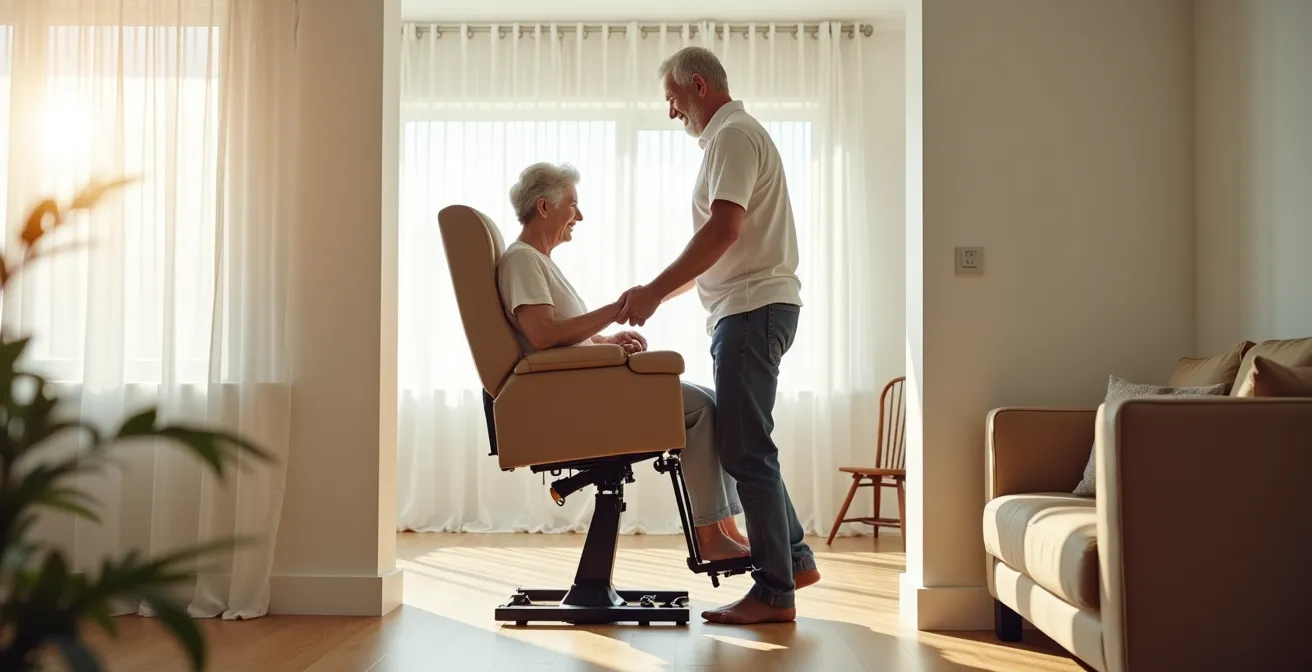
The long-term reliability of the motor and mechanism is also a testament to the chair’s value, as many users find them indispensable for daily living and recovery. The experience of long-time users often speaks volumes:
I have a Golden brand lift chair with zero gravity which is great for back pain. I bought mine used over 12 years ago. It is as good still as the day I got it. Mine had taken me through two knee replacements, a hip replacement and a shoulder replacement.
– Mayo Clinic Connect User
When selecting a lift chair, don’t focus solely on the fabric or color. Inquire specifically about the motor. Ask for a demonstration to feel the speed and smoothness of the lift. A chair that prioritizes a gentle, deliberate motion is one designed with a deep understanding of senior physiology, ensuring safety and confidence with every use.
How to Watch TV Without Straining Your Neck: The Eye-Level Rule
Neck strain is a frequent complaint for those who spend hours watching television, and the culprit is almost always poor screen positioning. The fundamental ergonomic principle is the “eye-level rule”: the center of your screen should be at or slightly below your natural eye level. When sitting upright, this is straightforward. However, in a recliner or zero gravity chair, your body’s geometry changes completely, and your TV setup must adapt accordingly.
In a traditional recliner that only elevates the feet, your head is often tilted forward and down to look at a standard-height TV, putting continuous strain on your cervical spine. A zero gravity chair creates a different challenge and opportunity. In the fully reclined, zero gravity position, your line of sight is angled upward. A TV placed on a low console will now be far too low, forcing you to crane your neck forward and down, causing stiffness and pain.
To correctly apply the eye-level rule in a reclined position, the TV must be mounted higher on the wall. When you are in your most comfortable reclined posture, your eyes should be able to look straight ahead toward the screen with your head resting comfortably on the headrest, maintaining a neutral cervical spine. This position aligns the torso and thighs, creating a 120-degree open angle that is central to the zero-gravity posture. This simple adjustment transforms TV watching from a source of strain into a truly relaxing activity that is in harmony with your body’s alignment.
Cervical vs. Memory Foam: Which Pillow Prevents Morning Neck Stiffness?
Waking up with a stiff, sore neck is a clear sign that your head and cervical spine were not properly supported during the night. The right pillow is a crucial part of the 24-hour whole-body alignment system, and the two most common options, cervical and memory foam pillows, offer very different approaches to support. Understanding their core functions is key to choosing the one that will prevent morning stiffness.
A cervical pillow is a tool of structural correction. It is ergonomically designed with a specific contoured shape, typically featuring a trough for your head and a raised, rounded edge that fits into the natural curve of your neck. Its primary purpose is to actively support and maintain the lordotic curve (the gentle forward curve) of the cervical spine. By filling the gap between your head and shoulders, it prevents your neck from sagging or being held at an unnatural angle, especially for back and side sleepers. It prioritizes alignment over pure softness.
A standard memory foam pillow, on the other hand, is a tool of pressure distribution. Its viscoelastic material reacts to your heat and weight, contouring perfectly to the unique shape of your head and neck. This provides excellent pressure relief and a feeling of being “cradled.” However, if the foam is too soft or lacks a supportive core, it can allow your head to sink too deeply, potentially compromising the neutral alignment that a cervical pillow is designed to enforce. While comfortable, it may not provide enough corrective support for someone with chronic neck stiffness.
For preventing morning neck stiffness, a cervical pillow is often the more effective choice because its function is explicitly to maintain alignment. It acts as a guide for your spine. A high-density memory foam pillow can also work, but only if it is firm enough to prevent your head from sinking out of alignment. The choice ultimately depends on whether your primary need is for structural support (cervical) or pressure relief (memory foam).
TV News or Reading: How Your Pre-Dinner Activity Affects Your Anxiety Levels?
The hour before dinner can set the tone for your digestion and your evening’s peace of mind. Your choice of activity during this time has a direct impact on your nervous system. Watching stimulating content like the TV news, with its often stressful reports and fast-paced visuals, activates the sympathetic nervous system—the body’s “fight or flight” response. This state increases your heart rate, tenses your muscles, and, importantly, diverts blood flow away from your digestive system, preparing you for action, not for a meal.
In contrast, engaging in a calming activity like reading a book or listening to quiet music activates the parasympathetic nervous system—the “rest and digest” response. This state lowers your heart rate, relaxes your body, and actively promotes digestive function. Making a conscious switch from a screen to a book 30 minutes before eating can significantly reduce anxiety and prime your body to properly receive and process your meal. This is not just a psychological trick; it’s a physiological necessity.
The link between digestion, posture, and sleep quality further deepens this connection. A fascinating study on GERD patients revealed that their condition had a more severe negative impact on sleep when they slept primarily on their right side. According to the research, having both GERD and sleeping for more than half the night on the right side was associated with significant decreases in sleep efficiency. Since the stomach is positioned on the left, lying on the left side helps gravity keep stomach acid in place. Poor sleep is a major contributor to anxiety, creating a feedback loop: anxiety affects digestion, and poor digestion (and posture) disrupts sleep, which in turn increases anxiety.
Therefore, a pre-dinner routine that includes a calming activity while relaxing in a zero gravity chair—ideally positioned on your left side if you are fully reclined—is a powerful strategy. It calms the mind, optimizes the body for digestion through parasympathetic activation, and uses gravity to your advantage, creating a holistic approach to reducing both physical and mental stress.
Key Takeaways
- A zero gravity chair is superior for reducing swelling because it improves whole-body circulation, not just leg elevation.
- Proper seated posture is critical for digestive health; slouching compresses internal organs and can worsen issues like acid reflux.
- Your chair should be considered part of a 24-hour alignment system that includes your mattress and pillows to manage chronic pain effectively.
How to Choose a Mattress That Relieves Hip Pain for Side Sleepers Over 60?
For side sleepers, especially those over 60, hip pain is a common complaint that can severely disrupt sleep. The pain often stems from two sources: a mattress that is too firm, creating pressure points, or a mattress that is too soft, allowing the hips to sink out of alignment with the spine. The solution lies in finding a mattress with a medium firmness that contours to the body’s curves while still providing underlying support. However, the effectiveness of your mattress is directly influenced by your daytime posture.
Your chair and your mattress are two halves of a 24-hour alignment system. Spending hours in a traditional recliner or office chair often tightens the hip flexors and encourages a posterior pelvic tilt. When you then move to your bed, these tight muscles can pull on your lower back and hips, contributing to pain regardless of your mattress quality. This is where a zero gravity chair provides a significant daytime benefit. By positioning your body with open angles, it gently stretches the hip flexors and de-compresses the lower back.
This synergistic relationship between daytime seating and nighttime relief is critical. A zero gravity chair actively prepares your body for a more restful night by counteracting the postural stress of the day. The following table illustrates how your choice of chair can impact the effectiveness of your mattress for hip pain relief.
As this comparative analysis of seating and mattress synergy shows, the benefits are interconnected.
| Daytime Chair Type | Recommended Mattress Firmness | Hip Flexor Impact | Pain Relief Rating |
|---|---|---|---|
| Traditional Recliner | Medium-Firm | Tightens hip flexors | Moderate |
| Zero Gravity Chair | Medium | Stretches hip flexors | High |
| Standard Office Chair | Firm | Creates posterior tilt | Low |
By adopting a zero gravity chair for your daytime relaxation, you are not just finding a comfortable place to sit; you are engaging in a form of passive therapy that helps to lengthen tight muscles and align your pelvis. This makes your medium-firm mattress more effective at night, allowing your hips and spine to rest in a truly neutral and pain-free position.
Frequently Asked Questions on Recliner or Zero Gravity Chair: Which Is Better for Reducing Lower Back Swelling?
What is the optimal TV height for zero gravity position?
The TV should be positioned so that it is at or slightly below your eye level when you are fully reclined in the zero gravity position. This typically requires mounting the TV higher on the wall than you would for upright viewing to maintain a neutral cervical spine alignment.
Should the TV be centered or offset for reclined viewing?
For a single viewer, the TV should be centered directly in front of the chair to avoid any twisting of the neck. If the chair is at an angle to the wall, you may need to use an articulating TV mount to position the screen perpendicular to your line of sight.
How far should the TV be from a zero gravity chair?
The ideal viewing distance remains consistent regardless of posture. A good rule of thumb is to maintain a distance of 1.5 to 2.5 times the diagonal screen size of your television. This ensures an immersive experience without causing eye strain.