
The best mobility device isn’t the one with the smallest turning radius, but the one that best integrates with the unique spatial geometry of your home.
- Power chairs excel in tight interior spaces due to a zero-turn capability, but this is only part of the equation.
- True maneuverability depends on analyzing “navigational pinch points,” approach angles to doorways, and the flow of your daily routines.
Recommendation: Before deciding, map your daily paths and measure clearances beyond just doorways to choose a device that enhances, not hinders, your in-home independence.
Choosing your first motorized mobility aid can feel like a monumental decision, especially when your living space is a small apartment. The rooms can suddenly seem to shrink, and every piece of furniture becomes a potential obstacle. The conventional wisdom often pits the power wheelchair against the mobility scooter in a simple contest of features, usually concluding that power chairs are for indoors and scooters are for outdoors. This advice, while well-intentioned, oversimplifies a fundamentally spatial problem.
The debate rarely moves beyond turning radius, leaving you with an incomplete picture. But what if the key to perfect indoor mobility isn’t just about the device’s ability to pivot in place? What if the true measure of a good fit is how the machine and the user interact with the unique geometry of the home? This guide takes a different approach. We will act as your personal mobility dealer and spatial consultant. We’ll move beyond generic advice and delve into the critical, often-overlooked details of your environment—from the clearance needed for your knuckles to pass a doorframe to the type of tires best suited for your hallway floors.
This article will dissect the problem from every angle. We will analyze the real-world clearance requirements, the logistics of vehicle transport, the nuances of battery performance, and even the financial framework of Medicare coverage. By treating your apartment as a complete navigational system, we can determine which device, a power chair or a scooter, will truly grant you the freedom and maneuverability you need to live comfortably and independently in your own home.
To help you navigate this complex decision, this article breaks down the comparison into key areas of concern. Each section addresses a specific spatial or lifestyle challenge, providing the detailed analysis needed to make an informed choice.
Summary: A Dealer’s Guide to Choosing an Indoor Mobility Vehicle
- 32 vs. 36 Inches: What Is the Real Minimum Clearance for a Power Wheelchair?
- Folding Electric Wheelchair vs. Scooter: Which Fits in the Trunk of a Toyota Camry?
- Hitch Lift vs. Trunk Hoist: How Will You Get Your Scooter into Your Sedan?
- Solid vs. Pneumatic Tires: Which Is Best to Avoid Flats on Rough Sidewalks?
- AGM vs. Gel Batteries: Which Power Source Lasts Longer in Cold Climates?
- The “Too Soon” Mistake: Why Switching to Electric Can Weaken Your Legs Faster?
- Scooters in Rome: How to Arrange Mobility Rentals Before You Arrive?
- Medicare Part B: What Specific Criteria Must You Meet to Get a Power Chair Covered?
32 vs. 36 Inches: What Is the Real Minimum Clearance for a Power Wheelchair?
The most common question we hear is about doorway clearance. Standard residential interior doors are often 32 inches wide, while accessibility guidelines recommend 36 inches. However, the true question of maneuverability goes far beyond this single number. It’s a question of spatial geometry. A power wheelchair’s primary advantage is its zero-turn capability, allowing it to pivot within its own footprint. This is where the simple measurement of a scooter’s turning circle can be misleading. While a scooter might need a 5-foot circle to turn around, many modern power chairs can navigate with a turning radius under 30 inches, with some compact models getting as low as 24 inches.
However, the doorway itself is only one part of the puzzle. You must consider the “approach angle.” Can you approach the door straight on, or do you have to navigate a narrow hallway and make a sharp turn? A 32-inch door at the end of a 48-inch-wide hall is far more accessible than the same door at the end of a 34-inch hall. You also need to account for “knuckle clearance”—the extra space your hands need on the joystick or tiller as you pass through the frame. This can easily add 3 inches to your required width.

To truly assess your space, you must identify all potential navigational pinch points. These are the tight spots in your daily path: the gap between the bed and the wall, the path around the dining table, and the tight entry into the bathroom. To maximize your existing space, consider these practical modifications:
- Install offset hinges on your doors to gain an extra 1.5 to 2 inches of clearance.
- Remove the doorstop molding, which can provide a critical half-inch of space.
- Map your approach angles; a 32-inch door often needs a hallway of at least 48 inches for a perpendicular approach.
- Choose a device with a short wheelbase and swivel front casters for maximum agility in tight quarters.
Folding Electric Wheelchair vs. Scooter: Which Fits in the Trunk of a Toyota Camry?
Mobility inside the home is one challenge; transporting your device is another spatial problem entirely. The trunk of a standard sedan like a Toyota Camry presents a rigid set of dimensional constraints. A folding electric wheelchair and a travel scooter that disassembles approach this problem in two fundamentally different ways. A folding power chair collapses into a single, often boxy unit. A travel scooter breaks down into 3 to 5 lighter, more manageable pieces. The key is not just total weight, but the weight of the heaviest piece you must lift.
When assessing a trunk, you must measure more than just the floor space. The trunk lip height determines how high you must lift the device. The opening angle and the curve of the trunk lid dictate the clearance for loading awkward shapes. A device’s folded height is critical; many folding chairs are too tall to fit under the Camry’s trunk opening curve, even if the width and depth are adequate. According to industry data, portable electric wheelchairs ranging from 53 pounds without batteries up to 195 pounds for heavy-duty models present a significant lifting challenge as a single unit.
Real-World Toyota Camry Loading Solutions
Users report success with mobility scooters that break down into 4 or 5 individual pieces fitting in standard Camry trunks. The key is selecting models where the heaviest piece weighs under 35 pounds. One user found that removing just the seat from their 3-wheel scooter reduced the main body weight enough to lift safely over the 8-inch trunk lip. Folding power chairs work best when they collapse to under 30 inches in height to fit below the Camry’s trunk opening curve.
Before purchasing, create a measurement template for your trunk. This isn’t just about length and width. Document these critical dimensions:
- Trunk opening width at its narrowest point.
- Trunk depth from the opening to the back seat.
- Trunk lip height: the vertical distance you must lift.
- Trunk opening angle and height clearance.
Hitch Lift vs. Trunk Hoist: How Will You Get Your Scooter into Your Sedan?
If lifting your device into the trunk isn’t feasible, the next logical step is to consider a vehicle lift. The two primary options for a sedan are a hitch-mounted lift and a trunk-installed hoist. Each solves the lifting problem but creates a new set of spatial considerations. A hitch-mounted lift is a platform that attaches to a receiver installed on your car’s frame. It’s generally less expensive and easier to transfer to a new vehicle. However, it extends the length of your vehicle, making parking more difficult, and leaves your expensive mobility device exposed to weather and potential theft.
A trunk hoist, by contrast, is a small crane installed inside your trunk. It does the lifting for you, placing the device safely inside the vehicle, protected from the elements. This solution doesn’t alter your vehicle’s length, making parking easier. However, it’s typically more expensive to install, may require professional re-installation if you change cars, and often has a lower weight capacity than a hitch lift.
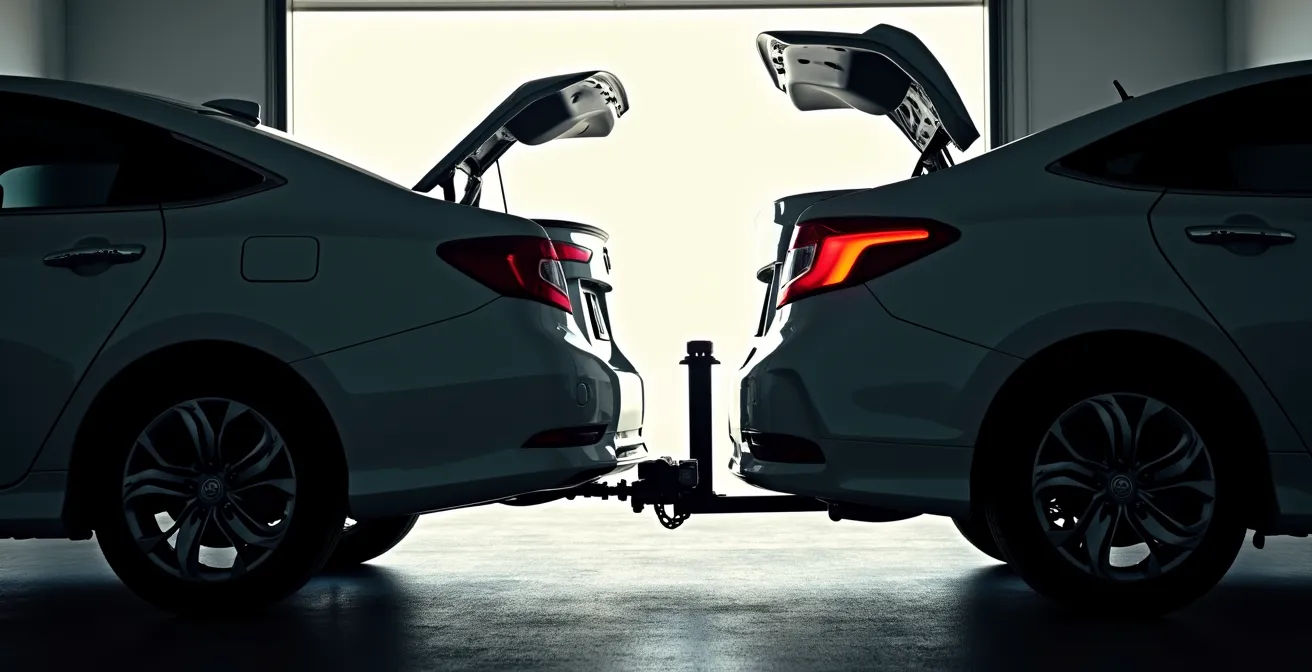
The choice between them is a trade-off between exterior and interior vehicle space, security, and cost. The following table breaks down the key differences to help you visualize how each system impacts your vehicle’s footprint and usability.
| Feature | Hitch Lift | Trunk Hoist |
|---|---|---|
| Vehicle Length Impact | Extends vehicle by 18-24 inches | No length extension |
| Weather Exposure | Device exposed to elements | Protected inside trunk |
| Weight Capacity | Up to 400 lbs typically | Up to 200 lbs typically |
| Installation Cost | $1,500-$3,000 | $2,000-$4,000 |
| Parking Requirements | Need extra clearance behind vehicle | Standard parking space sufficient |
| Transfer to New Vehicle | Easier if vehicle has hitch receiver | Requires professional reinstallation |
Solid vs. Pneumatic Tires: Which Is Best to Avoid Flats on Rough Sidewalks?
The interaction between your device and the ground beneath it is a critical aspect of mobility. The choice of tire—solid, pneumatic (air-filled), or foam-filled—directly impacts ride comfort, maintenance, and traction. For indoor use in a small apartment, this might seem secondary, but if your device will also be used for trips to the mailbox or navigating paved community paths, it becomes paramount. Solid tires offer the ultimate peace of mind: they are completely flat-proof. However, this reliability comes at the cost of comfort. They transfer every bump and vibration directly to the frame and, consequently, to you. This can be especially taxing for users with chronic pain or spasticity.
Pneumatic tires, on the other hand, act as the primary shock absorbers for your device. They provide a much smoother, more comfortable ride and offer better traction on a variety of surfaces, including potentially slippery indoor flooring. Their drawback is their susceptibility to punctures and the need for regular air pressure checks. Foam-filled tires offer a compromise, providing the flat-proof nature of solid tires with better shock absorption, though not to the same level as pneumatic tires.
The decision depends on a careful evaluation of your primary terrain and your personal physical needs. Someone living in an apartment with smooth floors and only occasional outdoor use on perfect sidewalks may find the comfort of pneumatic tires outweighs the minimal flat risk. A user who frequently traverses cracked sidewalks or debris-laden paths may prioritize the reliability of solid or foam-filled options.
| Aspect | Solid Tires | Pneumatic Tires | Foam-Filled |
|---|---|---|---|
| Flat Risk | Zero | High on rough terrain | Zero |
| Vibration Absorption | Poor – high frequency vibrations | Excellent cushioning | Good compromise |
| Indoor Traction (Smooth Floors) | Can be slippery on wet surfaces | Better grip | Good grip |
| Maintenance Required | Minimal – replace when worn | Regular pressure checks, puncture repairs | Minimal |
| Impact on Chronic Pain | May worsen due to vibrations | Better for pain management | Moderate comfort |
| Professional Service Cost | High – full tire replacement | Low – patch kits available | Moderate |
AGM vs. Gel Batteries: Which Power Source Lasts Longer in Cold Climates?
While maneuverability is a function of a device’s physical design, its usability is a function of its power source. For seniors living in colder climates, the battery’s performance during winter months is a critical consideration. The two most common types of sealed lead-acid batteries used in mobility devices are Absorbent Glass Mat (AGM) and Gel. Both are spill-proof and maintenance-free, but they react differently to temperature and charging cycles. A common misconception is that one type is vastly superior in the cold. However, cold chamber tests demonstrate that both AGM and Gel batteries experience a dramatic roll-off in their available capacity as temperatures drop below freezing, with both showing similar levels of performance degradation.
The real difference lies in their internal construction and charging requirements. Gel batteries have a reputation for being slightly more resistant to extreme temperatures and deep discharging, which can extend their overall lifespan. However, they are highly sensitive to their charging profile and can be permanently damaged by an incorrect charger. AGM batteries are more robust in their charging tolerance and can be charged up to 20% faster than their Gel counterparts, which can be a significant convenience. They also tend to perform better when delivering high currents, which can be a factor in devices with powerful motors.
For a user in a cold climate, the best practice is not necessarily choosing one type over the other but implementing a proper maintenance routine. Storing and, more importantly, charging the device indoors is the single most effective way to preserve battery health and ensure you get the maximum range on a cold day. A battery charged at a warm room temperature will deliver significantly more power than one that has been left to charge in a cold garage overnight.
The “Too Soon” Mistake: Why Switching to Electric Can Weaken Your Legs Faster?
One of the most sensitive but important topics to discuss is the timing of a switch to a powered mobility device. There’s a real concern among both users and physical therapists about the “too soon” mistake—becoming reliant on a power chair or scooter before it’s strictly necessary, which can accelerate muscle atrophy and lead to a faster decline in ambulatory ability. This is not an argument against powered mobility, which is a life-changing tool for independence. Instead, it’s a call for a more strategic, “hybrid mobility” approach.
Rather than viewing the choice as a binary switch from walking to sitting, consider the power device as a strategic tool to conserve energy for specific tasks. The goal is to eliminate the most fatiguing or dangerous parts of your day while still actively using your own muscles where it is safe and beneficial to do so. This approach preserves leg strength and cardiovascular health for longer.

For example, a user might employ a power chair to navigate the long hallway from the bedroom to the living area, a trip that was previously exhausting. But once in the kitchen, they might switch to a walker to move between the counter, sink, and refrigerator, continuing to bear weight and engage their leg muscles in a controlled, safe environment.
Hybrid Mobility Approach for Muscle Preservation
Power wheelchairs, which are able to maneuver better when indoors, especially through hallways and doorways, are suitable for strategic use in challenging spaces while preserving walking for safer, shorter distances. Users successfully maintain leg strength by designating specific ‘device-free zones’ in their homes, such as the kitchen or bedroom, where they continue to use walker support for short distances. This combines powered mobility for longer trips with preserved ambulation capacity in controlled environments.
Scooters in Rome: How to Arrange Mobility Rentals Before You Arrive?
While this guide focuses on in-home mobility, the principles of spatial analysis extend to travel. Arranging a mobility rental in a foreign city like Rome requires proactive planning, as the environment presents unique challenges. The city’s famous cobblestone streets, steep hills, and ancient layouts are not always friendly to mobility devices. A scooter that works perfectly on smooth American sidewalks may be uncomfortable or even unusable in the heart of Rome. When contacting rental companies, your questions should be highly specific to this unique terrain. Ask about ground clearance, battery range on hills, and tire type.
Pneumatic or foam-filled tires are practically essential to absorb the constant vibration from cobblestones. Before you even leave, use tools like Google Street View to scout the routes between your hotel and the attractions you want to visit. Look for curb cuts, identify potential stair obstacles, and get a feel for the condition of the sidewalks. It’s also wise to inquire directly with major attractions like the Vatican Museums and the Colosseum; many offer on-site rentals of devices that are specifically suited to their grounds, which may be a better option than a city-wide rental.
Here is a pre-travel checklist to ensure your mobility rental in Rome goes smoothly:
- Contact rental companies with Rome-specific questions: ground clearance for cobblestones, pneumatic tire availability.
- Use Google Street View to scout routes and identify obstacles like stairs and curbs.
- Inquire about on-site rentals at major attractions like the Colosseum and Vatican Museums.
- Confirm the inclusion of a European power adapter and verify voltage compatibility.
- Pre-arrange with your hotel for accessible overnight storage and a charging location.
- Ask about specific battery range for navigating Rome’s hills, such as the Palatine.
- Request options for a backup battery or mid-day charging for full-day excursions.
Key takeaways
- Assess maneuverability by analyzing your home’s “navigational pinch points” and device approach angles, not just the manufacturer’s turning radius.
- Consider the entire lifecycle of the device, including how you will transport it (trunk vs. lift) and how its power source (battery type) will perform in your climate.
- Adopt a “hybrid” mobility strategy, using a device to conquer fatiguing distances while preserving walking in safe, controlled zones to maintain muscle strength.
Medicare Part B: What Specific Criteria Must You Meet to Get a Power Chair Covered?
The final dimension of your decision is the financial one. For many seniors, the ability to acquire a device hinges on insurance coverage, primarily Medicare Part B. It’s crucial to understand that Medicare has extremely specific and strict criteria for covering a power wheelchair (PWC). Critically, Medicare does not pay for a PWC to enhance mobility *outside* the home. The entire justification must be based on the need for mobility *within* your home to accomplish Mobility-Related Activities of Daily Living (MRADLs), such as getting to the kitchen, bathroom, and bedroom. You must be unable to do this with a cane or walker.
The process is rigorous. It begins with a face-to-face examination with your doctor, who must document your mobility limitations in detail. As the Centers for Medicare & Medicaid Services state, the standard is clear:
The patient’s condition is such that without the use of a wheelchair, the patient would not be able to perform Mobility-Related Activities of Daily Living within the home
– Centers for Medicare & Medicaid Services, Power Wheelchair Coverage Overview
If you meet the criteria and your deductible, Medicare Part B covers 80% of the approved amount for the device. You are responsible for the remaining 20% coinsurance, which can be covered by a supplemental policy. It is also important to note that mobility scooters are typically covered under different, often more restrictive, criteria and are generally considered for outdoor use, making them harder to qualify for based on in-home needs. To successfully navigate this process, follow a precise set of steps.
Your action plan: Medicare Power Chair Qualification Checklist
- Schedule face-to-face examination with your Medicare-enrolled physician.
- Document inability to perform Mobility-Related Activities of Daily Living (MRADLs) even with a cane or walker.
- Demonstrate that power chair is needed specifically for in-home mobility, not just outdoor use.
- Obtain a written Certificate of Medical Necessity within 45 days of the examination.
- Ensure your Durable Medical Equipment (DME) supplier conducts a home assessment to verify the wheelchair can be used in your living space.
Armed with this detailed, spatial-focused analysis of your home, your vehicle, and your lifestyle, you are now equipped to move beyond the simple “power chair vs. scooter” debate. You can confidently engage with a mobility dealer, ask the right questions, and select the device that doesn’t just fit a specification sheet, but truly fits your life.
Frequently asked questions on Power Chair or Scooter: Which Is Better for Indoor Maneuverability in Small Apartments?
What type of tires work best on Rome’s cobblestone streets?
Pneumatic or foam-filled tires are essential for Rome’s uneven surfaces. Solid tires create excessive vibration on cobblestones, potentially causing discomfort and device damage.
Can I access major Rome attractions with a rental scooter?
Most major sites like the Colosseum, Vatican Museums, and Roman Forum have accessible entrances, but require advance booking for accessible tours and may have specific entry points.
What’s the typical rental cost for a week in Rome?
Weekly mobility scooter rentals in Rome range from €150-350 depending on model, with delivery to hotel typically adding €30-50.