
The $2,000 you “save” on over-the-counter (OTC) hearing aids could be the most expensive gamble you ever take with your long-term brain health and personal safety.
- OTC devices bypass professional fitting, which is crucial for overcoming the initial adaptation period and preventing a cascade of non-use, social withdrawal, and auditory deprivation.
- Poorly managed hearing loss is a major modifiable risk factor for dementia, and professionally guided hearing aids have been proven to slow cognitive decline by nearly 50% over three years.
Recommendation: Reframe the choice from a simple cost comparison to a value-analysis of investing in an “ecosystem of care” that protects your cognitive function, social connections, and physical safety.
The arrival of over-the-counter (OTC) hearing aids promises accessibility and affordability, a tempting proposition for anyone facing the high cost of traditional devices. The prospect of saving thousands of dollars is undeniably attractive. Many see it as a simple consumer choice: a DIY solution versus a full-service package. However, as an audiologist, I must caution that this perspective misses the most critical part of the equation. The debate isn’t merely about cost versus service; it’s about understanding the profound, cascading risks of an improper fit versus the protective benefits of a professionally managed solution.
The common advice suggests OTC is for “mild-to-moderate” loss, but this label is dangerously simplistic. It ignores the fact that hearing is not just about volume; it’s a complex neurological process. When a device isn’t precisely programmed to your unique hearing loss profile, your brain is forced to work harder to interpret distorted or incomplete sound. This increased cognitive load is the first step in a chain reaction I call the “Fit Cascade”: initial discomfort leads to inconsistent use, which fosters social withdrawal and, most alarmingly, accelerates cognitive decline.
The true value of a prescription hearing aid isn’t just the device itself, but the entire ecosystem of care that surrounds it. This includes the initial diagnostic testing, the precise fitting and programming, crucial follow-up adjustments, and integration with safety systems. This article will deconstruct the hidden physiological, cognitive, and safety “costs” of a “good enough” approach. We will explore why the initial sound of your own voice is a critical benchmark, how untreated hearing loss starves the brain, and why managing comorbidities like arthritis or vision loss makes professional guidance indispensable. The question is not “Can I save money?” but rather, “Is the saving worth the risk to my brain health and independence?”
To help you navigate this critical decision, this guide breaks down the key differences and hidden risks, moving beyond price to focus on long-term value for your health and well-being.
Summary: A Comprehensive Guide to OTC and Prescription Hearing Aids
- Why Your Own Voice Sounds “Tinny” and How Long Until It Sounds Normal?
- Wax Guards and Dehumidifiers: The Weekly Routine That Doubles Your Aid’s Lifespan
- The Brain Drain: Why Untreated Hearing Loss Triples Your Risk of Cognitive Decline?
- Why Social Disengagement Accelerates Dementia Symptoms by 50% in 3 Years?
- Restaurant Mode: How to Use Your App to Filter Out Clattering Dishes?
- Rechargeable vs. Disposable Batteries: Which Is Better for Arthritic Fingers?
- Magnifying Glass vs. Digital Zoom: Which Reading Aid Is Better for Macular Degeneration?
- Why You Need Connected Smoke Detectors If You Have Hearing Loss?
Why Your Own Voice Sounds “Tinny” and How Long Until It Sounds Normal?
One of the first and most disorienting experiences for a new hearing aid user is the sound of their own voice. It can sound unnaturally loud, hollow, or “tinny.” This is known as the occlusion effect, caused by the physical presence of the hearing aid in the ear canal blocking sound that normally escapes. For an unguided OTC user, this single issue is often the primary reason for abandoning the device, believing it’s defective. This is the first critical failure point in the “Fit Cascade.” An audiologist anticipates this and manages it through both technology and counseling.
Professionally fitted devices often use an “open-fit” design with a perforated dome that allows sound to vent naturally. In fact, research shows that open-fit hearing aids can reduce the occlusion effect by up to 25 dB SPL. Beyond the hardware, an audiologist provides crucial coaching. They explain that this sensation is temporary and that the brain needs time to adapt—a process called neuroplasticity. A study from Vanderbilt University highlighted that for most people, the occlusion effect subsides within one to two weeks of consistent daily use. This guided adaptation period is what turns an initial challenge into a long-term success, a stark contrast to the frustrating and isolating DIY experience of figuring it out alone.
Ultimately, a prescription ensures the fit is optimized to minimize this effect from day one, and the user is supported through the brain’s adaptation phase. This support is fundamental to achieving long-term satisfaction and preventing the device from ending up in a drawer. The data is clear: the same study found that 78 percent of people who used hearing aids were satisfied, more than double the rate of those with hearing loss who did not use aids.
Wax Guards and Dehumidifiers: The Weekly Routine That Doubles Your Aid’s Lifespan
A hearing aid is not a “set it and forget it” piece of consumer electronics; it is a sophisticated medical device operating in a warm, moist, and waxy environment. Proper, consistent maintenance is not optional—it is essential for the device’s performance and longevity. With OTC devices, you become the sole technician. You are responsible for diagnosing issues, performing delicate cleaning procedures, and managing repairs. For prescription devices, this maintenance is a core part of the “ecosystem of care” an audiologist provides, significantly reducing the burden on the user.
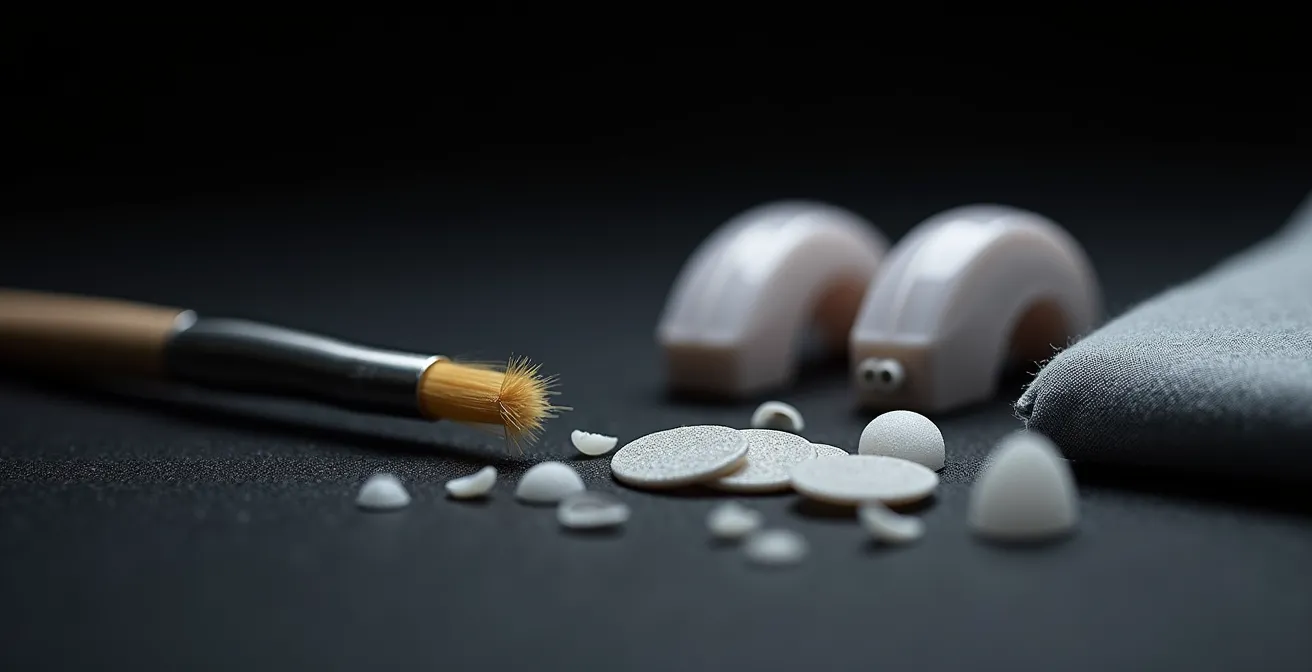
The weekly routine involves several key tasks: changing tiny wax guards (filters just a few millimeters wide), brushing away debris from microphone ports, and using a dehumidifier to remove moisture that can corrode internal electronics. Failing to do so can lead to a dead or underperforming device, leaving you once again in silence. While OTC companies provide online guides, this pales in comparison to the in-person support offered with a prescription. An audiologist or technician can clean and service your device, troubleshoot problems on the spot, and often provide a loaner device if yours needs to be sent for repair, ensuring you are never without the ability to hear.
The following table illustrates the stark difference in the support structure between the two models. This isn’t just about convenience; it’s about ensuring the multi-thousand-dollar investment you’ve made continues to function correctly, safeguarding your connection to the world.
| Maintenance Aspect | OTC Hearing Aids | Prescription Hearing Aids |
|---|---|---|
| Professional Cleaning | Not included – DIY only | Included in service package |
| Troubleshooting Support | Online guides/phone support | In-person immediate assistance |
| Warranty Service | Ship for repairs (2-3 weeks) | Walk-in loaner devices available |
| Follow-up Care | User responsible | Scheduled maintenance included |
The Brain Drain: Why Untreated Hearing Loss Triples Your Risk of Cognitive Decline?
The most significant “hidden cost” of choosing a poorly fitted or under-supported hearing aid has nothing to do with money. It concerns the health of your brain. For decades, we viewed hearing loss as a simple inconvenience of aging. We now know it is a critical health issue directly linked to cognitive decline and dementia. When you can’t hear properly, certain parts of your brain responsible for processing sound become understimulated. This phenomenon, known as auditory deprivation, causes those neural pathways to weaken and atrophy. Furthermore, the constant strain of trying to decode incomplete sound signals diverts cognitive resources from other important functions like memory and executive function.
The scientific evidence is overwhelming and deeply concerning. Groundbreaking research from Johns Hopkins found that the prevalence of dementia among participants with moderate/severe hearing loss was 61% higher than those with normal hearing. Even mild hearing loss doubles the risk. This isn’t a minor correlation; it is one of the most significant modifiable risk factors for dementia identified to date. Choosing an OTC device that you can’t tolerate or that doesn’t adequately correct your specific hearing profile is functionally equivalent to leaving your hearing loss untreated, exposing you to this elevated risk.
There’s still much we don’t fully understand, but we know hearing loss appears to be a risk factor for dementia. The exciting part is that hearing is something we can address, making it a potentially modifiable risk factor.
– Dr. Carrie Nieman, Johns Hopkins Cochlear Center for Hearing and Public Health
This is why the choice is so critical. A prescription hearing aid, professionally fitted and adjusted, is not just an amplifier; it is a therapeutic tool designed to properly restimulate the brain and reduce cognitive load. It is a direct investment in your long-term cognitive resilience.
Why Social Disengagement Accelerates Dementia Symptoms by 50% in 3 Years?
The pathway from hearing loss to cognitive decline often runs through a devastating intermediary: social isolation. When you can’t follow conversations in a noisy restaurant, hear your grandchildren clearly, or participate in group activities, the natural tendency is to withdraw. This disengagement starves the brain of the complex, stimulating input it needs to stay healthy. Social interaction is a powerful form of cognitive exercise, forcing the brain to process language, interpret social cues, and engage memory. Removing that stimulation has a direct and measurable negative impact.
The good news is that this is a reversible cycle. Treating hearing loss effectively can break the chain of isolation and significantly protect cognitive function. The landmark Aging and Cognitive Health Evaluation in Elders (ACHIEVE) study provided the strongest evidence to date. As the research team noted:
In older adults at increased risk for cognitive decline, treating hearing loss with hearing aids slowed down loss of thinking and memory abilities by 48% over 3 years
– ACHIEVE Study Research Team, Aging and Cognitive Health Evaluation in Elders Study
Slowing cognitive decline by nearly 50 percent is a monumental finding. It elevates hearing aids from a quality-of-life accessory to a frontline tool in the fight against dementia. Furthermore, the 2024 Lancet Commission on dementia prevention reaffirmed this, calculating that treating hearing loss could prevent up to 7% of dementia cases globally. This is why a “good enough” solution from an OTC device is such a gamble. If it doesn’t enable you to confidently re-engage in social settings, it fails at its most important job: protecting your brain.
Restaurant Mode: How to Use Your App to Filter Out Clattering Dishes?
One of the most common complaints from individuals with hearing loss is the inability to function in noisy environments, like a bustling restaurant. This is where the technological and programming differences between many entry-level OTC aids and prescription devices become most apparent. While an OTC device might simply amplify all sounds equally—making the clatter of dishes as loud as your companion’s voice—a professionally programmed prescription aid uses sophisticated technology to improve speech clarity.

Modern prescription hearing aids feature directional microphones and advanced noise reduction algorithms. In a “Restaurant Mode,” often selectable via a smartphone app or a button on the device, the hearing aids can be programmed to focus on sounds coming from in front of you (your dining partner) while actively suppressing background noise from the sides and rear. This isn’t a simple volume adjustment; it’s a dynamic reshaping of your auditory environment. An audiologist customizes these settings based on your specific needs and lifestyle, ensuring the feature works effectively for you. Some high-end OTC models from major brands offer similar technology, but without professional tuning, the user is left to navigate complex app settings to find a tolerable balance, a task that can be overwhelming and often fruitless.
The ability to hear well in background noise is not a luxury; it is the key to maintaining social connections. It’s the difference between enjoying a family dinner and sitting in frustrating silence, which, as we’ve seen, has profound consequences for brain health. A prescription model, tailored by an expert, provides a reliable tool to stay connected in the real world.
Rechargeable vs. Disposable Batteries: Which Is Better for Arthritic Fingers?
The decision between rechargeable and disposable batteries seems like a simple matter of convenience, but for a senior with dexterity issues like arthritis, it becomes a critical accessibility challenge. This is a perfect example of how an audiologist’s holistic approach provides value that an OTC transaction cannot. An audiologist doesn’t just see a hearing loss; they see a whole person, with all the related health and physical challenges they may face.
Manipulating tiny, coin-sized disposable batteries can be difficult or impossible for someone with arthritic fingers. In this case, a rechargeable model with a simple drop-in charging cradle is clearly the superior choice. However, not all charging stations are created equal. Some require precise alignment, while others use magnets to guide the aid into place. While some premium OTC models boast impressive features like a 90-minute full charge capability, the physical design of the charger might still be a barrier. An audiologist allows the patient to physically handle different models and chargers in the office to find one that truly works for their specific physical limitations.
Furthermore, the discussion extends to the battery doors on the devices themselves, which can be difficult to open. Prescription aids often offer a wider range of models with user-friendly designs specifically intended for those with limited dexterity. This level of personalized assessment is absent in the OTC model, where a user might purchase an expensive device online only to find they are physically unable to maintain it.
Action Plan: Choosing a Battery System with Dexterity in Mind
- Assess charging station design: Look for and physically test models with magnetic alignment or simple drop-in cradles that don’t require precise placement.
- Evaluate real-world battery life: Consider not just the advertised hours, but whether a portable charging case is available for all-day confidence away from home.
- Test battery door mechanisms: If considering disposable batteries, handle the device and try opening and closing the battery door several times.
- Factor in cognitive load: Acknowledge the mental effort of tracking disposable battery inventory versus the simple nightly routine of a rechargeable system.
- Discuss backup options: Ask an audiologist about emergency backup options, such as using disposable batteries in a normally rechargeable aid if the power goes out.
Key Takeaways
- The choice between OTC and prescription hearing aids is a long-term health decision, not a simple consumer purchase. The real cost is measured in cognitive risk, not dollars.
- A poor fit or lack of professional support can lead to a “Fit Cascade” of non-use, social isolation, and accelerated cognitive decline.
- Professionally managed hearing aids are a proven, modifiable intervention that can slow cognitive decline by nearly 50% by keeping the brain stimulated and socially engaged.
Magnifying Glass vs. Digital Zoom: Which Reading Aid Is Better for Macular Degeneration?
Hearing loss rarely exists in a vacuum. For many seniors, it is a comorbidity, co-existing with other age-related conditions like macular degeneration, arthritis, or diabetes. This is where the one-size-fits-all, app-driven approach of most OTC hearing aids can fail dramatically. A person struggling with vision loss from macular degeneration may find a smartphone app with small icons and text-based controls completely inaccessible, rendering their new hearing aid unusable.
An audiologist’s role is to integrate the hearing solution into the patient’s entire life, including their other assistive technology needs. For a patient with both hearing and vision loss, a prescription hearing aid with tactile physical buttons, a simple remote control with large buttons, or even automatic program-switching is far superior to an app-only interface. The setup and all subsequent adjustments are handled by the professional, removing the technological barrier for the user. As experts at Soundly note, while top OTC brands offer technology nearly identical to prescription versions, the key differentiator is that prescription models provide a broader range of customization options, especially for more complex needs, and crucial ongoing, in-person support.
The interface of the device is as important as its sound-processing capabilities. The following table highlights the critical accessibility differences for a user with compromised vision, a factor that is almost entirely overlooked in the OTC purchasing process.
| Feature | OTC Hearing Aids | Prescription Hearing Aids |
|---|---|---|
| Control Method | Primarily smartphone app-based | Physical buttons or remote control options |
| Setup Process | Self-guided via app interface | Professional handles all programming |
| Adjustment Interface | Visual touchscreen required | Audiologist-managed or tactile controls |
| Accessibility Features | Limited to app accessibility settings | Custom solutions for individual limitations |
Why You Need Connected Smoke Detectors If You Have Hearing Loss?
The final, and perhaps most critical, risk of an unguided approach to hearing loss is physical safety. At home, we rely on auditory cues to alert us to danger: a smoke alarm, a carbon monoxide detector, a doorbell, or even the sound of a window breaking. For someone with significant hearing loss, especially who removes their aids at night, these life-saving alerts can go completely unheard. The OTC purchasing process entirely bypasses a comprehensive lifestyle and safety needs assessment, leaving users dangerously unaware of these vulnerabilities.
A core part of an audiologist’s consultation is discussing home safety. They can recommend and help integrate specialized alert systems that work alongside hearing aids. Many prescription hearing aids can pair directly with smart home safety equipment. These systems don’t just produce a loud noise; they can transmit a wireless signal directly to the hearing aids or to a separate device, like a bed-shaker or a flashing light alert. This creates a redundant, multi-sensory alert system that ensures the user is notified of danger, whether they are awake or asleep, wearing their aids or not. This is a level of integrated safety that entry-level OTC models simply do not offer.
This safety gap is not a small matter. According to a recent AARP report, almost half of U.S. adults are unaware that untreated hearing loss increases risks for safety hazards in the home, alongside social isolation and cognitive decline. Choosing a hearing solution is not just about hearing conversations better; it’s about ensuring you remain safe and independent in your own home. This non-negotiable aspect of care is a fundamental part of the value provided by a professional audiologist.
The decision between OTC and prescription hearing aids extends far beyond the price tag. It is a fundamental choice about how you wish to invest in your long-term health, cognitive function, and safety. While OTC devices can be a starting point for some with very mild loss and no complicating factors, they place the entire burden of fitting, maintenance, and risk assessment on the user. For a budget-conscious senior, the initial saving of $2,000 can seem like a victory, but it is a victory that may be paid for with the far greater costs of social isolation, accelerated cognitive decline, and compromised safety. A professionally guided, prescription solution represents an investment in an ecosystem of care designed to protect your most valuable asset: your connection to the world and the health of your brain.
Frequently Asked Questions About OTC vs. Prescription Hearing Aids
Do OTC hearing aids include safety assessments for home alert systems?
No, OTC purchases bypass the comprehensive lifestyle and safety needs assessment that audiologists perform. This can leave users unaware of necessary safety accommodations like connected smoke detectors or specialized alert systems that work with hearing loss.
What percentage of adults are unaware of the broader risks of untreated hearing loss?
According to a 2024 AARP report, almost half of U.S. adults are unaware that untreated hearing loss increases risks for social isolation, cognitive decline, and significant safety hazards in the home.
Can prescription hearing aids directly connect to home safety systems?
Yes, many prescription hearing aids are specifically designed to pair directly with telecoil systems, specialized visual or vibrating alert devices, and smart home safety equipment. This integrated safety feature is often lacking in entry-level OTC models.