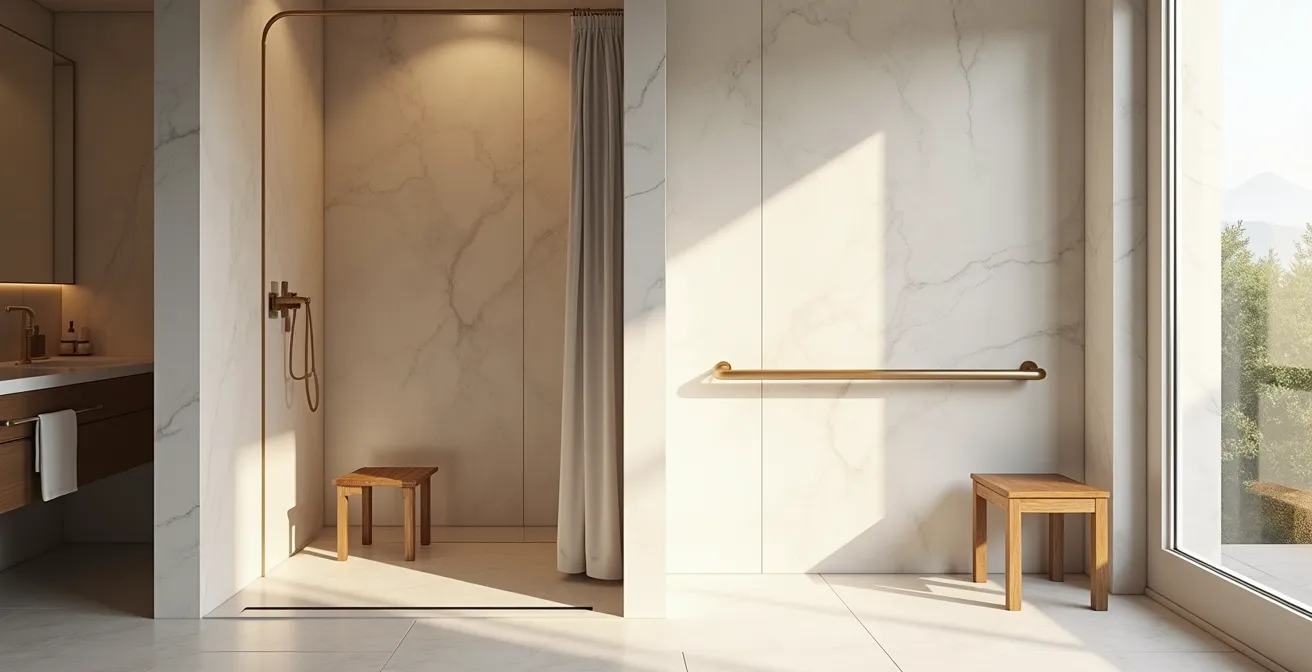
The choice between a linear and center drain is not about aesthetics; it is the core engineering decision that defines your shower’s entire hydro-dynamic integrity.
- A linear drain permits a simple, single-plane slope, which is structurally sounder and allows for large-format tiles.
- A center drain demands a complex, four-way pitch toward the middle, creating a funnel that complicates tiling and introduces more potential failure points.
Recommendation: Prioritize the waterproofing system (like a sheet membrane compatible with linear drains) over the visible tile. A leak in the underlying system necessitates a complete and costly teardown.
The vision of a zero-entry, curbless shower is one of seamless elegance and accessibility. It promises an open, spa-like experience, free from the visual and physical barrier of a curb. Yet, for many homeowners, this dream quickly collides with a wall of confusing plumbing requirements. The discussion often gravitates toward surface-level choices: tile size, glass thickness, or fixture finishes. This is a critical misstep.
The most fundamental decision, the one that dictates the long-term success or failure of a barrier-free shower, lies beneath the surface. It is the choice of the drain. While often presented as a simple aesthetic battle between a modern linear drain and a traditional center drain, the reality is a matter of pure hydro-dynamics. This choice dictates the structural slope of the floor, the type of waterproofing system required, and the overall safety and water-containment capabilities of the entire enclosure.
Viewing the shower not as a decorated room but as a complete water-containment envelope is the only way to ensure a leak-proof and safe result. The drain is the heart of this system. Misunderstand its function, and you risk chronic water escape, structural damage, and a constant state of anxiety.
This guide will deconstruct the critical components of a barrier-free shower from a plumbing specialist’s perspective. We will move beyond aesthetics to analyze the physics of water management, ensuring your investment results in a truly functional and safe bathing experience.
Summary: Designing the Ultimate Barrier-Free Bathing Experience
- Built-In Bench or Teak Stool: Which Is More Flexible for Caregiver Assistance?
- Glass Door vs. Weighted Curtain: Which Allows Easier Access for emergency personnel?
- Where to Place the Valve So You Can Turn Water On Without Getting Wet?
- How to Prevent Water from Flooding the Bathroom Floor in an Open Shower?
- Slide Bar vs. Fixed Head: Why You Need Both for Seated Bathing?
- Schluter vs. Hot Mop: Why the Waterproofing System Matters More Than the Tile?
- The “Roll-In Shower” Request: Why You Must Call the Hotel Directly?
- Cork, Vinyl, or Rubber: Which Flooring Material Is Best for Reducing Impact if You Fall?
Built-In Bench or Teak Stool: Which Is More Flexible for Caregiver Assistance?
The choice between a permanent, built-in bench and a freestanding teak stool is a decision between integration and adaptability. A built-in bench, typically tiled to match the shower walls, offers immense stability. It becomes a structural element of the shower, capable of supporting significant weight without any risk of shifting. For users who can transfer independently, this provides a profound sense of security. However, this permanence is also its primary drawback for caregiver assistance. A fixed bench dictates the user’s position and can severely limit a caregiver’s ability to access the user from all sides for washing and assistance.
A high-quality teak or medical-grade stool, conversely, offers superior flexibility. It can be positioned precisely where needed for a specific task—or removed entirely to create maximum space for a roll-in commode or a standing transfer. This adaptability is invaluable for caregivers, allowing them to adjust their posture and approach to minimize physical strain and provide more thorough care. The stool can be moved to facilitate cleaning of both the user and the shower itself. While it may not feel as monolithically stable as a built-in bench, modern designs with rubberized, non-slip feet offer excellent security on a properly sloped, non-slip tile surface.
For scenarios involving progressive mobility loss or the need for high-level caregiver support, the flexibility of a freestanding stool is almost always the superior hydro-dynamic and ergonomic choice. It allows the space to adapt to changing needs, which a permanent fixture cannot do. The key is to ensure the floor provides a stable, non-slip foundation for any seating option.
Action Plan: Auditing Your Shower for Caregiver Safety
- Points of contact: Securely anchor grab bars to wall studs, verifying they can support over 250 pounds of dynamic weight.
- Seating position: Place seating at an optimal height for transfers and ensure there is adequate clear floor space around it for caregiver movement.
- Surface integrity: Choose non-slip surfaces with a high dynamic coefficient of friction (DCOF) suitable for wet, soapy conditions.
- Line of sight: Maintain clear, unobstructed sight lines between the shower area and the main bathroom for easy monitoring.
- Access and egress: Ensure the shower entry is wide enough and the layout allows a caregiver to assist without being trapped or contorted.
Glass Door vs. Weighted Curtain: Which Allows Easier Access for emergency personnel?
While a frameless glass door provides a sleek, modern aesthetic and excellent water containment, it presents a significant physical barrier in an emergency. In the event of a fall or medical event inside the shower, a glass door—especially one that swings inward—can be blocked by the user’s body. Even an outward-swinging door requires a specific clearance path that may not be available in a moment of crisis. Paramedics and emergency responders need immediate, unimpeded access to the patient. Forcing a glass door can result in dangerous shattering and critical delays in care.
This risk is not theoretical. Data from the CDC reveals that an estimated 234,094 nonfatal bathroom injuries among persons aged ≥15 years are treated in U.S. emergency departments annually. A significant portion of these incidents are falls, where every second of response time matters.
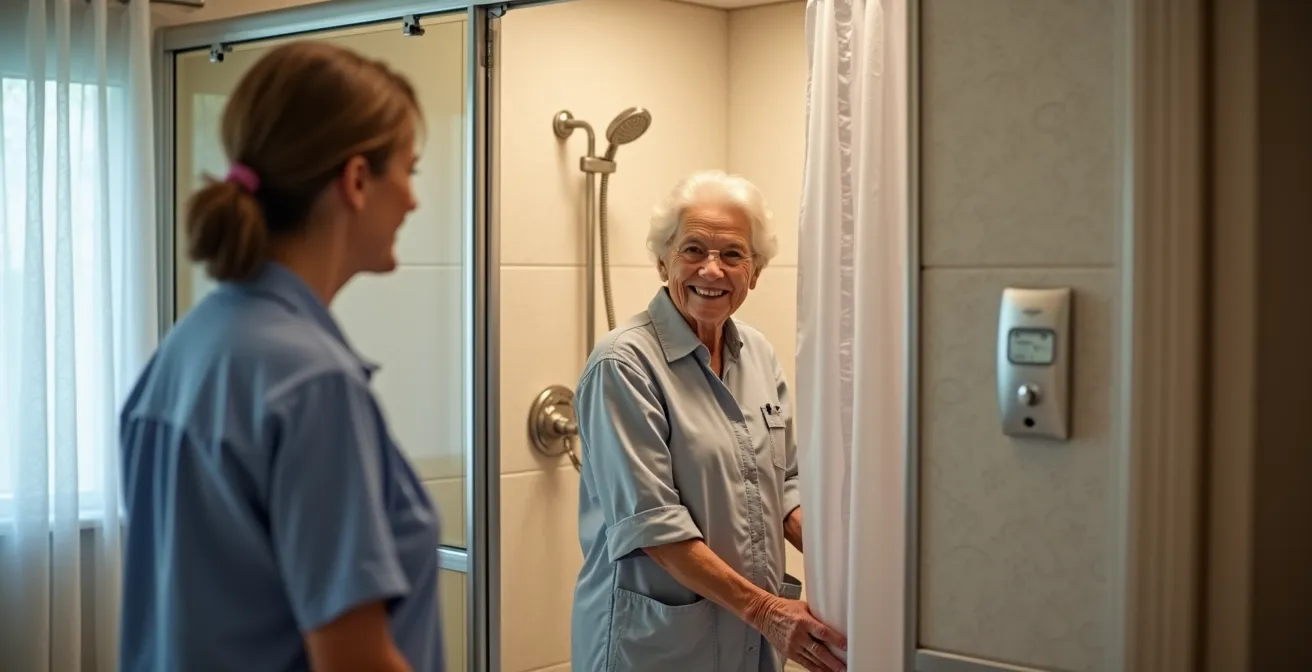
From a purely functional and safety-oriented perspective, a weighted shower curtain is the superior choice for emergency access. A curtain can be instantly swept aside or even torn down, creating a full-width opening with zero obstruction. This allows multiple responders to access the user simultaneously from various angles. Modern weighted curtains, combined with a low-profile, flexible water dam at the threshold, offer surprisingly effective water containment while prioritizing the non-negotiable need for immediate access. For any household with seniors or individuals with mobility challenges, the choice should be clear: the potential for a blocked access path makes a glass door an unacceptable risk.
Where to Place the Valve So You Can Turn Water On Without Getting Wet?
One of the most common design flaws in any shower, and particularly aggravating in a curbless one, is placing the control valve directly under the showerhead. This forces the user to either endure an initial blast of cold water or perform an awkward reach-in maneuver. In a barrier-free shower designed for safety and convenience, this is unacceptable. The primary control valve should be located near the entrance of the shower, on the wall opposite the showerhead if possible, or at the very least, just inside the entry and offset from the spray.
This placement allows the user or a caregiver to turn on the water, set the desired temperature, and let it warm up before ever stepping into the water stream. This simple ergonomic consideration dramatically improves comfort and safety, preventing the startling effect of cold water that could lead to a slip or fall. The height of the valve is equally critical and must be determined by the primary user’s needs—whether they will be standing, seated on a bench, or operating it from a wheelchair.
A thermostatic or pressure-balance valve is a non-negotiable safety feature in this context. It automatically adjusts for pressure fluctuations (e.g., a flushing toilet) to prevent sudden, scalding bursts of hot water. Placing this life-saving control in an accessible, dry location is a hallmark of a thoughtfully designed, user-centric accessible shower.
This table outlines the optimal placement heights for the main control valve based on different user scenarios, as recommended by accessibility design principles. This data, sourced from an analysis of barrier-free shower design, provides a clear technical guide.
| User Position | Recommended Height | Distance from Entry | Key Considerations |
|---|---|---|---|
| Standing Adult | 48-52 inches | 6-12 inches | Standard ergonomic reach |
| Seated on Bench | 38-42 inches | Within 18 inches | Accessible from transfer position |
| Wheelchair User | 38-48 inches | Side wall preferred | Parallel approach possible |
| Caregiver Access | 42-48 inches | Outside splash zone | Opposite wall from shower head |
How to Prevent Water from Flooding the Bathroom Floor in an Open Shower?
The single greatest fear in designing a curbless shower is water escape. Preventing a bathroom flood is not about a single component, but about the flawless execution of a complete hydro-dynamic system. The foundation of this system is the slope. The floor of the entire shower area must act as a shallow funnel, directing every drop of water toward the drain. According to the Ceramic Tile Foundation, plumbing codes mandate a minimum slope of 1/4 inch per vertical foot to ensure effective drainage and prevent pooling.
This is where the linear vs. center drain decision becomes paramount. A center drain requires a complex, multi-directional pitch; the floor must slope down toward the center from all four sides. This is difficult to execute perfectly and forces the use of small tiles to conform to the compound curves. A linear drain, especially when placed against a wall, allows for a simple, uniform, single-plane slope across the entire shower floor. This is far easier to construct accurately, ensures more predictable water flow, and allows for the use of large, elegant, and easier-to-clean tiles.
Beyond the slope, the water containment envelope is the next critical layer. This refers to the waterproofing membrane that lies beneath the tile. This membrane must be installed flawlessly, extending up the walls at least 6-12 inches to create a “tub within a tub.” A case study on ADA-compliant installations highlights that systems with top-mounted clamping drains and single-piece construction significantly reduce the potential for leaks at the drain-membrane connection, which is the most common failure point. Finally, consider the drain’s flow rate capacity; it must be sufficient to handle the output of your showerhead(s) to prevent the system from being overwhelmed.
Case Study: The Noble Company FreeStyle Linear Drain System
Noble Company’s implementation of FreeStyle Linear Drains in ADA-compliant installations demonstrates that effective water containment requires extending waterproofing membranes 6-12 inches up bathroom walls. Their system’s top-mounted clamping mechanism ensures thin-bed membranes are properly secured, while the single-piece ABS/PVC drain construction reduces potential leak points. This approach successfully maintains the required 1/4 to 1/2 inch per foot slope, creating a truly barrier-free environment that meets stringent accessibility and water management standards.
Slide Bar vs. Fixed Head: Why You Need Both for Seated Bathing?
Relying on a single, fixed showerhead in a shower designed for accessibility is a fundamental design error. A fixed, high-mounted head is great for a standing user, providing a drenching, ambient spray. However, for an individual who is bathing while seated, this setup is deeply impractical. The water jet will be too high, angled incorrectly, and will spray over their head, making it difficult to wash hair and impossible to avoid getting water in their face. It forces uncomfortable and potentially unsafe leaning and reaching.
This is why a dual-system approach is the professional standard. You need both a fixed “rainfall” head and a handheld head on an adjustable slide bar. The slide bar is the key to versatility. It allows the handheld showerhead to be positioned at any height, from a low point for a seated user to a higher point for a standing user of any stature. The user or caregiver can lock the head in place on the bar for hands-free washing or detach it for targeted rinsing and cleaning. The handheld wand is indispensable for thorough and dignified personal care, especially for users with limited mobility.

This combination is managed by a diverter valve, which allows the user to run either showerhead individually or both simultaneously. For maximum utility, the system should incorporate these features:
- An adjustable slide bar with a vertical range of at least 38 to 72 inches.
- A handheld shower hose that is a minimum of 60 inches long for full reach around a seated person.
- A fixed head mounted at a standard height of 80-84 inches.
- The slide bar should be mounted within 18 inches of the shower seat for easy access.
This dual-fixture setup transforms the shower from a single-purpose station into an adaptable, multi-user environment that provides safety, comfort, and independence.
Schluter vs. Hot Mop: Why the Waterproofing System Matters More Than the Tile?
Homeowners often spend the most time selecting the tile for their new shower, focusing on color, texture, and pattern. While aesthetically important, tile and grout are not waterproof. They are merely the decorative finish. The true “life” of the shower—the component that prevents catastrophic water damage to your home’s structure—is the hidden waterproofing system beneath. As one expert from the Bathroom Remodeling Teacher resource puts it, a leak in this system requires a total teardown, making it the most critical long-term decision.
The choice of waterproofing system is directly tied to your drain selection and the goal of a curbless design. Traditional “hot mop” or PVC liner systems create a waterproof pan under a thick mortar bed. This method is old-school, labor-intensive, and notoriously difficult to integrate with a zero-entry design. The thick mortar bed creates a significant vertical buildup that works against the goal of a flush threshold. Furthermore, if a leak develops, it is nearly impossible to pinpoint its origin without demolition.
Modern sheet membrane systems, like those from Schluter-KERDI, represent a paradigm shift in hydro-dynamic integrity. These fabric-like membranes are applied directly to the substrate with thin-set mortar, creating a bonded, monolithic waterproof and vapor-proof layer. This system is specifically designed for curbless applications and linear drains. It allows for the necessary single-plane slope and makes the waterproofing layer continuous from the drain all the way up the walls, creating a completely sealed envelope. This modern approach is far more reliable and predictable than traditional methods.
This table, with data derived from an industry guide on linear drains, starkly illustrates the advantages of modern systems, especially for a barrier-free project.
| Feature | Schluter/Sheet Membrane | Hot Mop/Traditional Liner |
|---|---|---|
| Installation Complexity | Moderate – Direct tile application | High – Requires mortar bed |
| Linear Drain Compatibility | Seamless integration | Requires adaptation |
| Leak Detection | Easier pinpointing | Difficult to locate |
| Repair Process | Localized repairs possible | Often requires full teardown |
| Curbless Application | Designed for barrier-free | Challenging implementation |
| Waterproofing Height | Full wall coverage possible | Limited to pan area |
The “Roll-In Shower” Request: Why You Must Call the Hotel Directly?
For travelers with mobility needs, booking an “accessible room” online is often a leap of faith. The term “accessible” is used loosely by hotel booking sites, and the reality upon arrival can be dangerously different from the expectation. A “roll-in shower” is a specific ADA-defined term, but many hotels mislabel “transfer showers” or showers with a low lip as roll-in. This distinction is not trivial; it’s the difference between independence and being unable to bathe.
A true roll-in shower must have interior dimensions of at least 60×30 inches to allow a wheelchair to enter and maneuver. It must also have a threshold that is completely flush with the bathroom floor (no more than 1/2 inch high, beveled). A transfer shower, on the other hand, is smaller (typically 36×36 inches) and is designed for a user to transfer from their wheelchair onto a built-in bench. Attempting to use a transfer shower as a roll-in is impossible and unsafe. A 1-inch lip, which seems minor to an ambulatory person, can be an insurmountable barrier for a wheelchair user.
Therefore, you must never rely solely on a website’s description. You must call the hotel directly and speak to someone at the front desk or, ideally, in management or engineering. Ask specific, pointed questions: “Is it a roll-in or a transfer shower?”, “What is the exact height of the threshold at the shower entrance?”, “What are the interior dimensions of the shower?”, and “Is the shower bench fixed or removable, and on which side is it located?”. This diligence is not an inconvenience; it is a necessary step to ensure your safety and ability to function while traveling. Do not accept vague answers. If they cannot answer confidently, ask them to physically go and measure. Your safety depends on it.
Key Takeaways
- Drain choice dictates slope: A linear drain enables a safer, single-plane slope, while a center drain requires a complex, funnel-like pitch that complicates construction.
- Waterproofing is the core system: The hidden membrane (e.g., a bonded sheet membrane) is more critical than the visible tile, as a leak in the system requires a complete demolition.
- Safety is a system of components: Strategic valve placement, dual showerheads, and emergency-ready access are just as crucial as the floor itself for a truly accessible and functional design.
Cork, Vinyl, or Rubber: Which Flooring Material Is Best for Reducing Impact if You Fall?
In a bathroom, the floor is the largest single surface, and its properties are critical to safety. While tile is the conventional choice, its unyielding nature makes it unforgiving in a fall. For a space designed with maximal safety in mind, especially a wet environment like a curbless shower, exploring alternative flooring materials is a vital exercise. The goal is to find a material that balances slip resistance (measured by its DCOF rating), water resistance, durability under rolling loads (like wheelchairs), and, crucially, impact absorption.
Sheet vinyl offers an excellent balance. It can be installed seamlessly, eliminating grout lines that can harbor mold and present a trip hazard. It is completely waterproof, durable enough for wheelchairs, and provides good slip resistance. While it offers more cushion than tile, it is not the best for impact absorption. Cork flooring provides excellent impact absorption and a warm, soft feel underfoot. However, it is more susceptible to compression under the point loads of wheelchair casters and requires diligent sealing to remain water-resistant.
Rubber flooring stands out for its superior combination of impact absorption and slip resistance. It offers the highest DCOF ratings, making it exceptionally grippy even when wet. Its natural elasticity provides significant cushioning, which can be the difference between a bruise and a fracture in a fall. However, some softer rubber variants can create more rolling resistance for wheelchairs. For a bathroom where fall prevention and impact reduction are the absolute top priorities, a high-density, textured rubber floor is often the best, albeit less conventional, choice.
The following table, using data from an in-depth guide on accessible design, compares these materials on key safety and performance metrics.
| Material | DCOF Rating | Impact Absorption | Wheelchair Compatibility | Maintenance |
|---|---|---|---|---|
| Cork | ≥0.42-0.60 | Excellent | May compress under wheels | Requires sealing |
| Vinyl Sheet | ≥0.42-0.50 | Good | Excellent – firm surface | Seamless installation |
| Rubber | ≥0.60-0.85 | Excellent | Can impede rolling | Low maintenance |
| Textured Tile | ≥0.42-0.70 | Poor | Good – stable surface | Grout maintenance needed |
To ensure the long-term safety, accessibility, and hydro-dynamic integrity of your barrier-free shower, it is critical to evaluate these technical requirements with a qualified and certified plumbing professional before beginning construction.
Frequently Asked Questions on Zero-Entry Shower Design
What is the exact threshold height of the accessible shower?
A true zero-entry shower has no lip or threshold at all. Many rooms described as ‘accessible’ may have a 1-2 inch lip, which can be a significant barrier for wheelchairs. It is crucial to confirm that the shower floor is completely flush with the main bathroom floor.
Is it a roll-in shower or transfer shower?
These are not the same. Roll-in showers must be a minimum of 60×30 inches to allow a wheelchair to enter. Transfer showers are smaller, typically 36×36 inches, and feature a bench designed for transferring out of a wheelchair. They serve very different mobility needs.
What side is the shower bench on and is there clear floor space?
The side of the bench (left or right) determines the transfer approach and must match the user’s specific needs and abilities. Additionally, there must be a clear floor space of at least 30×48 inches adjacent to the bench to allow for proper positioning of the wheelchair.