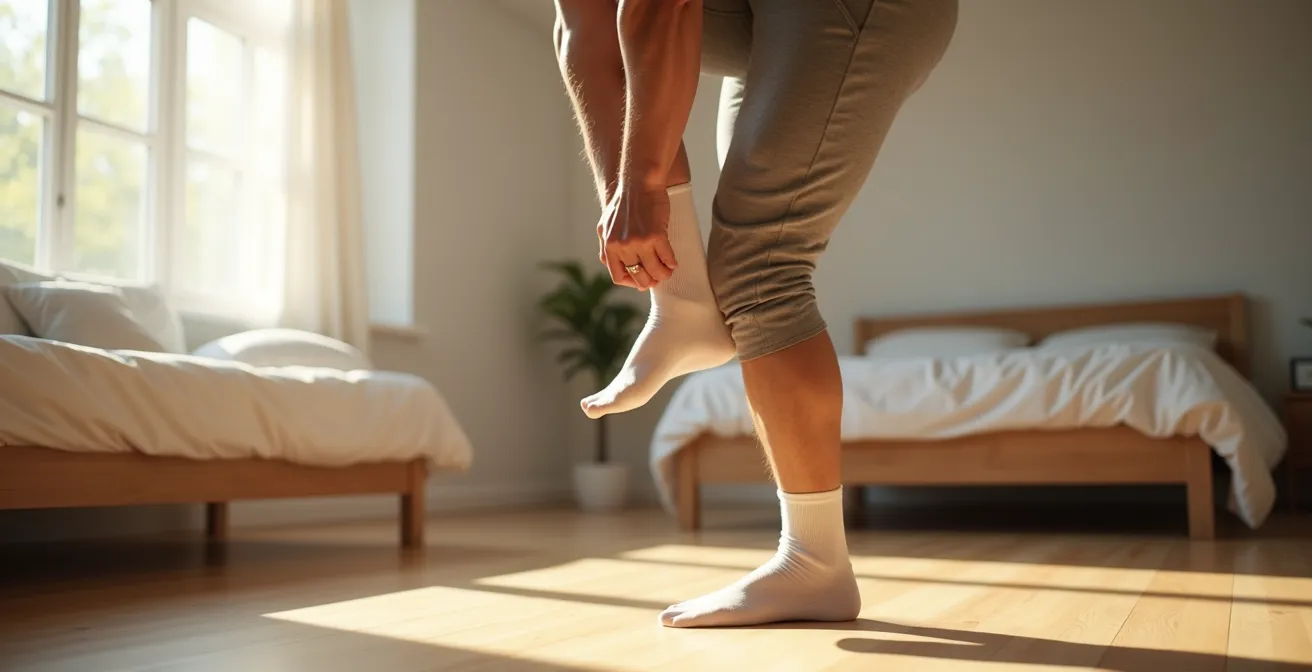
Losing the ability to put on your socks isn’t just an inconvenience; it’s a critical warning sign that your body’s foundational movement system is breaking down.
- This decline is caused by specific muscle weakness (glutes, core) and stiffness (hip flexors), not just “old age”.
- Simple, targeted exercises like sit-to-stands and balance drills can retrain this system and reverse the decline.
Recommendation: The first step is to test your baseline with the 30-second chair stand test and commit to a single, functional goal.
The quiet frustration in the morning is a familiar story. You lean forward, sock in hand, and your body just… stops. Your hip feels like a rusty hinge, your back protests, and balancing on one leg seems like a distant memory. The simple act of putting on a sock without sitting down has become a daily mountain to climb. Many resign themselves to this reality, buying long-handled sock aids and accepting it as an inevitable part of aging. We often hear advice about general stretching or “staying active,” but these tips miss the fundamental point.
The inability to perform this task is not an isolated problem. It is a key symptom, a clear signal from your body that your entire functional movement system is compromised. This system is the intricate network of muscles, nerves, and joints that allows you to perform daily tasks with ease—getting up from a low chair, stepping over a curb, or catching yourself before a fall. The stiffness you feel trying to reach your foot is directly connected to the strength you need to push yourself off the toilet and the balance required to walk across a room without shuffling.
But what if the true key isn’t just stretching your hamstrings, but reactivating the powerful muscles in your glutes and core? What if the solution lies in retraining the communication between your brain and your feet? This is not about accepting limitations; it is about understanding the specific biomechanical breakdown and addressing it with precision. This is about reclaiming your autonomy, one movement at a time.
This article provides an anatomy-based approach to rebuilding your body’s foundational strength. We will diagnose the interconnected issues—from leg power to foot-lifting mechanics—and provide a clear, encouraging path to restore the fluid, confident movement you may think you’ve lost for good. We will prove that regaining the ability to put on your socks is not just possible, but is the first step toward a more stable, independent, and resilient life.
To help you navigate this journey of functional restoration, we’ve structured this guide to address each critical component of your movement system. The following sections will walk you through the interconnected challenges and their targeted solutions.
Summary: A Functional Approach to Reclaiming Your Morning Routine
- The “No Hands” Test: Which Leg Exercises Restore Your Ability to Get Off the Toilet?
- Heat or Movement: What Is the Quickest Way to “Unfreeze” Knees on Cold Mornings?
- Why Walking Too Slowly at Crosswalks Is a Sign of Frailty You Can Reverse?
- Heel-to-Toe: How to Retrain Your Brain to Lift Your Feet and Avoid Carpet Trips?
- The 30-Minute Rule: Why Sitting Longer Than Half an Hour Stiffens Your Hip Flexors?
- How to Turn a Casual Stroll into a Cardio Workout Without Running?
- Why Slouching in Your Armchair Is Causing Your Digestion Problems?
- How to Start an Exercise Routine at 65+ If You Haven’t Worked Out in Decades?
The “No Hands” Test: Which Leg Exercises Restore Your Ability to Get Off the Toilet?
Before we even think about reaching for our feet, we must address the foundation of all standing movement: lower body strength. The ability to get off a low surface, like a deep armchair or a toilet, without using your hands for support is a direct measure of your functional independence. This isn’t just about leg muscles; it’s a coordinated effort involving your glutes, quadriceps, and core to propel your body upward against gravity. When this becomes difficult, it’s a primary indicator of sarcopenia—age-related muscle loss—and a significant risk factor for falls.
The consequences of losing this strength are severe. Research from the Merck Manual for healthcare professionals indicates that up to 60% of older adults do not recover their previous level of mobility after a fall. This statistic highlights why proactive strength training is not a luxury, but a necessity. The “no hands” test is your personal diagnostic tool. The key exercise to restore this power is a variation of what you’re already doing every day: the sit-to-stand, or box squat.
Start with a sturdy, armless chair that allows your knees to be at a 90-degree angle. Cross your arms over your chest. Without rocking forward, squeeze your glutes and push through your heels to rise to a full standing position. Then, control the descent back to a seated position without plopping down. The controlled descent is just as important as the ascent, as it builds eccentric strength. Studies on sarcopenia screening have validated the effectiveness of sit-to-stand tests, noting they assess not just strength but also balance and exercise capacity. Aiming to perform these repetitions with control is the first and most crucial step in rebuilding your kinetic chain from the ground up.
Heat or Movement: What Is the Quickest Way to “Unfreeze” Knees on Cold Mornings?
That familiar morning stiffness, where your knees feel locked and achy, is a common complaint. Many people reach for a heating pad, believing that warmth is the answer. While heat can provide temporary comfort by increasing blood flow, it doesn’t address the root cause of the stiffness: stagnant synovial fluid. Think of synovial fluid as the oil in your car’s engine. It’s a viscous liquid that lubricates your joints, reduces friction, and nourishes your cartilage. When you are inactive overnight, this fluid thickens and settles.
The quickest and most effective way to “unfreeze” your knees is not passive heat, but gentle, active movement. The motion itself acts like a pump, circulating the synovial fluid and warming the joint from the inside out, restoring its smooth, gliding function. This process is essential for preparing the body for the day’s activities, including the complex movement of putting on socks. Starting your day with aggressive stretching on “cold” joints can be counterproductive and even risky.
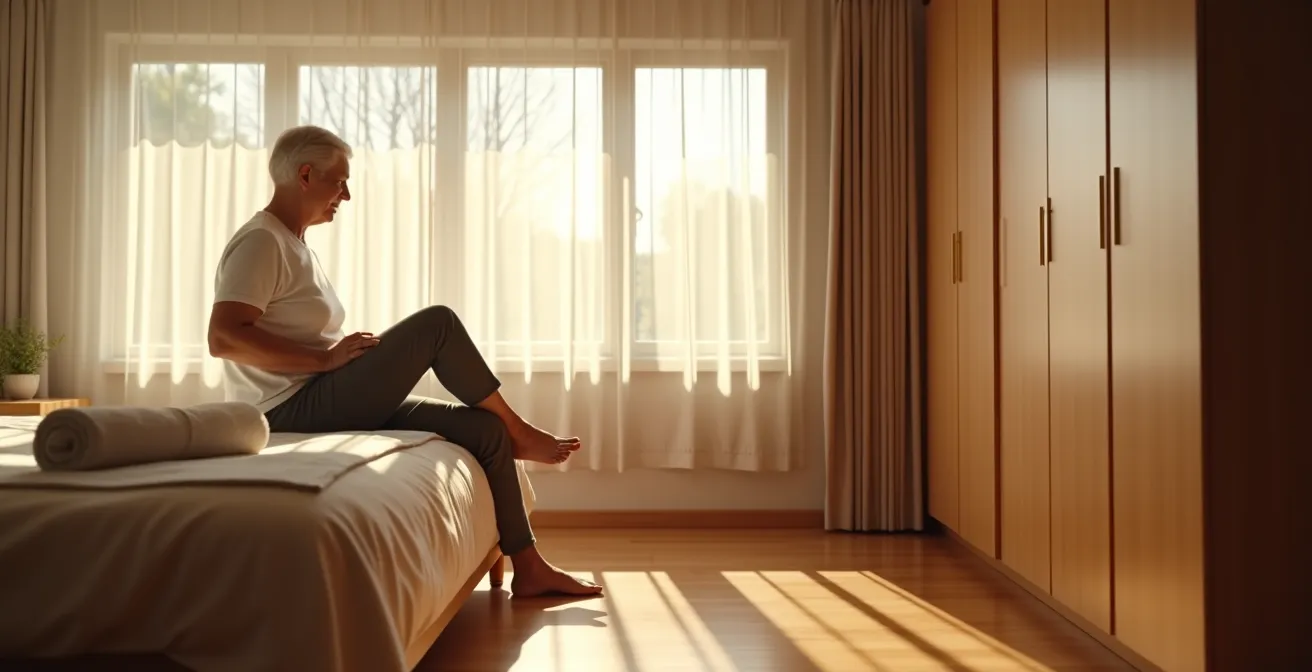
Instead, begin before you even get out of bed. While sitting on the edge of the mattress, gently perform a series of heel slides. Extend one leg out, keeping the heel on the floor or bed, and then slowly slide it back towards you, bending the knee. Repeat this 10-15 times on each leg. This simple, non-weight-bearing exercise lubricates the knee joint and gently awakens the hamstrings and quadriceps. Follow this with gentle ankle circles in both directions to prepare the entire lower leg. This preparatory sequence takes less than two minutes but makes a world of difference in your mobility for the rest of the day.
Why Walking Too Slowly at Crosswalks Is a Sign of Frailty You Can Reverse?
Your walking speed in the community is one of the most powerful predictors of your overall health and longevity. It’s often called the “sixth vital sign.” The scenario of feeling rushed at a crosswalk, hearing the beeping signal speed up as you’re only halfway across, is more than just an inconvenience. It’s a real-world test of your gait speed, balance, and power. A slow gait speed is a hallmark of frailty, a condition characterized by diminished strength, endurance, and reduced physiologic function that increases an individual’s vulnerability for developing increased dependency or death.
This isn’t about being an athlete; it’s about having the functional capacity to navigate your environment safely. Research shows a direct link between a slow walking speed and an increased risk of falls. The core issues are often a weak push-off from the back leg (a sign of weak glutes and calves) and poor single-leg stability. Every step you take is a moment of balancing on one leg. If that stability is compromised, your brain will instinctively shorten your stride and slow your pace to minimize risk. This creates a vicious cycle: fear of falling leads to less activity, which leads to further muscle and balance loss.
The consequences can be serious. As CDC data reveals, 37% of those who fall report an injury that requires medical treatment or restricts their activity, further accelerating the cycle of frailty. Reversing this trend starts with shifting your mindset. Your daily walk is not just a casual stroll; it is a training session. Focus on consciously pushing off the ground with your back foot and landing on your front heel. Try walking with a slightly longer stride for short bursts, perhaps from one lamppost to the next. These small, intentional changes begin to rebuild the power and neuromuscular coordination needed for a confident, safe gait.
Heel-to-Toe: How to Retrain Your Brain to Lift Your Feet and Avoid Carpet Trips?
Do you ever find yourself catching your toe on the edge of a rug or an uneven patch of pavement? This common and dangerous issue, often dismissed as clumsiness, is rarely a problem of vision. It’s a breakdown in proprioception—your brain’s ability to sense the position and movement of your body in space without looking. As we age, the sensitivity of the nerves in our feet can diminish, and our brain’s “map” of our lower limbs becomes less clear. This leads to a shuffling gait, where we fail to lift our feet high enough to clear small obstacles.
Rebuilding this brain-body connection is a form of neuromuscular re-education. You must consciously teach your body what it once did automatically. This involves exercises that challenge your balance and heighten your sensory awareness of your feet. The goal is to improve dorsiflexion (the ability to lift your toes toward your shin) and retrain the classic “heel-to-toe” walking pattern. This pattern is crucial for safety, as landing on your heel naturally forces your toes to lift, clearing the ground for the rest of your stride.
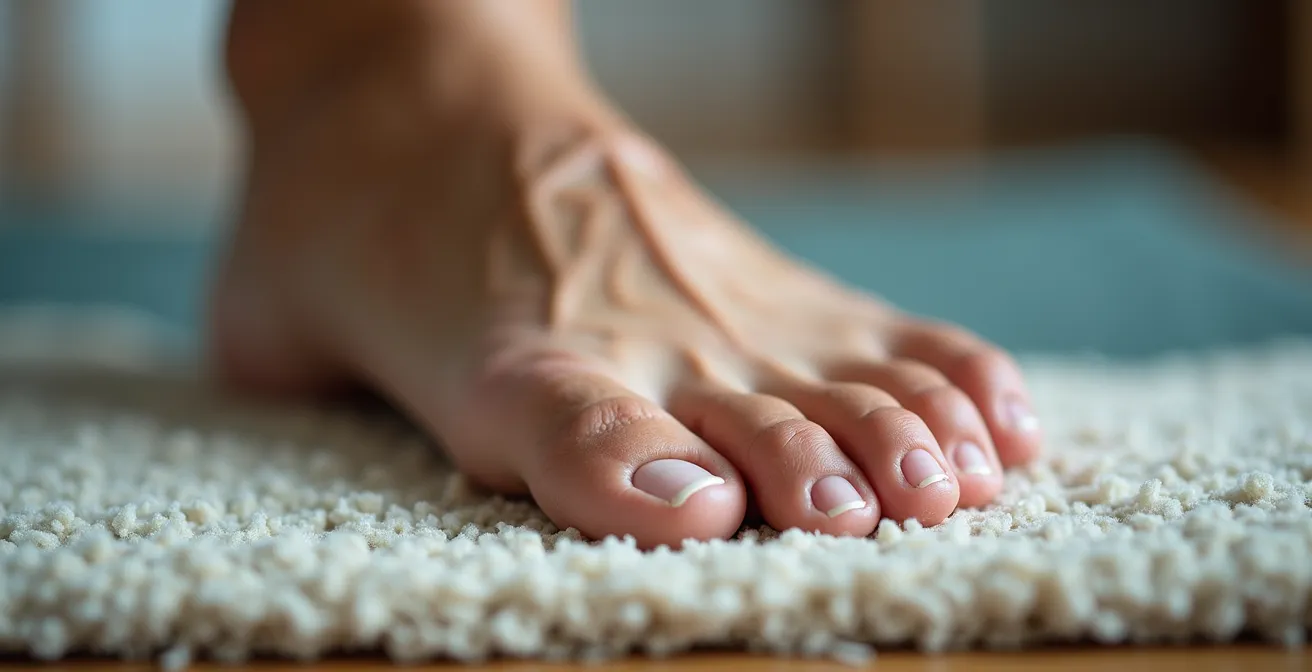
Practicing barefoot on different surfaces can help reawaken the nerves in your feet. Simply walking from a carpeted area to a hardwood floor and paying close attention to the change in sensation is a powerful proprioceptive exercise. The primary drill, however, is tandem walking, or heel-to-toe walking. This exercise directly trains the balance and coordination needed to prevent shuffling and falls.
Action Plan: Heel-to-Toe Walking Protocol
- Start position: Stand tall near a wall or sturdy furniture for support, with your feet together and arms extended for balance.
- Step 1: Place the heel of one foot directly in front of the toes of your other foot, as if walking on a tightrope.
- Step 2: Slowly shift your weight forward and take the next step, maintaining the direct heel-to-toe alignment.
- Step 3: Focus intently on the sensation of your heel striking the floor first, then your foot rolling forward to the toes.
- Step 4: Practice this for 10-15 steps on a flat, non-slippery surface with good lighting, then turn around and repeat.
The 30-Minute Rule: Why Sitting Longer Than Half an Hour Stiffens Your Hip Flexors?
The ability to bend forward and reach your foot is governed by a group of muscles at the front of your pelvis called the hip flexors. When you sit, these muscles are held in a shortened, contracted position. The human body is incredibly adaptive; if you hold a muscle in a shortened position for too long, it will adapt by becoming chronically tight. This is the primary reason why a sedentary lifestyle directly robs you of the flexibility needed for tasks like putting on socks.
The “30-Minute Rule” is a simple but powerful guideline: never sit for more than 30 consecutive minutes without getting up. When your hip flexors become tight, they pull your pelvis into an anterior tilt. This, in turn, puts strain on your lower back and inhibits the activation of their opposing muscles—the glutes. Weak glutes and tight hip flexors are a dysfunctional partnership that cripples your mobility. You lose the ability to hinge at the hips properly, forcing you to round your back to bend over, which is inefficient and unsafe.
This loss of hip mobility is a direct contributor to fall risk, as it limits your ability to take a long stride or lift your leg high. According to the National Council on Aging, falls are a significant threat, with over one out of four older adults falling each year. Interrupting prolonged sitting is the single most important habit you can adopt to combat this stiffness. Set a timer, and when it goes off, simply stand up, walk around the room, or perform a few gentle standing stretches. This simple act prevents your hip flexors from “learning” to be short and tight.
The chair stand test mentioned earlier is not only a measure of strength but also an indicator of sufficient hip mobility. Comparing your performance to established norms can be a powerful motivator.
| Age Group | Women (reps) | Men (reps) | Fall Risk Level |
|---|---|---|---|
| 60-64 years | 12-17 | 14-19 | Low if within range |
| 65-69 years | 11-16 | 12-18 | Low if within range |
| 70-74 years | 10-15 | 12-17 | Low if within range |
| 75-79 years | 10-14 | 11-16 | Moderate if below range |
| 80+ years | 9-13 | 10-14 | High if below 10 reps |
How to Turn a Casual Stroll into a Cardio Workout Without Running?
Many seniors are advised to walk for cardiovascular health, but a leisurely stroll often doesn’t provide enough intensity to create significant improvements. At the same time, running or jogging can be too high-impact on the joints. The solution lies in a method called Functional Interval Training. This involves turning your regular walk into a workout by incorporating periods of higher intensity and functional challenges, without ever needing to break into a run.
The simplest way to do this is with “walk/fast-walk” intervals. For example, walk at your normal pace for three minutes, then for one minute, walk as fast as you can without jogging. Focus on pumping your arms and taking longer strides. Repeat this cycle 4-5 times. This method elevates your heart rate in a safe, controlled manner, improving your cardiovascular endurance. But we can take it a step further by integrating balance and strength drills directly into your walk.
When you reach a park bench or a safe, stable object, pause your walk to perform balance exercises. As Canadian research highlights, exercises like the single-leg stand can dramatically reduce fall risk. Try to stand on one leg, initially holding on for support, and work your way up to standing unsupported for 30 seconds, then a minute. You can also add 10-15 calf raises or even a set of controlled bench squats. By peppering your walk with these “movement snacks,” you are simultaneously training your heart, muscles, and balance system. This transforms a simple walk into a comprehensive workout that directly enhances your ability to perform daily tasks and remain independent.
Why Slouching in Your Armchair Is Causing Your Digestion Problems?
We often think of posture in terms of back pain or looking confident, but its effects run much deeper, right down to your digestive system. When you slouch in an armchair, your spine curves into a “C” shape. This posture compresses your abdominal cavity, putting direct physical pressure on your stomach and intestines. This compression can slow down peristalsis—the wave-like muscle contractions that move food through your digestive tract—leading to issues like bloating, acid reflux, and constipation.
However, the impact of poor posture extends far beyond digestion. It’s a critical component of the functional decline we’ve been discussing. A slouched posture weakens the deep core muscles and the postural muscles of your upper back. As a result, your head juts forward, and your shoulders round. This shifts your center of gravity, forcing your body to work much harder to stay balanced. This inefficient posture is a major contributor to fatigue and directly undermines your stability when walking or standing.
The connection between posture, disability, and falls is well-documented. A comprehensive review by the National Academies Press on aging and disability found a strong link between poor postural control and an increased likelihood of falls. For instance, studies show that older adults who need help with daily activities are drastically more likely to report multiple falls. Correcting your seated posture—by sitting up tall with your feet on the floor and perhaps a small cushion for lumbar support—is not just about aesthetics. It is a fundamental practice for maintaining both internal organ function and your overall postural stability, which is essential for every move you make.
Key Takeaways
- The inability to put on socks is not a standalone issue but a symptom of a systemic decline in functional mobility, strength, and balance.
- Targeted exercises like sit-to-stands, heel-to-toe walks, and hip flexor stretches directly address the root biomechanical causes.
- Consistency and breaking habits like prolonged sitting are more important than the intensity of any single workout.
How to Start an Exercise Routine at 65+ If You Haven’t Worked Out in Decades?
The thought of starting an exercise routine after years, or even decades, of inactivity can be overwhelming. The gym seems intimidating, and the fear of injury or not knowing where to begin can lead to paralysis. The biggest mistake people make is trying to do too much, too soon. The key to long-term success is to abandon the “all or nothing” mindset and adopt what can be called the “One-Goal Method.” Instead of a vague goal like “get in shape,” you choose one highly specific, meaningful, and functional goal. Your goal could be: “Within 60 days, I want to be able to put my socks on while standing.”
This single goal becomes your guiding star. Every exercise you do is now in service of that objective. This approach provides clarity and a powerful source of intrinsic motivation. You’re not just doing “leg lifts”; you’re building the stability needed to balance on one foot. You’re not just doing “squats”; you’re building the power to lower yourself with control. The program builds itself around the goal. Start with exercises you can do safely with support, like standing on one leg while holding onto a sturdy chair.
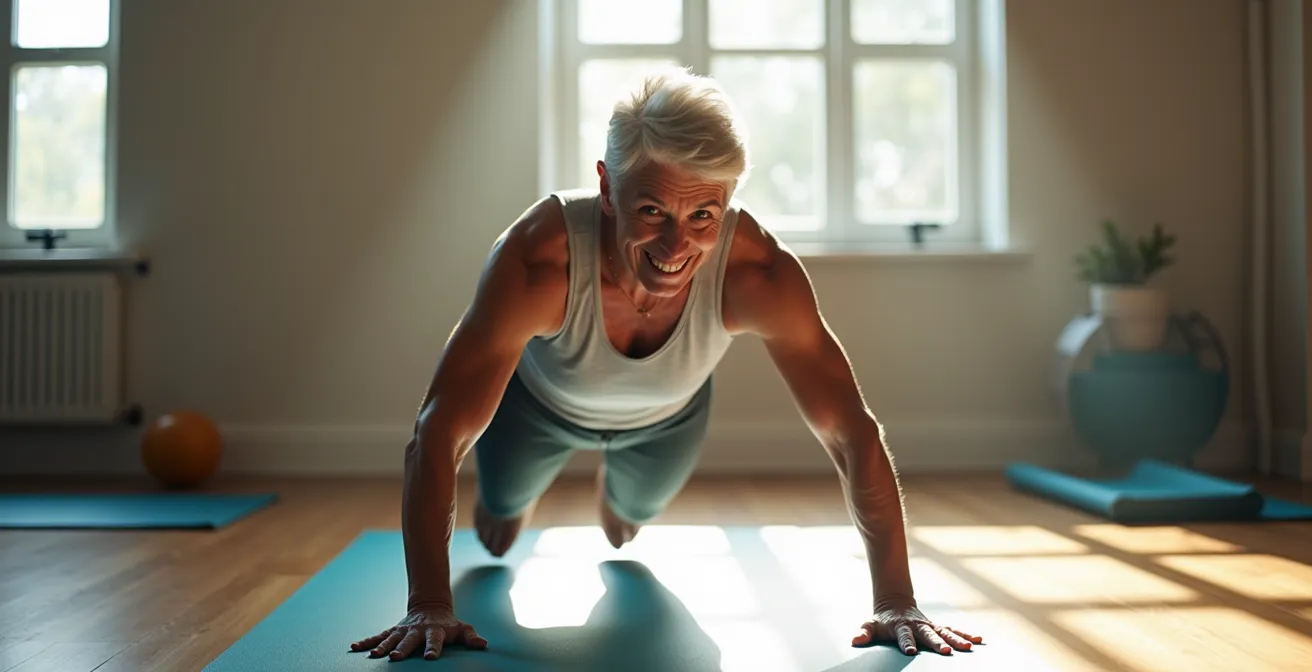
A simple progression might start with chair-supported balance drills and heel raises. As you get stronger, you can progress to a “flamingo stand,” lifting your knee towards your chest while holding on. Eventually, you can practice the actual motion of putting on a sock, always with the chair nearby for safety. The “Rule of Two” is a great guide for progression: when you can perform two more repetitions than your target for two consecutive sessions, it’s time to make the exercise slightly more challenging. This gradual, goal-oriented approach demystifies exercise and transforms it from a chore into a rewarding project of self-reclamation.
By systematically rebuilding your functional movement system, you are doing more than just making your morning routine easier. You are investing in a future with more freedom, confidence, and independence. The next logical step is to assess your own starting point and begin implementing these targeted movements into your daily life.