
Contrary to common belief, significant blood pressure reduction isn’t just about drastic salt cuts or exhausting cardio. The key lies in precise, evidence-based “micro-calibrations” to your daily routine.
- Mastering the sodium-potassium balance in your diet often yields better results than just reducing sodium alone.
- Specific, low-impact exercises like isometrics can be more effective and safer for lowering blood pressure than traditional cardio.
- Accurate home monitoring is non-negotiable to avoid misdiagnosis and ensure your efforts are measured correctly.
Recommendation: Start by implementing a consistent 7-day home measurement protocol to establish a reliable baseline before making any other changes. This data is your most powerful tool.
Receiving a high blood pressure diagnosis can be unsettling. Your first thought might be about a future filled with more prescriptions. As a cardiologist, I see this concern daily, especially among my patients over 60. The conventional advice is often predictable: cut salt, lose weight, and exercise more. While these are not wrong, they are broad strokes that can feel overwhelming and sometimes miss the most impactful, targeted strategies. Many patients try these and feel frustrated when their numbers don’t budge significantly.
What if the path to lowering your blood pressure by a meaningful 10 points didn’t require a complete life overhaul or immediately adding new medication? What if it was about making smarter, more precise adjustments? The truth is, your body operates on a system of delicate balances. By understanding and influencing these systems through specific, evidence-based “micro-calibrations,” you can gain substantial control over your numbers. This approach is about working with your body’s physiology, not just fighting against a diagnosis.
This guide moves beyond the generic advice. We will explore the science-backed nuances that make a real difference: the critical role of potassium, the surprising effectiveness of specific exercise types, and the non-negotiable importance of accurate self-monitoring. The goal is to empower you with knowledge and practical steps to complement your current treatment plan. Crucially, this advice is designed to work alongside your doctor’s recommendations. Never change or stop any prescribed medication without their direct guidance. Think of these strategies as powerful tools to add to your health toolkit, giving you a proactive role in managing your well-being.
This article will walk you through a series of these targeted adjustments. We will examine each one, explaining the science behind it and providing actionable steps to integrate it into your life. The journey to better blood pressure control is a marathon, not a sprint, and it begins with understanding the right levers to pull.
Summary: A Practical Guide to Lowering Blood Pressure Naturally
- Why Cutting Salt Isn’t Enough: The Potassium Factor You Are Probably Ignoring
- Isometrics or Cardio: Which Exercise Protocol Is Safer for Spiking Blood Pressure?
- Meditation or Deep Breathing: Which Technique Drops Acute Stress Pressure Faster?
- The Danger of Treating “Office Highs” If Your Home Pressure Is Actually Low
- Arm Cuff vs. Wrist Monitor: Which One Is Accurate Enough for Your Doctor to Trust?
- Morning or Evening: When Is the Most Critical Time to Check Your Numbers?
- TV News or Reading: How Your Pre-Dinner Activity Affects Your Anxiety Levels?
- How to Hit 30g of Protein per Meal When You Have a Smaller Appetite?
Why Cutting Salt Isn’t Enough: The Potassium Factor You Are Probably Ignoring
For decades, the primary dietary advice for hypertension has been a simple mantra: “cut the salt.” While reducing sodium is indeed important, it’s only half of a crucial equation. Your body manages fluid balance and blood pressure through a delicate interplay between sodium and another mineral: potassium. Focusing only on sodium reduction is like trying to balance a seesaw by only adjusting one side. The real “metabolic leverage” comes from addressing both. As the American Heart Association explains, potassium plays a vital role in lessening sodium’s effects; the more potassium you consume, the more sodium your body excretes through urine.
The goal isn’t to eliminate sodium, which is essential for bodily functions, but to improve its ratio relative to potassium. In fact, many health bodies are now focusing on this relationship, with some WHO guidelines suggesting an optimal 1:1 sodium-to-potassium ratio for cardiovascular health. For most people eating a modern diet, this ratio is heavily skewed towards sodium. By consciously increasing potassium-rich foods—like lentils, spinach, bananas, and avocados—you actively help your body counteract the pressure-raising effects of the sodium you do consume.
Making this shift doesn’t require a radical diet. It’s about strategic swaps. Instead of a can of soup high in sodium, a homemade lentil soup can dramatically shift the mineral balance in your favor. This table illustrates how simple changes can have a significant impact on both your sodium and potassium intake.
| Instead of This | Choose This | Sodium Reduction | Potassium Boost |
|---|---|---|---|
| Canned soup (800mg sodium) | Homemade lentil soup | -600mg | +365mg |
| Processed deli meat sandwich | Fresh grilled chicken wrap | -750mg | +420mg |
| Potato chips (170mg sodium) | Unsalted almonds | -150mg | +200mg |
This focus on the sodium-to-potassium ratio is a more sustainable and effective long-term strategy. It shifts the mindset from one of pure restriction to one of strategic enrichment, making your diet both healthier and more enjoyable.
Isometrics or Cardio: Which Exercise Protocol Is Safer for Spiking Blood Pressure?
When a doctor recommends exercise for blood pressure, most people picture brisk walking, jogging, or cycling. This type of aerobic (cardio) exercise is certainly beneficial for heart health. However, for some individuals, particularly those new to exercise or with very high baseline pressure, intense cardio can cause a temporary—and sometimes worrying—spike in blood pressure during the activity. A growing body of evidence points to a different type of exercise as a potentially safer and even more effective alternative: isometric resistance training (IRT).
Isometrics involve contracting a muscle without any visible movement of the joint, such as holding a “wall sit” or squeezing a handgrip dynamometer. This static contraction creates a unique physiological response. While blood pressure rises during the hold, the blood vessels “rebound” afterward, becoming more flexible and relaxed over time. This leads to a significant reduction in resting blood pressure. In fact, a 2023 British Journal of Sports Medicine meta-analysis found that isometric exercise led to an average 8.24/4.00 mmHg reduction, compared to just 4.49/2.53 mmHg for traditional aerobic training.
The key advantage of isometrics for seniors is their low-impact nature. They don’t strain joints and can be performed safely at home with minimal equipment. A simple wall sit, holding the position for a comfortable duration, is a perfect starting point. The image below shows the correct, safe form for this powerful exercise.

The best approach often combines different types of exercise. Integrating a few short isometric sessions into your week alongside regular walks can create a powerful synergistic effect, conditioning your cardiovascular system while also actively lowering your resting blood pressure. A balanced plan could look like this:
- Monday, Wednesday, Friday: 30-minute brisk walks for cardiovascular conditioning.
- Tuesday, Thursday: 3 sets of 2-minute wall sits (starting with 20-30 seconds and building up).
- Saturday: A combined session of 20 minutes walking plus 2 different isometric exercises.
- Daily: 5-minute handgrip exercises at 30% of your maximum effort.
By incorporating isometrics, you are choosing a scientifically-backed, joint-friendly method that may offer superior results for blood pressure management, providing a safe and effective path toward your 10-point goal.
Meditation or Deep Breathing: Which Technique Drops Acute Stress Pressure Faster?
Stress is a well-known trigger for elevated blood pressure. When you’re anxious or tense, your body releases hormones like cortisol and adrenaline, which cause your heart to beat faster and your blood vessels to narrow. While the advice to “reduce stress” is common, it’s often too vague to be useful. For real-time control, it’s important to distinguish between long-term stress management (like meditation) and acute stress reduction (like specific breathing techniques). Both are valuable, but they serve different purposes.
Mindfulness meditation is a powerful tool for long-term change. By practicing regularly, you can retrain your brain’s response to stressors, leading to sustained improvements in blood pressure. One study on a mindfulness-based program showed participants reduced their systolic blood pressure by an average of 5.9 mmHg over 8 weeks, compared to just 1.4 mmHg in a control group. This is about building resilience over time.
However, when you feel your stress and pressure rising in the moment—before a doctor’s appointment, for instance—you need a faster-acting tool. This is where diaphragmatic, or “deep belly,” breathing excels. Specifically, techniques that emphasize a longer exhale have a direct and immediate effect on your vagus nerve, which helps regulate heart rate and blood pressure. A simple 4-6 breathing pattern (inhaling for 4 seconds, exhaling for 6) can lower your acute blood pressure in just a few minutes. It’s a “targeted relaxation” technique you can deploy anywhere, anytime.
Here is a simple 2-minute exercise you can use to immediately lower stress-induced pressure:
- Step 1: Sit comfortably in a chair with your feet flat on the floor and your back supported.
- Step 2: Place one hand on your chest and the other on your belly.
- Step 3: Inhale slowly and deeply through your nose for a count of 4. Feel your belly expand, while your chest remains relatively still.
- Step 4: Exhale gently and completely through pursed lips for a count of 6. Feel your belly fall.
- Step 5: Repeat this cycle 12 times, which will take about 2 minutes.
Think of deep breathing as your emergency brake for acute stress spikes, and meditation as the regular engine maintenance that prevents your system from overheating in the first place. Using both gives you a comprehensive strategy for managing stress’s impact on your blood pressure.
The Danger of Treating “Office Highs” If Your Home Pressure Is Actually Low
One of the most critical aspects of managing blood pressure is ensuring the data you’re acting on is accurate. A common phenomenon known as “white coat hypertension” occurs when a person’s blood pressure is elevated in a medical setting but normal at home. This anxiety-induced spike can lead to a misdiagnosis and, more dangerously, the over-prescription of medication. If your blood pressure is actually normal or even low in your daily life, taking medication to treat artificially high “office highs” can cause dizziness, fatigue, and an increased risk of falls—a significant concern for seniors.
The opposite and equally dangerous condition is “masked hypertension,” where your reading is normal at the doctor’s office but high at home. This can lead to untreated hypertension, leaving you at risk for heart disease and stroke. This is why learning to take and interpret your own readings is not just a good idea; it is an essential part of your health management. Your home readings, taken consistently over time in a relaxed state, provide a much more accurate physiological signal of your true cardiovascular health.
The first step is to track your readings diligently. The second is to communicate this data effectively to your doctor. You must be a proactive partner in your care. Don’t be intimidated; your doctor needs this information to make the best decisions. This table clarifies the difference between these two critical conditions.
As confirmed by organizations like the American Heart Association, understanding your unique blood pressure pattern is key to proper treatment.
| Condition | Office Reading | Home Reading | Risk | Action Needed |
|---|---|---|---|---|
| White Coat Hypertension | High (≥140/90) | Normal (<130/80) | Overmedication risk | Home monitoring protocol |
| Masked Hypertension | Normal | High | Untreated hypertension | 24-hour monitoring |
Your Action Plan: Talking to Your Doctor About Home Readings
- Opening: Start the conversation clearly. “Doctor, I’d like to discuss my blood pressure readings.”
- Present Data: Provide your evidence. “My home readings are consistently lower than what we see here. Here is my two-week log showing my morning and evening measurements.”
- Ask the Key Question: Get to the heart of the matter. “Could we review whether my medication needs an adjustment based on these more consistent home readings?”
- Establish a Protocol: Look to the future. “What is the best protocol for me to follow for accurate home monitoring moving forward?”
- Confirm Next Steps: Ensure clarity on follow-up. “Should I continue logging and bring the results to our next appointment in three months?”
By taking ownership of your data, you transform from a passive patient into an informed advocate for your own health, ensuring your treatment plan is tailored to your real needs, not just a snapshot from a stressful doctor’s visit.
Arm Cuff vs. Wrist Monitor: Which One Is Accurate Enough for Your Doctor to Trust?
Once you commit to home monitoring, the next question is: which device should you use? You’ll find two main types on the market: upper arm cuffs and wrist monitors. While wrist monitors are often smaller and more convenient, the overwhelming consensus in the medical community is that upper arm cuff monitors are the gold standard for accuracy. Your doctor will almost always trust the readings from a validated upper arm device over those from a wrist monitor.
The reason for this is simple anatomy. As cardiologist Dr. R. Kannan Mutharasan of Northwestern Medicine explains, “The brachial artery in the upper arm is larger and closer to the heart, making readings less prone to error.” The arteries in your wrist are smaller and more superficial, and readings can be easily influenced by the position of your hand. For a measurement to be accurate with a wrist monitor, your wrist must be held perfectly at heart level. Even a slight deviation can skew the numbers significantly, making the data unreliable for making medical decisions.
So, should you throw away a wrist monitor if you already own one? Not necessarily. While an upper arm cuff is always the first choice, a wrist monitor can still provide useful information if used with meticulous technique. It is better than no monitoring at all. However, you must be extremely diligent about your positioning and protocol to get a reading that is even close to accurate.
If you must use a wrist monitor, follow these best practices to maximize its accuracy, as recommended by institutions like Northwestern Medicine:
- Keep your wrist at exact heart level. The easiest way to do this is to sit at a table and rest your arm on a pillow to elevate it to the correct height.
- Take 3 consecutive readings, waiting one minute between each.
- Average the 3 readings to get your final, most reliable number.
- Do not move, talk, or cross your legs during the measurement.
- Validate your device. Take your wrist monitor to your next doctor’s appointment and compare its reading to the one from their calibrated device. This will tell you if your monitor reads consistently high, low, or is simply unreliable.
Ultimately, for a decision as important as managing your blood pressure medication, investing in a validated upper arm cuff monitor is one of the most effective steps you can take. It ensures that all the effort you put into lifestyle changes is measured by a trustworthy and accurate tool.
Morning or Evening: When Is the Most Critical Time to Check Your Numbers?
You have the right device and the right technique. Now, when should you measure? The timing of your blood pressure readings is not arbitrary; it’s a critical piece of the data puzzle. Blood pressure naturally fluctuates throughout the day, following a circadian rhythm. For most people, it is lowest during sleep, begins to rise just before waking, and continues to climb throughout the morning. This “morning surge” is a well-documented phenomenon. In fact, a healthy blood pressure typically shows a 10-20% nighttime BP dip compared to daytime values. An absent or reduced dip can be a sign of increased cardiovascular risk.
Because of this morning surge, the most critical time to check your numbers is in the morning, before you’ve had breakfast, coffee, or taken your medication. This reading gives your doctor a picture of your baseline pressure at what is often its highest point of the day. A second set of readings in the evening, before dinner, provides a valuable comparison point, showing how your pressure behaves after the day’s activities and stresses.
Consistency is everything. Measuring sporadically at random times of the day will produce a confusing set of data. Your doctor needs a consistent, predictable log to identify patterns and make informed decisions. Following a strict protocol for a full week before your appointment provides the clearest and most actionable information.
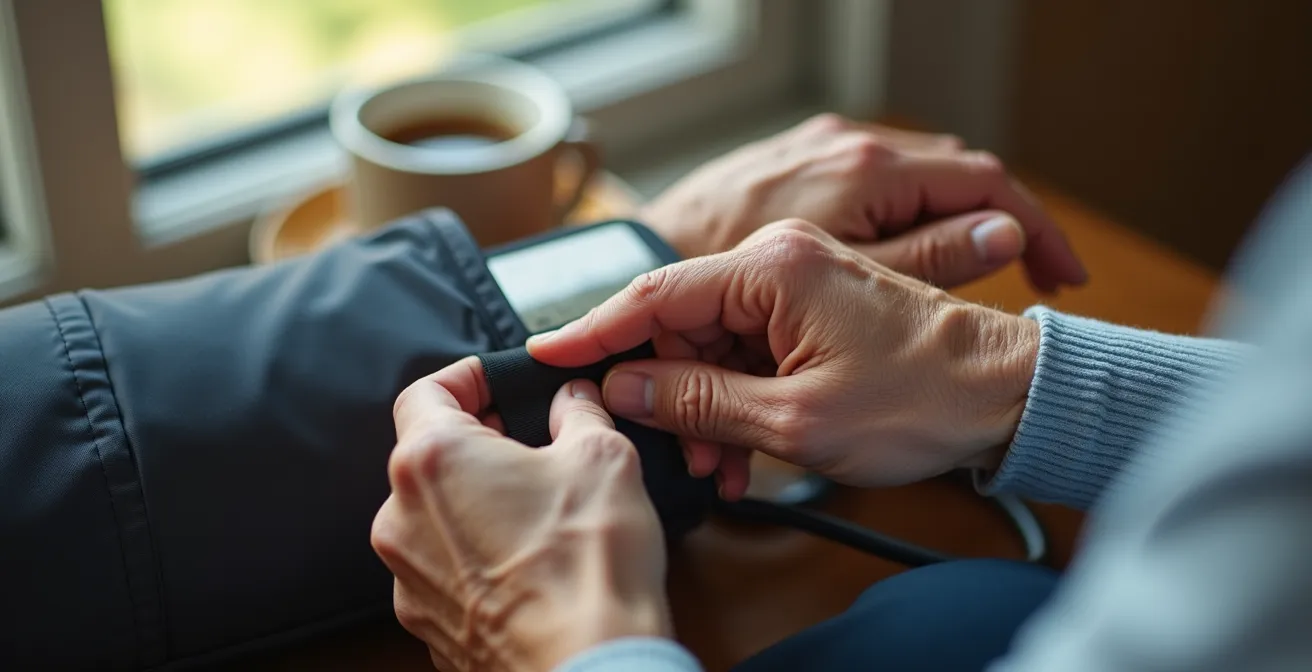
To get the most reliable data for your doctor, follow this 7-day measurement protocol:
- Days 1-7, Morning: Within an hour of waking and before eating or taking medication, sit and rest for 5 minutes. Then, take two readings, one minute apart.
- Days 1-7, Evening: Before your evening meal, sit and rest for 5 minutes. Take two readings, one minute apart.
- Record all readings with the date and time.
- Note any unusual factors that might have influenced a reading, such as a particularly stressful event, poor sleep, or unusual physical activity.
- At the end of the week, calculate the average of all your morning readings and all your evening readings. Bring this log to your doctor.
This disciplined approach transforms random numbers into a powerful diagnostic tool, giving you and your doctor a clear view of your true blood pressure patterns and enabling a truly personalized management plan.
TV News or Reading: How Your Pre-Dinner Activity Affects Your Anxiety Levels?
We’ve discussed diet, exercise, and measurement, but the “micro-calibrations” that affect your blood pressure extend to your environment and mental state, especially during transition periods of the day. The hour before your evening meal is a prime example. For many, this is a time to unwind from the day. However, *how* you choose to unwind can either help or hinder your blood pressure goals. The stimuli you expose yourself to can directly trigger your body’s stress response.
Flicking on the evening news, often filled with stressful, fast-paced reports and dramatic music, can be a significant source of “passive stress.” You may not feel actively anxious, but your body is reacting. Your heart rate can increase and your blood vessels can constrict, subtly elevating your blood pressure right before you take your evening reading. This principle is demonstrated in studies on auditory stimuli; for example, a 2022 study found that music with a slower, calmer tempo helped lower participants’ heart rate, while fast-paced, agitating music had the opposite effect. The same applies to the overall sensory input of your pre-dinner activity.
In contrast, choosing a calming activity can actively lower your blood pressure. Engaging in an activity that is quiet, focused, and positive sends a signal to your nervous system to relax. This could be reading a novel, working on a jigsaw puzzle, listening to soft instrumental music, or practicing gentle stretches. By consciously curating a “wind-down” environment, you are actively managing your blood pressure before you even sit down to eat or take a measurement.
Consider creating a “menu” of calming pre-dinner activities to choose from:
- Listen to ambient music or nature sounds (ideally under 60 beats per minute).
- Work on a jigsaw puzzle, crossword, or Sudoku.
- Practice 10 minutes of gentle stretching or chair yoga.
- Read a chapter of a book (preferably fiction or uplifting non-fiction).
- If weather permits, take a slow, mindful walk around your neighborhood, focusing on your surroundings.
This isn’t about eliminating all news or media; it’s about being strategic. Save the news for another time of day and protect that critical pre-dinner, pre-measurement window. It’s a simple, no-cost micro-calibration that can have a noticeable effect on your evening readings and overall well-being.
Key Takeaways
- True blood pressure control is achieved through small, specific, and evidence-based adjustments, not just broad, overwhelming changes.
- Accurate data is paramount. Mastering home monitoring with the right device (arm cuff), technique, and timing is the foundation of any successful management plan.
- Beyond diet and exercise, environmental factors like your evening routine have a measurable impact on your blood pressure and should be managed intentionally.
How to Hit 30g of Protein per Meal When You Have a Smaller Appetite?
While often associated with muscle building, adequate protein intake is crucial for seniors for many reasons, including maintaining muscle mass, which supports a healthy metabolism and overall cardiovascular function. A common recommendation is to aim for around 30 grams of protein per meal. However, this can be a daunting target for many older adults who naturally experience a smaller appetite or “anorexia of aging.” Forcing down a large chicken breast or steak is often not feasible or pleasant. The solution is not to eat more, but to eat smarter by focusing on protein density.
Protein density refers to the amount of protein packed into a certain number of calories. The goal is to choose foods that give you the most protein for the smallest volume. For example, Greek yogurt and egg whites are protein powerhouses that are relatively light and easy to consume. A scoop of protein powder can be a senior’s best friend, as it can be stirred into yogurt, oatmeal, or a smoothie to add 20-25 grams of protein with almost no added volume.
To understand which foods offer the most value, this table from sources like Northwestern Medicine ranks common foods by their protein density.
| Food | Protein per 100 cal | Serving Size |
|---|---|---|
| Egg whites | 20g | 3/4 cup |
| Greek yogurt (nonfat) | 17g | 2/3 cup |
| Cottage cheese (low-fat) | 15g | 1/2 cup |
| Chicken breast | 14g | 2 oz |
| Protein powder | 21g | 1 scoop |
Another effective strategy is “protein pulsing”—spreading your intake across smaller, more frequent meals and snacks throughout the day. This approach prevents you from feeling overly full at any one time while ensuring you still reach your daily goal. A schedule might look like this:
- 7 AM: Greek yogurt parfait with half a scoop of protein powder (20g protein).
- 10 AM: Small bowl of cottage cheese with berries (15g protein).
- 1 PM: Half a chicken salad sandwich or a small wrap (18g protein).
- 4 PM: A small protein smoothie (15g protein).
- 7 PM: A light piece of fish with steamed vegetables (20g protein).
By prioritizing protein density and frequency over sheer volume, you can easily meet your nutritional needs to support your strength and cardiovascular health without feeling uncomfortably full. This is a perfect example of a smart “micro-calibration” that respects your body’s changing needs.