The fear of being a burden isn’t solved by apologizing, but by confidently redirecting the social connection.
- Declining an invitation is an act of energy management, not a social failure.
- Using pre-planned “confidence scripts” shifts the conversation from limitation to proactive solutions.
Recommendation: Instead of saying “I can’t,” start practicing the phrase, “That setup doesn’t work for me, but how about we…?”
The phone rings. It’s a friend, excited about a new rooftop restaurant or a gallery opening. Your heart sinks. You know there will be stairs, and the familiar, heavy feeling washes over you: the dread of having to explain, the fear of being seen as difficult, and the whisper of a thought that it’s just easier to say you’re busy. This moment, this choice between connection and self-preservation, is a silent battle for countless seniors whose mobility has changed.
The common advice is to “just be honest” or “put your health first.” But this ignores the deep-seated emotional challenge: the feeling of becoming a burden. You don’t want to be the reason the plan changes, the person who needs special accommodation. The result is a slow, quiet retreat from the world, where “I’ll just stay home” becomes a reflex. But what if declining wasn’t an apology? What if it was an opportunity?
This guide reframes the entire conversation. We will move beyond the simple “no” and equip you with the tools of a social confidence coach. The key isn’t to list your limitations, but to confidently redirect the connection. You will learn how to use non-negotiable, empowering scripts that preserve your dignity, strengthen your friendships, and keep you engaged with the world on your own terms. It’s not about the stairs; it’s about taking control of the narrative.
This article will provide you with a complete toolkit to navigate these social challenges. We will explore how to assess venues for “invisible” accessibility, manage your energy like a budget, advocate for yourself with your doctor, and take the first crucial steps back into a vibrant social life.
Summary: Navigating Social Life Confidently with Evolving Mobility
- Museum or Theater: Which Venue Offers Better “Invisible” Accessibility for limited walkers?
- The “Spoon Theory”: How to Budget Your Physical Energy for a Wedding Weekend?
- How to Tell Your Doctor Your Mobility Is Worse Than They Think?
- Why “I’ll Just Stay Home” Is the Most Dangerous Sentence for Your Mobility?
- Gardening from a Chair: How to Build Raised Beds That Don’t Require Bending?
- The “Crowded Loneliness” Mistake: Why Being Around People Doesn’t Cure Isolation
- How to Take the First Step Out the Door When You Haven’t Socialized in Weeks?
- How to Make New Friends After 60 When You Don’t Like Bingo or Bridge?
Museum or Theater: Which Venue Offers Better “Invisible” Accessibility for limited walkers?
The first step in confidently accepting or declining an invitation is to become a master of your environment. Not all public spaces are created equal, especially when it comes to “invisible” accessibility—the features that make a venue manageable without it being an overt “disability-friendly” space. Understanding this difference gives you the power to suggest alternatives that work for everyone. A museum and a theater, for example, present entirely different energy demands.
A museum often involves an unknown amount of walking and standing. You are at the mercy of bench placement, and navigating multiple rooms or levels can drain your energy reserves unexpectedly. A theater, by contrast, offers a guaranteed assigned seat. The primary energy expenditure is getting to that seat; once there, you can rest for the duration of the performance. This is a predictable energy pattern, making it a much safer bet for someone with limited walking capacity.
Evaluating a venue based on these subtle factors is a key skill. It allows you to transform a vague “I’m not sure I can handle that” into a concrete, confident suggestion. You’re not just declining; you’re offering a better-planned alternative. This table breaks down the core differences in energy expenditure.
| Feature | Museum | Theater |
|---|---|---|
| Seating Availability | Limited benches in transitional spaces | Guaranteed assigned seat |
| Exit Flexibility | Can leave anytime | Disruptive to leave early |
| Pace Control | Self-paced exploration | Fixed duration performance |
| Energy Pattern | Steady, low energy drain | High burst for arrival, then rest |
| Navigation Complexity | Multiple rooms and levels | Single destination |
This analysis gives you the data to make an informed choice. Instead of a blanket “no” to a cultural outing, you can now redirect the connection: “A long afternoon at the museum might be too much walking for me, but I’d love to see that new play at the Grand Theater. The seating there is so comfortable!”
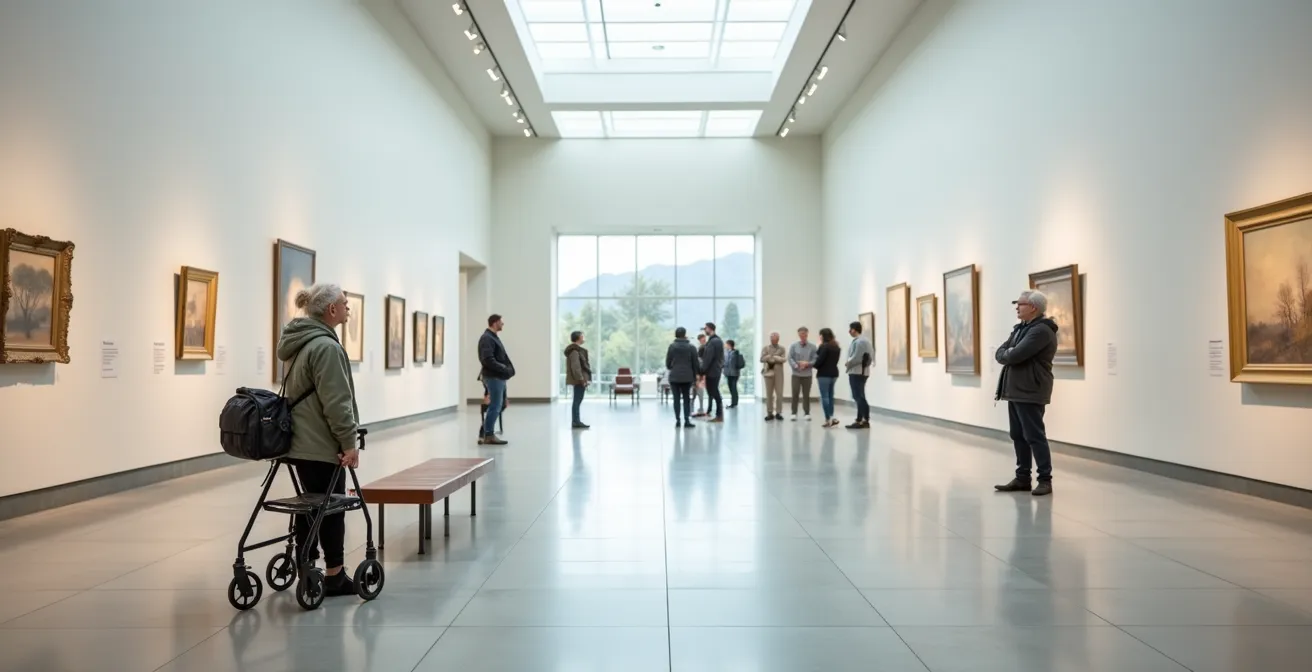
As you can see, strategic seating and predictable environments are paramount. Choosing a venue where you can engage with the activity without the constant worry of finding a place to rest is a form of self-advocacy. It’s about setting yourself up for success and enjoyment, which is the entire point of a social outing.
The “Spoon Theory”: How to Budget Your Physical Energy for a Wedding Weekend?
When you have limited mobility or a chronic condition, physical energy is not an unlimited resource; it’s a finite budget. The “Spoon Theory,” created by Christine Miserandino, is a brilliant metaphor for this reality. Imagine you start each day with a set number of spoons, and every single activity—from getting out of bed to showering to making breakfast—costs you one spoon. A big event like a wedding weekend isn’t one activity; it’s a dozen, and it can leave you with a “spoon deficit” for days.
Thinking like an energy accountant is empowering. It moves the conversation from “I’m not capable” to “I must be strategic.” It’s not a personal failing to have fewer spoons; the skill is in learning how to spend them wisely. This means you must become ruthless in prioritizing. Not every event at a wedding weekend is created equal. The ceremony might be your non-negotiable “Core Mission,” while the late-night after-party is a “Skippable Side-Quest.”
This proactive approach is about planning, not passivity. As a case study on chronic illness management shows, a behavioral health therapist planned for a demanding day by delegating tasks like dog walking and asking for help with dinner. This wasn’t a sign of weakness; it was a strategic allocation of resources to ensure she had enough “spoons” for her most important appointments. For a wedding, this could mean ordering room service instead of going to the hotel restaurant or scheduling a two-hour rest period between the ceremony and reception.
Your Action Plan: The Event Triage Method
- Core Mission Activities: Identify the 1-2 non-negotiable events (e.g., the ceremony itself) that are most important to you. Allocate the majority of your energy “spoons” to these.
- High-Value Social Operations: Select 1-2 meaningful gatherings where you can connect with loved ones (e.g., the rehearsal dinner toast). These are your secondary priorities.
- Skippable Side-Quests: Make a list of optional activities (e.g., the farewell brunch, after-party, group hike) that you can decline without guilt or major social consequences.
- Recovery Basecamp Setup: Plan for recovery. This means pre-booking room service, packing comfortable clothes, and scheduling mandatory 1-2 hour rest periods in your room between events.
- Social Delegate Assignment: Designate a trusted friend or family member as your “delegate.” Their mission: to gather stories and photos from any events you miss, so you can still feel connected.
Using this framework allows you to communicate your needs with confidence. Your script changes from an apology to a statement of fact: “I’ll be saving my energy for the ceremony and reception, so I’ll be skipping the brunch. I can’t wait to see you at the main event!”
How to Tell Your Doctor Your Mobility Is Worse Than They Think?
One of the most frustrating experiences is leaving a doctor’s appointment feeling misunderstood. In a 15-minute consultation, it’s easy for the reality of your day-to-day mobility struggles to be lost. You might describe “difficulty walking,” but your doctor may not grasp that this means you can no longer stand long enough to cook a meal or that you use a grocery cart as a makeshift walker. To get the right support, you must move from vague descriptions to concrete evidence.
Your new role is that of a data collector. Before your next appointment, create a “Mobility Evidence Log.” For one week, document the specifics. Don’t just say “I’m tired”; write down, “After walking to the mailbox (100 feet), I had to sit down for 10 minutes to recover.” This transforms a subjective feeling into an objective data point that a medical professional can act upon. This evidence is your most powerful tool for advocacy.
Sometimes, numbers alone aren’t enough. As Johns Hopkins neurologist Dr. Scott Newsome notes in an article on WebMD, it’s also about painting a picture. He states that for symptoms that are hard to quantify, you should try ” using analogies and/or metaphors… to help clinicians… get a better understanding of the impact.” For example, you could say, “By the end of a grocery trip, my legs feel like they’re filled with wet sand,” or “Getting out of a low chair feels like I’m trying to lift a bag of cement.”
Using analogies and/or metaphors for symptoms that are difficult to quantify can help clinicians and patients’ loved ones get a better understanding of the impact of specific activities on a patient.
– Dr. Scott Newsome, WebMD
Here are the key points to include in your Mobility Evidence Log:
- Specific Mobility Metrics: Track distances, times, and the number of rest stops needed for daily tasks (e.g., “Took 5 minutes to walk to the car today, with 2 stops”).
- Functional Impacts: Document what you can no longer do, or do for less time (e.g., “Cannot stand to do dishes for more than 3 minutes,” “Skipped shower yesterday due to fatigue”).
- Adaptive Behaviors: Note when you use objects or people for support (e.g., “Leaned on the counter to walk through the kitchen,” “Asked my spouse to get something from the top shelf”).
- Comparison Timeline: Provide context by comparing your current state to the past (e.g., “Six months ago, I could walk the entire grocery store. Now, I need a motorized cart after two aisles”).
Why “I’ll Just Stay Home” Is the Most Dangerous Sentence for Your Mobility?
It starts as a logical choice. An invitation seems too challenging, the logistics too complicated, and the potential for embarrassment too high. So you say, “I’ll just stay home.” While it feels like the safest option in the moment, this sentence is a trap. It marks the beginning of a perilous cycle where social withdrawal and physical decline feed each other, creating a downward spiral that becomes increasingly difficult to escape.
Each time you opt out, you miss an opportunity to use your muscles, challenge your balance, and engage your mind. The body is ruthlessly efficient; what you don’t use, you lose. This process, known as deconditioning, happens at an alarming rate in older adults. In fact, research on deconditioning shows elderly adults can lose up to 5% of their muscle mass per day during periods of inactivity like bed rest, compared to just 1% in younger adults. While staying home isn’t the same as bed rest, the principle holds: prolonged inactivity accelerates muscle and function loss.

The solution isn’t to force yourself into overwhelming situations. The antidote to “I’ll just stay home” is the “micro-outing.” This is a small, manageable, and low-stakes trip out of the house. It’s not about running errands or socializing for hours. It’s about breaking the pattern of staying inside. A micro-outing can be as simple as enjoying a cup of coffee on your front porch, walking to the end of the driveway to get the mail, or sitting on a park bench for ten minutes.
These small acts are deceptively powerful. They maintain a baseline level of physical activity, preventing the rapid deconditioning that comes from a completely sedentary lifestyle. More importantly, they rebuild your confidence. Each successful micro-outing proves that you are still capable of engaging with the world. It recharges your “social battery” and makes the idea of a slightly bigger outing feel less daunting. It is the first, most crucial step in reversing the retreat into isolation.
Gardening from a Chair: How to Build Raised Beds That Don’t Require Bending?
Staying active and engaged doesn’t always mean leaving the house. For many, finding an adaptive hobby that can be done from home is a powerful way to maintain physical function and mental well-being. Seated gardening is a perfect example. It provides light physical activity, sensory stimulation, and a profound sense of purpose. The key is to design a garden that comes to you, eliminating the need to bend, kneel, or strain.
The foundation of any accessible garden is the raised bed, but “raised” is a relative term. The ideal height depends entirely on how you will be seated. A gardener in a wheelchair has a different reach zone than someone sitting on a garden stool or bench. Building or buying beds at the correct height is the single most important factor for a comfortable and sustainable gardening practice. A bed that is too low will still cause back strain, while one that is too high can strain your shoulders.
According to an analysis of accessible gardening setups, the width of the bed is just as important as the height. A narrower bed ensures you can reach the center without overextending. The following table provides a clear guide for matching bed dimensions to your seating type, creating a truly ergonomic and enjoyable gardening experience.
| Bed Height | Optimal Width | Reach Zone | Best For |
|---|---|---|---|
| 24-28 inches | 24 inches max | 12 inches from edge | Wheelchair users |
| 30-32 inches | 30 inches max | 15 inches from edge | Walker/seated on stool |
| 16-20 inches | 36 inches max | 18 inches from edge | Seated on garden bench |
| Table height (29-31″) | 24 inches max | Full width accessible | Standing with support |
Beyond the beds themselves, a mobile potting station is a game-changer. Instead of carrying heavy bags of soil or multiple tools, you can bring everything you need with you on a simple rolling cart. This minimizes trips back and forth and keeps all your supplies within easy arm’s reach, conserving your precious energy for the actual gardening.
- Select a sturdy rolling cart with at least two shelves and locking wheels for safety.
- Keep lightweight items like tools and seeds on the top shelf for easy access.
- Store potting soil in smaller, manageable containers (no more than 5 lbs each) on the middle shelf.
- Place a watering can with a long spout on the bottom shelf for stability.
- Add hooks or magnetic strips to the sides for hanging hand tools.
The “Crowded Loneliness” Mistake: Why Being Around People Doesn’t Cure Isolation
As mobility changes, there’s a natural push from well-meaning family and friends to simply “get out more” or “be around people.” The assumption is that proximity to others is a direct cure for loneliness. But this overlooks a crucial distinction: the difference between social isolation (an objective lack of contact) and loneliness (the subjective feeling of being disconnected). You can be in a crowded room and feel profoundly lonely if the connections are not meaningful. This is “crowded loneliness.”
The problem is widespread; National Academies research reveals that nearly one-third of adults aged 45 and older report feeling lonely. For seniors with mobility issues, simply attending a generic social event can make this feeling worse. You may be physically present, but if you can’t fully participate or don’t share common ground with the group, the experience can highlight your sense of separation rather than alleviate it. The solution isn’t just being around people; it’s about fostering quality, reciprocal connections.
This is where purpose-driven interaction comes in. A powerful case study from the nonprofit Lori’s Hands illustrates this perfectly. The program pairs college students with community members who have chronic illnesses. The students help with practical tasks like grocery shopping, but the true magic happens in the relationship that forms. The senior is not just a passive recipient of help; they are a mentor, a storyteller, and a friend. The student is not just a helper; they are a learner and a companion.
Case Study: Lori’s Hands Intergenerational Program
The Lori’s Hands nonprofit model addresses both practical needs and emotional isolation by pairing college students with chronically ill community members for weekly visits. The students assist with tasks like grocery shopping and housework, but more importantly, they provide a source of meaningful social connection. The organization’s Executive Director reports that this reciprocal model leads to decreased loneliness scores for participants, while the students gain valuable perspective on aging and disability. It’s a system where both parties give and receive, creating a genuine bond that combats “crowded loneliness.”
The lesson is clear: fighting loneliness requires more than just attendance. It requires engagement in relationships where you feel seen, valued, and can contribute in a meaningful way. It’s about finding your role, whether as a mentor, a listener, or a shared enthusiast in a common interest.
How to Take the First Step Out the Door When You Haven’t Socialized in Weeks?
When you’ve been home for a while, the thought of a social outing can feel like preparing to climb a mountain. The pressure is immense: you have to get ready, navigate the outside world, make conversation, and, worst of all, you feel you have to “have fun.” This pressure to perform can be so paralyzing that it’s easier to do nothing at all. The secret to breaking this inertia is to radically lower the stakes.
Instead of aiming for a successful social event, your first goal is much simpler. As care planning specialists from CarePatrol wisely advise, you should reframe the entire objective. Your first outing is not a test of your social skills; it’s a “Data-Gathering Mission.”
Frame the first outing as a ‘Data-Gathering Mission’. The objective is not to ‘have fun’—which is too much pressure—but simply to ‘collect information’: How did my body feel? What was the accessibility like?
– Care planning specialists, CarePatrol Blog on Combating Loneliness
This reframe is a powerful psychological shift. It removes the pressure of enjoyment and replaces it with a simple, achievable task: observation. You are a detective, and your only job is to collect clues about a new coffee shop’s accessibility or how your energy holds up during a 15-minute walk. To execute this mission, you can use a structured, gradual approach called an “exposure protocol.” The idea is to take tiny, incremental steps that slowly rebuild your confidence and desensitize you to the anxiety of leaving the house.
Here is a sample 5-Minute Exposure Protocol you can adapt:
- Days 1-3: Get fully dressed in outdoor clothes and shoes. Stand by your front door for five minutes. Then, you’re done for the day. Mission accomplished.
- Days 4-6: Step outside onto your porch or into the building hallway. Stay there for five minutes. Notice the sounds and smells. Then, go back inside.
- Days 7-9: Walk to the end of your driveway or the end of the hallway and back. This is a short, controlled “micro-outing.”
- Days 10-12: Complete one small, independent errand during a quiet time of day, like checking the mail or buying a newspaper from a nearby corner store.
- Days 13-14: Schedule a brief, 15-minute meetup with a trusted friend at a familiar and highly accessible location, like a bench in a nearby park.
Key Takeaways
- Your mobility does not define your social worth; your confidence in managing it does.
- Shift your mindset from apology (“I’m sorry I can’t”) to proactive redirection (“That doesn’t work, but this would”).
- Treat your physical energy like a budget, investing it in high-value activities and relationships.
How to Make New Friends After 60 When You Don’t Like Bingo or Bridge?
A common frustration for many seniors is the assumption that socializing must revolve around a narrow set of stereotypical activities. If bingo, bridge, or group trips aren’t your cup of tea, it can feel like there are no avenues left to make new friends, especially if your mobility is limited. But this overlooks your greatest asset: a lifetime of experience, knowledge, and expertise. The most powerful way to build new, authentic connections is to shift from being a passive participant to an active contributor.
Instead of looking for activities to join, look for opportunities to share what you know. In today’s digital world, you don’t need to leave your home to be a mentor, a teacher, or a valued expert. Your professional background, deep-seated hobbies, or unique life experiences are valuable commodities. There are communities actively seeking the wisdom you possess. This approach creates connections based on mutual respect and shared interests, which are far more durable than those formed over a bingo card.
This isn’t just about feeling useful; it’s a strategic way to meet like-minded people. When you lead a workshop on a topic you’re passionate about, you naturally attract others who share that passion. When you mentor a young professional, you build a meaningful intergenerational bond. You are connecting on the basis of your strengths, not your limitations. This is the foundation for genuine friendship at any age.
Here are some avenues to explore for sharing your expertise from home:
- Offer Virtual Mentoring: Organizations like SCORE (for business professionals) or professional associations in your former field are always looking for experienced mentors to guide the next generation via video calls.
- Lead Online Workshops: Your local library, community center, or lifelong learning institute may be thrilled to have you host a workshop via Zoom on anything from financial planning to historical research to genealogy.
- Join Specialized Online Forums: Move beyond general social media and find niche online forums or groups dedicated to your specific interests, whether it’s classic cars, a particular software, or a genre of literature.
- Create a Blog or YouTube Channel: Share your knowledge with the world. You can document a project, teach a skill, or offer commentary on your area of expertise.
- Participate in Oral History Projects: Many universities and historical societies seek to record the experiences of people from specific professions or eras. Your life story is a valuable historical record.
Building a vibrant social life after 60 has nothing to do with bingo and everything to do with purpose. By sharing your unique skills and wisdom, you don’t just find friends; you build a community that values you for who you are and what you know. Start today by identifying one skill you could share and researching one organization that could benefit from your expertise.