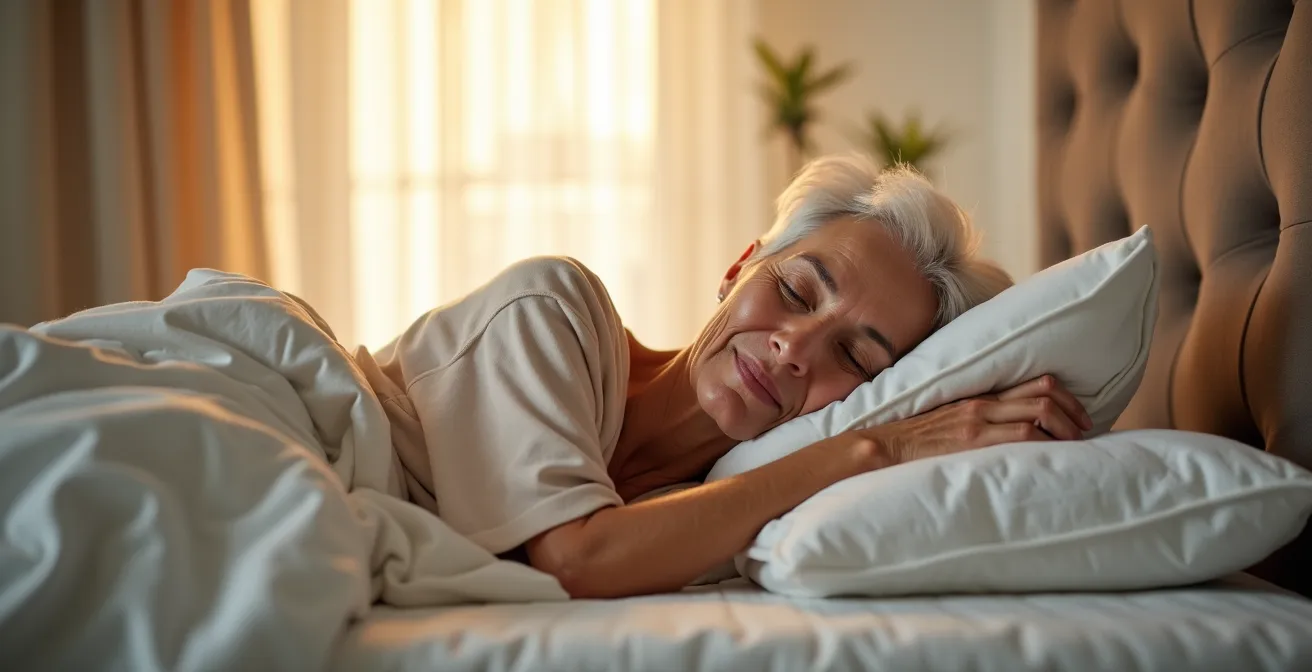
The solution to chronic hip pain for side sleepers over 60 is not just a ‘medium-firm’ mattress, but engineering a complete sleep ecosystem that actively counteracts age-related sleep disruption.
- Your mattress must provide zoned support to allow your hips and shoulders to sink in slightly while supporting your spine.
- Effective sleep depends on managing your entire environment: temperature, sound, light, and even the pillows you use for your head and knees.
Recommendation: Prioritize a hybrid or latex mattress with proven pressure relief and reinforced edges. Integrate it into a holistic system designed for your specific physiological needs.
Waking up at 4 AM with a sharp, nagging pain in your hip is a frustratingly common experience for many side sleepers over 60. You’ve likely tried the standard advice: get a new mattress, maybe a firmer one, or try different sleeping positions. Yet, the cycle of tossing, turning, and fragmented sleep continues, leaving you with brain fog and stiffness the next day. The pain feels like a nightly betrayal by your own body, and the endless search for the “perfect” mattress becomes exhausting.
The conventional wisdom often oversimplifies the problem, focusing solely on mattress firmness. But what if the issue isn’t just the mattress, but a fundamental mismatch between your sleep environment and your body’s changing physiology? The key isn’t to find a single magic bullet product, but to build a personalized sleep ecosystem—a holistic system of gear and habits that works in concert to provide deep, restorative rest.
This guide moves beyond generic recommendations. We will deconstruct the specific age-related challenges that disrupt your sleep, from shifts in hormone production to increased sensitivity to temperature and sound. For each challenge, we will present a specific, ergonomic countermeasure, showing you how to transform your bedroom from a source of pain into a sanctuary for recovery. You’ll learn why the right pillow between your knees can be as important as the mattress itself, how a specific room temperature can unlock deeper sleep, and how to structure your environment for uninterrupted rest.
To navigate this comprehensive approach, the following sections break down each component of your ideal sleep ecosystem. From the science of your internal clock to the practicalities of nighttime safety, this table of contents will guide you through creating a truly restorative sleep environment.
Summary: How to Build a Pain-Free Sleep Ecosystem for Seniors
- Why You Wake Up at 4 AM: The Shift in Melatonin Production You Can’t Fight?
- Fan, Static, or Rain: Which Sound Frequency Actually Masks Tinnitus?
- Cervical vs. Memory Foam: Which Pillow Prevents Morning Neck Stiffness?
- The “Nightcap” Myth: Why That Glass of Wine Is Causing Your 2 AM Awakening?
- Why 65°F (18°C) Is the Critical Temperature for Deep Senior Sleep?
- Motion Sensor vs. Voice Control: Which Is Better for Midnight Bathroom Trips?
- Wedge Pillow or Adjustable Base: What Works Best for Acid Reflux at Night?
- How to Structure Your Morning Routine to Eliminate Brain Fog by 10 AM?
Why You Wake Up at 4 AM: The Shift in Melatonin Production You Can’t Fight?
That consistent, early-morning awakening isn’t just a bad habit; it’s a biological reality of aging. The primary culprit is a natural and significant decline in melatonin, the hormone that governs your sleep-wake cycle. Research is stark: there can be up to a 10-fold decrease in melatonin production in octogenarians compared to teenagers. This change flattens your sleep-wake cycle, making you more susceptible to waking up from minor disturbances like pain or noise, especially in the later part of the night when your drive for sleep is naturally lower.
This physiological shift has a measurable impact on the quality of your rest. As experts noted in the journal *Nature and Science of Sleep*, this leads to a direct decline in sleep quality:
Sleep efficiency dropped from 87% to around 80% in senior people, with a reciprocal rise in sleep onset latency (SOL), the proportion of time spent in light sleep stages N1 and N2 (non-rapid eye movement, NREM), and waking after sleep onset (WASO).
– Authors from Nature and Science of Sleep journal, Melatonin’s Benefits and Risks as a Therapy for Sleep Disturbances in the Elderly
Since you can’t reverse this hormonal decline, the strategy must be to create an environment so perfectly optimized for sleep that it compensates for your body’s reduced ability to stay asleep. This means building a “fortress of sleep” around you—a set of non-negotiable conditions that minimize every possible disruption. It’s about taking control of your environment because you have less biological margin for error.
Your Fortress of Sleep: A 5-Point Action Plan
- Temperature Control: Lower the room temperature to 65°F (18°C) to help trigger and maintain the body’s sleep-related temperature drop, compensating for reduced natural thermoregulation.
- Pressure Relief: Use a mattress with zoned support specifically designed to cradle the hips and shoulders, preventing the pressure points that send pain signals to your brain.
- Sound Masking: Implement a consistent source of brown or pink noise to mask sudden environmental sounds (like plumbing or traffic) that can easily pull you out of light sleep.
- Rhythm Consistency: Maintain a strict sleep-wake schedule, even on weekends, to maximize the effectiveness of your body’s remaining melatonin production.
- Consultative Supplementation: Discuss low-dose (e.g., 5mg) melatonin supplementation with your physician, to be taken 30 minutes before bed as a potential aid.
Fan, Static, or Rain: Which Sound Frequency Actually Masks Tinnitus?
For many seniors, silence isn’t golden; it’s ringing. Tinnitus, a persistent ringing or buzzing in the ears, can make falling and staying asleep a nightly battle. The solution is not more silence but the right kind of sound—a technique called sound masking. However, not all sounds are created equal. The goal is to use a steady, broad-spectrum noise to make the tinnitus less perceptible by reducing the contrast between it and the silent background.
The effectiveness of a sound depends on its frequency profile. While many people use a simple fan, its sound is often inconsistent and may not cover the specific frequency of their tinnitus. Dedicated sound machines offer more precise options:
- White Noise: Contains all frequencies at equal intensity, much like static on a television. It’s effective at masking high-pitched ringing but can sound harsh or hissy to some people.
- Pink Noise: More balanced and natural-sounding, with lower frequencies being more powerful. It’s often compared to steady rainfall or wind and is excellent for general sleep disruption.
- Brown Noise: The deepest of the three, with a strong emphasis on very low frequencies. It sounds like a gentle roar or a strong waterfall and is the most effective for masking low-frequency background rumbles like traffic or plumbing, which often disturb seniors.
For seniors, brown noise is often the superior choice. Its deep, low-frequency character is less intrusive than white noise and does a better job of covering the common environmental sounds that can jolt a light sleeper awake. By creating a smooth, consistent “sonic blanket,” it helps the brain ignore both internal (tinnitus) and external disruptions, allowing for a smoother transition into and maintenance of deep sleep.
Cervical vs. Memory Foam: Which Pillow Prevents Morning Neck Stiffness?
Your mattress can be perfect, but if your head and neck are out of alignment, you’re still setting yourself up for pain. The primary goal of a pillow is to fill the space between your head and the mattress, keeping your spine in a neutral, straight line. For side sleepers, this is particularly critical. A pillow that’s too thin or too thick will force your neck into a stressful angle all night, leading to morning stiffness and pain that can radiate down your back.
While memory foam pillows are popular for their contouring ability, a cervical pillow often offers a more structured, ergonomic solution. These pillows have a specific curved design with a higher contour for neck support and a lower valley for the head. This design actively promotes proper spinal alignment rather than just passively molding to your shape. However, the most overlooked element in a side sleeper’s alignment system isn’t the head pillow at all—it’s the one between their knees.
Case Study: The “Third Element” for Perfect Side-Sleeper Alignment
Research and clinical observations highlighted by the Sleep Foundation have shown that a simple knee pillow is a game-changer for side sleepers with hip and back pain. When you sleep on your side without support, your top leg naturally falls forward and down, twisting your pelvis and straining your lower back and hip joint. As documented in studies on spinal alignment, placing an ergonomic, hourglass-shaped pillow between the knees prevents this collapse. This small addition keeps the hips, pelvis, and spine aligned. Physical therapists often refer to it as the “third element” of the sleep system (mattress + head pillow + knee pillow), as it directly counteracts the torsional forces that create pain overnight.
Therefore, preventing morning neck stiffness isn’t just about the pillow under your head. It’s about seeing your body as a complete system. By using a supportive cervical pillow for your neck and an ergonomic knee pillow for your hips, you create two crucial points of alignment that allow your entire spine to rest in a neutral, tension-free state.
The “Nightcap” Myth: Why That Glass of Wine Is Causing Your 2 AM Awakening?
It’s a tempting ritual: a small glass of wine or spirits to help you relax and drift off to sleep. And initially, it seems to work. Alcohol is a sedative, and it can indeed shorten the time it takes to fall asleep. However, this perceived benefit comes at a very high cost, which is typically paid during the second half of the night. The “nightcap” is one of the most common culprits behind those predictable 2 AM or 3 AM awakenings.
As your body metabolizes the alcohol, a phenomenon known as “REM rebound” occurs. Your sleep architecture, which was initially suppressed, surges back in a disorganized and fragmented way. This leads to a lighter, more agitated state of sleep that is far from restorative. Any underlying discomfort, like the pressure on your hip from an unsupportive mattress, is magnified during this period.
Alcohol initially suppresses REM sleep, but as it’s metabolized, the body overcompensates, leading to a shallow, agitated second half of the night. This rebound phase magnifies any underlying discomfort, such as hip pain from a bad mattress.
– Sleep Medicine Specialists, Clinical observations on alcohol and sleep patterns
Instead of relying on a substance that ultimately sabotages your sleep, the solution is to cultivate a sensory ritual that signals to your body that it’s time to rest. This could involve a warm bath 90 minutes before bed (the subsequent drop in body temperature mimics a natural sleep trigger), listening to calming music, or practicing gentle stretches. These activities calm the nervous system without disrupting your sleep architecture, paving the way for a night of consistent, deep rest rather than a brief slumber followed by hours of tossing and turning.
Why 65°F (18°C) Is the Critical Temperature for Deep Senior Sleep?
Your body’s ability to regulate its internal temperature, or thermoregulation, becomes less efficient with age. To initiate and maintain sleep, your core body temperature needs to drop slightly. A cooler bedroom environment facilitates this natural process. The widely recommended temperature of around 65°F (18°C) isn’t arbitrary; it’s the optimal point that helps your body achieve this necessary temperature drop, signaling that it’s time for deep, restorative sleep. A room that is too warm can interfere with this process, contributing to the sleep fragmentation experienced by many seniors. Given that epidemiological findings show 12-20% of people over 65 suffer from insomnia, optimizing every environmental factor is crucial.
However, room temperature is only half the battle. The other half is your “in-bed microclimate”—the environment of heat and humidity trapped around your body by your mattress and bedding. This is especially important when considering a mattress for hip pain, as many pressure-relieving materials, like traditional memory foam, are notorious for trapping heat. A mattress that solves your pressure problem but causes you to overheat is only trading one problem for another.
This is where modern material science comes in. Hybrid mattresses with coil systems promote airflow, while newer open-cell or gel-infused foams are designed to be more breathable. Pairing these with the right bedding is essential for creating an optimal microclimate, as this guide shows:
| Mattress Type | Heat Retention | Recommended Sheet Material | Optimal Comforter Type |
|---|---|---|---|
| Memory Foam | High (traps heat) | Bamboo or Tencel | Lightweight down alternative |
| Hybrid/Coils | Low (breathes well) | Cotton or linen | Standard down or wool |
| Latex | Medium | Cotton percale | Temperature-regulating wool |
By consciously managing both the macro-environment of your room and the micro-environment of your bed, you create the ideal thermal conditions for uninterrupted sleep. It ensures that you won’t wake up from being too hot or too cold, allowing you to stay in the deeper stages of sleep for longer.
Motion Sensor vs. Voice Control: Which Is Better for Midnight Bathroom Trips?
Nighttime trips to the bathroom are a fact of life for many seniors, but they also represent one of the highest-risk moments for falls. Fumbling for a light switch in the dark while groggy is a recipe for disaster. While smart home technology offers solutions like voice-controlled lights, these can be disruptive, often requiring a loud command that fully awakens you (and your partner). A far more elegant and safer solution is one that is both automatic and unobtrusive.
The most effective systems are those that provide light exactly when and where you need it, without requiring conscious thought. This is where targeted, motion-activated lighting excels. These systems are a core component of a safe sleep ecosystem, and some are even integrated with the bed itself.
Case Study: Pressure-Activated Under-Bed Lighting
Research on senior safety highlights the effectiveness of pressure-activated under-bed lighting. These systems use sensor strips placed beside the bed. The moment your feet touch the floor, they activate a warm, low-intensity LED light that illuminates the floor around the bed. This provides a clear path without the harsh, sleep-disrupting glare of an overhead light. Studies on this targeted approach show it can reduce nighttime fall risk by a staggering 40% compared to navigating in the dark.
This concept of safety extends to the mattress itself. Getting in and out of bed is another potential point of instability. A mattress with weak edges can sag dramatically, creating an unstable surface. As the Sleep Foundation’s research team notes, a firm edge is a critical safety feature:
The perimeter is also reinforced to reduce sinkage when you get in and out of bed. A mattress with a firm, reinforced edge makes sitting up and getting out of bed far safer and more stable for a senior who may be groggy.
– Sleep Foundation Research Team, Best Mattress for Hip Pain Lab Testing
Therefore, a safe nighttime environment combines smart, passive lighting with a physically stable mattress. This combination ensures that necessary trips out of bed are as safe and minimally disruptive as possible, allowing for a quick return to sleep.
Wedge Pillow or Adjustable Base: What Works Best for Acid Reflux at Night?
Hip pain isn’t the only condition that can be aggravated by lying flat. Acid reflux, or GERD, is another common sleep disruptor, causing painful heartburn when stomach acid flows back into the esophagus. The solution is gravity: elevating your upper body prevents this backflow. The two primary tools for achieving this are the wedge pillow and the adjustable bed base. While both serve the same purpose, they offer vastly different levels of integration, comfort, and cost.
A wedge pillow is an affordable, entry-level solution. It’s a simple foam wedge that elevates your entire torso. While effective for occasional or mild reflux, it has drawbacks. It can create an awkward bend at the waist, potentially introducing new pressure points, and it can be difficult to stay positioned on it throughout the night. An adjustable base, on the other hand, is a fully integrated solution. It elevates the entire head section of the mattress, creating a smooth, ergonomic incline from the waist up. This eliminates awkward bends and provides a more stable and comfortable sleeping surface. Furthermore, its benefits extend far beyond reflux relief, as it allows for a “zero-gravity” position that can also alleviate pressure on the hips and lower back.
Choosing between them often comes down to the severity of the condition, budget, and long-term goals, as this matrix illustrates:
| Factor | Wedge Pillow | Adjustable Base |
|---|---|---|
| Cost | $50-150 | $800-3000 |
| Best For | Occasional mild reflux | Chronic reflux, multiple conditions |
| Integration | Standalone, may create awkward torso bend | Seamless ergonomic incline |
| Additional Benefits | Portable, minimal investment | Zero-gravity position for hip/back relief |
| Compatibility | Works with any mattress | Requires flexible mattress |
For seniors building a long-term sleep ecosystem, the adjustable base is often the superior investment. In fact, testing by AARP’s review team gave it a perfect 5/5 score for its compatibility in reducing both hip and lower back pressure when paired with a flexible mattress like a hybrid or memory foam model. It transforms the bed from a static surface into a dynamic tool for health and comfort.
Key Takeaways
- Your goal is not to buy a mattress, but to engineer a complete sleep ecosystem tailored to your body.
- Every piece of gear—from your mattress to your pillows—should be seen as an ergonomic countermeasure against specific age-related issues like hip pain or reflux.
- Actively manage your in-bed microclimate with the right mattress and bedding to prevent overheating, a common sleep disruptor.
How to Structure Your Morning Routine to Eliminate Brain Fog by 10 AM?
The success of your night is ultimately measured by the quality of your morning. The goal of a perfect sleep ecosystem is not just to eliminate pain but to wake up feeling refreshed, clear-headed, and ready for the day. If you’re still battling “brain fog” hours after waking, it’s a sign that your circadian rhythm—your body’s internal 24-hour clock—is still out of sync. A structured morning routine is the final, crucial piece of the puzzle, as it sends a powerful signal to your brain to switch from “sleep mode” to “wake mode.”
The most powerful signal you can send is light. Exposing your eyes to direct morning sunlight for just 10-15 minutes upon waking is the single most effective way to shut down melatonin production and reset your circadian clock for the day. This simple act tells your body unequivocally that the day has begun, which helps to consolidate your sleep the following night. You don’t need to be outside; simply sitting by a window is effective.
The second step is rehydration and mobility. After a night of breathing and transpiring, you are naturally dehydrated. A large glass of water, perhaps with a pinch of salt and a squeeze of lemon to help replenish electrolytes, helps to restore cognitive function. Following this with five minutes of gentle mobility exercises—such as neck rolls, shoulder shrugs, and hip circles—increases blood flow to the brain and muscles, further dispelling stiffness and grogginess.

By making this simple “light, water, and movement” routine a non-negotiable part of your morning, you complete the 24-hour cycle of sleep hygiene. The quality of your night dictates the quality of your morning, and the actions you take in the morning help solidify the quality of your next night’s sleep. It’s a virtuous cycle that reinforces itself, leading to consistently better days and nights.
Your journey to pain-free, restorative sleep begins not with a trip to the store, but with a thoughtful assessment of your own needs. Use this guide as a framework to audit your current sleep ecosystem and identify the single most impactful change you can make. By taking a deliberate, systematic approach, you can reclaim your nights and wake up to brighter, clearer mornings.