
The belief that a quick chore is harmless is a statistical fallacy that lands thousands of seniors in my emergency room. The real choice isn’t between spending a little money or saving it; it’s between a controlled, predictable service fee and the catastrophic, life-altering cost of a single fall.
- A fall isn’t a minor incident; it’s often the trigger for a cascade of health crises, loss of independence, and devastating financial burdens that far exceed the cost of any home maintenance service.
- Proactively outsourcing high-risk tasks like ladder work, heavy lifting, and navigating slippery surfaces is not a sign of weakness but a critical, non-negotiable strategy for preserving your health and autonomy.
Recommendation: Stop calculating the cost of help and start calculating the cost of a fall. Use the audit in this guide to identify your personal risk factors and systematically outsource them before they lead to an irreversible medical event.
Every shift in the emergency room, I treat the consequences of a decision made because “it only takes a minute.” A fractured hip from cleaning a gutter. A traumatic head injury from changing a lightbulb. These aren’t freak accidents; they are predictable outcomes of a dangerous risk calculation. The single most dangerous tool in a senior’s home is not a power saw—it’s a stepladder. And the most dangerous mindset is the frugal independence that tells you to climb it.
The numbers don’t lie. As a doctor, I deal in data, not anecdotes. The data shows that home maintenance tasks are a primary vector for catastrophic injury in adults over 65. We routinely discuss installing grab bars or removing throw rugs, yet we ignore the elephant in the room: the recurring, high-risk chores we insist on doing ourselves. The reality is that over 500,000 Americans visit emergency rooms annually due to ladder falls alone. These visits are not for minor scrapes; they are for injuries that permanently alter lives.
This article is not another gentle safety guide. It is a clinical intervention. My goal is to reframe your thinking from “how can I save money?” to “how can I prevent a life-shattering injury?” We will dissect the most common high-risk chores, not as DIY projects, but as environmental hazards requiring professional mitigation. We will analyze the brutal math of a fall—the financial, physical, and emotional cost—and weigh it against the trivial expense of hiring vetted, insured help. This is your prescription for truly aging in place: not just living in your home, but surviving it.
This guide provides a systematic review of the highest-risk household tasks and the strategic rationale for outsourcing them. By understanding the true cost of an accident, you can make clinically sound decisions to protect your most valuable asset: your continued independence.
Summary: A Clinical Guide to Outsourcing Home Risks and Preventing Falls
- Apps vs. Word of Mouth: Where to Find Vetted Help for Small Jobs?
- Robot Mowers: Are They Worth the Investment to Avoid Pushing a Heavy Machine?
- Deep Cleaning vs. Maintenance: How Often Should You Hire Help for Windows and Drapes?
- Contract vs. Per-Service: Why You Need a Snow Plan Before the First Flake Falls?
- The Damp Spot: Why Ignoring a Small Leak Lead to Black Mold Health Risks?
- Why Spending $500 on Lighting Prevented More Falls Than a $5,000 Bathroom Remodel?
- What Happens to Your Smart Security When the Wi-Fi or Power Goes Out?
- How to Audit Your Home for Fall Risks in Less Than 2 Hours Without Hiring a Pro?
Apps vs. Word of Mouth: Where to Find Vetted Help for Small Jobs?
The first point of failure in preventing a fall is often the hiring process itself. Relying on a neighbor’s cousin or an unvetted handyman introduces a new layer of risk. If that person falls from a ladder on your property, you could be held liable. The goal is to transfer risk, not just the task. Modern service apps (like Thumbtack or Angi) and traditional, reputable agencies offer a crucial layer of protection that word-of-mouth recommendations often lack: verified insurance and background checks. This is non-negotiable.
When you hire a service, you are not just paying for their time; you are paying for their liability coverage, their workers’ compensation insurance, and their professional-grade equipment. The few extra dollars this costs are an insurance policy against a lawsuit or being responsible for someone else’s medical bills. Asking a contractor for proof of insurance isn’t rude; it’s a mandatory step in your own risk management. Any hesitation on their part is a major red flag. Never hire anyone who works “for cash” or cannot provide a certificate of insurance.
Treat the hiring process like a clinical diagnosis. You need to verify the provider’s credentials before you “prescribe” them the work. This systematic approach ensures the person cleaning your gutters is not only capable but also fully insured, protecting both them and you from a financial catastrophe. This isn’t about trust; it’s about documented, verifiable safety protocols.
Robot Mowers: Are They Worth the Investment to Avoid Pushing a Heavy Machine?
Pushing a heavy mower across an uneven lawn in the summer heat is a perfect storm for a medical event. The risks are multi-faceted: cardiac strain, heat exhaustion, and falls from loss of balance on soft or sloped ground. From an ER perspective, this is an elective risk with a high potential for a non-elective hospital admission. The question of a robot mower’s worth is not about convenience; it’s a stark cost-benefit analysis of your health.
The initial investment in a robot mower may seem high, but it is a rounding error when compared to the cost of a single fall-related injury. The numbers are staggering, with the healthcare system seeing $80 billion in healthcare spending for nonfatal falls in 2022. Your portion of that bill, even with insurance, can easily eclipse the price of any lawn equipment. A robot mower eliminates the primary risk factors associated with lawn care: physical exertion, fatigue, and exposure to uneven terrain.
Consider the following breakdown not as a shopping guide, but as an actuarial table for your personal risk. The “cost” of manual mowing is not zero; it’s a deferred payment that can come due at any moment in the form of a 911 call.
| Option | Initial Cost | Annual Cost | Fall Risk | Independence Level |
|---|---|---|---|---|
| Robot Mower | $800-$2,500 | $50 maintenance | Eliminated | Full autonomy |
| Lawn Service | $0 | $1,500-$3,000 | None | Service dependent |
| Manual Mowing | $200-$500 | $0 | High fatigue risk | Physical limitation |
| Fall-related ER visit | N/A | $3,000+ average | After incident | Potentially reduced |
The choice is clinically clear. Automating or outsourcing this task is a direct investment in your continued mobility and financial stability. It’s not a luxury; it’s a preventative health measure.
Deep Cleaning vs. Maintenance: How Often Should You Hire Help for Windows and Drapes?
High-reach cleaning tasks—windows, drapes, ceiling fans, smoke detector batteries—are the very definition of a high-risk, low-frequency activity. Because they are done infrequently, you are less practiced, using equipment (ladders) that may not be in perfect condition. This is precisely the scenario that leads to over-confidence and a subsequent fall. The solution is not to get better at climbing ladders; it is to eliminate the need to climb them at all.
The most effective strategy is to bundle these tasks and schedule a professional service once or twice a year. Instead of facing multiple risky situations spread throughout the year, you consolidate them into a single, safe, outsourced event. A professional window cleaner already has the correct ladders, safety equipment, and insurance. They are accustomed to working at heights. You are not. By bundling services, you can often negotiate a better price and create a predictable maintenance schedule.
This transforms your approach from reactive (e.g., “that smoke detector is beeping again”) to proactive. You schedule a “High-Reach Maintenance Day” every six months. On this day, a professional handles:
- Washing interior and exterior high windows
- Taking down, cleaning, and re-hanging drapes
- Dusting high ceiling fans and light fixtures
- Changing all smoke and carbon monoxide detector batteries
This strategy converts a dozen potential falls into a zero-risk event, managed by a professional.
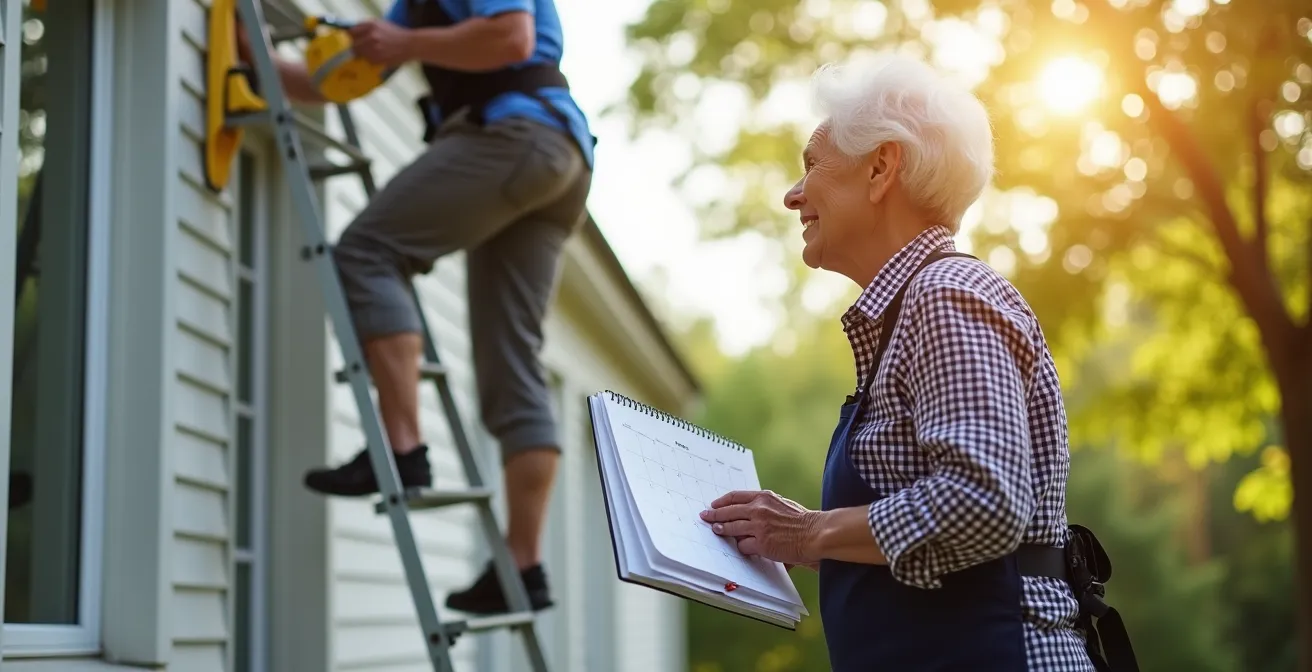
Observing a professional handle these tasks from the safety of the ground is not a sign of weakness; it’s a sign of superior risk management. You have successfully triaged a hazardous activity and delegated it to a specialist, preserving your health and independence.
Contract vs. Per-Service: Why You Need a Snow Plan Before the First Flake Falls?
A sudden snowfall presents an immediate and non-negotiable hazard. A simple trip to the mailbox can become a high-risk expedition across an icy surface. Waiting until after the snow has fallen to find help is a failed strategy; demand will be high, and you may be forced to take a risk yourself. A proactive snow removal contract is the only medically sound approach. It’s an emergency response plan you put in place before the emergency happens.
A per-service arrangement is unreliable. A seasonal contract guarantees you are a priority. When negotiating a contract, your focus should be on specific clauses that minimize your risk exposure. This is not a simple agreement to “plow the driveway.” It is a detailed safety protocol that must be documented in writing. Ambiguity leads to risk.
Your contract is a medical necessity, so its terms must be clinical and precise. Vague promises are worthless when you’re facing an icy walkway. The goal is to ensure your environment is made safe automatically and immediately, without you having to make a single phone call.
Your Non-Negotiable Snow Contract Checklist
- Trigger Depth of 1 Inch or Less: Service must be automatic, not on-call. Do not wait for heavy accumulation.
- Mandatory Salt/Sand Application: Clearing snow is only half the job. Ice prevention on all walking surfaces is critical.
- 4-Hour Maximum Response Time: The service must be rendered quickly after snowfall stops to prevent compaction and ice formation.
- Explicit Liability Insurance Verification: The contract must state their insurance information, protecting you from liability.
- Priority Service for Medical Appointments: A clause that ensures your property is cleared first on days you have scheduled appointments.
Signing a detailed contract before the first flake falls is like having a paramedic on standby. It’s a system designed to prevent the injury before it has a chance to occur.
The Damp Spot: Why Ignoring a Small Leak Lead to Black Mold Health Risks?
A small damp spot on the ceiling or a musty smell in the basement is not a cosmetic issue; it’s the first symptom of a developing medical crisis. From an ER perspective, ignored water intrusion is a chronic condition that inevitably becomes acute. It creates two distinct threats: first, the structural damage can create unseen fall hazards like a soft spot in the floor. Second, and more insidiously, it creates the perfect breeding ground for black mold (Stachybotrys chartarum), a significant respiratory threat, especially for older adults.
The development of mold introduces neurotoxins into your home’s air. For a senior, whose respiratory and immune systems may already be compromised, this can lead to a cascade of health problems: chronic coughing, shortness of breath, sinus infections, and even cognitive symptoms like confusion and dizziness. These symptoms themselves become significant fall risk factors. Dizziness while walking down the hall is just as dangerous as a slippery floor.
Ignoring the problem because it seems small is a catastrophic financial and medical miscalculation. The cost of remediation escalates exponentially over time, as does the damage to your health. The data is clear: small problems, left untreated, become disasters.
| Timeline | Issue Stage | Repair Cost | Health Impact |
|---|---|---|---|
| Week 1-2 | Small leak detected | $100-300 | None |
| Month 1-3 | Water damage spreads | $500-1,500 | Mild odor, humidity increase |
| Month 3-6 | Mold begins growing | $2,000-5,000 | Respiratory irritation begins |
| Year 1-2 | Extensive mold/structural damage | $10,000+ | Severe respiratory issues, confusion, dizziness |
The appearance of a damp spot requires an immediate response. It must be treated with the same urgency as a chest pain—a symptom that requires immediate professional diagnosis and intervention. A licensed plumber or water damage specialist can identify the source and prevent the progression to a full-blown health hazard.
Why Spending $500 on Lighting Prevented More Falls Than a $5,000 Bathroom Remodel?
In the ER, we see countless falls that happen at night during a simple trip from the bedroom to the bathroom. Patients often focus on expensive renovations like walk-in tubs, but the highest-impact, lowest-cost intervention is often overlooked: strategic, automated lighting. A $5,000 bathroom remodel is useless if you trip in a dark hallway on the way there. Poor visibility is a primary environmental hazard, and it’s one of the easiest and cheapest to remedy.
The goal is to create a “path of light” that activates automatically, requiring no fumbling for switches in the dark. This is not about leaving a bright lamp on all night, which can disrupt sleep. It’s about using low-cost, low-wattage technology to illuminate walkways and key areas just enough for safe navigation. For a modest investment, you can create a comprehensive system that virtually eliminates the risk of a nighttime fall due to poor visibility.
A well-designed, sub-$500 lighting system provides a far greater return on investment in terms of fall prevention than many larger, more expensive projects. It directly addresses one of the most common and dangerous fall scenarios. Here’s a clinical breakdown of a highly effective, low-cost system:
The $500 Fall-Proof Lighting System Prescription
- $50: Motion-Sensor LED Nightlights: Place them along the floor in hallways and on the path to the bathroom. They provide instant, low-level light upon movement.
- $100: Under-Cabinet LED Strips: Install in the kitchen and bathroom. They illuminate countertops for tasks or getting a glass of water without blinding you.
- $100: Smart Bulbs with Voice Activation: For bedside lamps or overhead lights, allowing you to turn on lights before you even get out of bed.
- $150: Professional Installation of Illuminated Switches: Replacing key light switches with ones that glow in the dark eliminates searching for the switch.
- $100: Battery-Backup Emergency Lights: These plug into outlets and turn on automatically during a power outage, preventing total darkness.

This layered approach ensures that from the moment you swing your feet out of bed until you return, your path is safely lit. It is one of the most powerful preventative measures you can implement.
What Happens to Your Smart Security When the Wi-Fi or Power Goes Out?
The proliferation of “smart” devices has introduced a new, often-unseen vulnerability into home safety: dependence on power and Wi-Fi. Many consumer-grade security cameras, smart speakers, and automated devices become expensive paperweights during an outage. When assessing your home’s safety net, you must perform a clinical triage: separating “lifeline” devices from “lifestyle” devices.
A lifestyle device is one of convenience, like a smart speaker that plays music. Its failure is an annoyance. A lifeline device is one that is critical to your safety, such as a medical alert system or emergency lighting. Its failure during a crisis can be catastrophic. Many seniors mistakenly believe their smart home setup provides a safety net, when in reality, it’s a house of cards that collapses with the first power flicker or internet disruption.
Your critical safety systems must have redundancy. This means they need a backup power source (an uninterruptible power supply or UPS) and, ideally, a backup communication method (a cellular connection). A medical alert pendant that relies solely on your home Wi-Fi is not a reliable medical device. Security cameras that stop recording when the power goes out are merely deterrent theater. You must prioritize your technology based on its function during a worst-case scenario.
Your Lifeline vs. Lifestyle Device Triage
- Lifeline Devices (Must Have Backup): Medical alert systems, automated pathway lighting, stairway illumination, and emergency phones. These must function in an outage.
- Important but Secondary: Security cameras at entrances and smart door locks. These should have battery backup and, for locks, a manual key override.
- Lifestyle Devices (No Backup Needed): Smart speakers, streaming devices, and automated blinds. Their failure does not pose an immediate safety risk.
- Monthly System Check: Test your backups. Unplug your router and main power to verify that your lifeline devices switch to their battery and/or cellular backup.
- Verify Manual Overrides: Ensure you can still use essential items like door locks manually if the smart technology fails.
Assuming your technology will work when you need it most is a dangerous gamble. You must actively test and verify its resilience. True security lies in redundancy, not just connectivity.
Key takeaways
- The decision to perform high-risk chores yourself is a statistical gamble where the potential loss (a life-altering fall) vastly outweighs the potential gain (saving a small service fee).
- A proactive strategy of outsourcing tasks involving ladders, heavy lifting, or slippery surfaces is a non-negotiable medical and financial prescription for safe aging in place.
- Your home’s safety is a system; it’s only as strong as its weakest link, whether that’s poor lighting, an un-vetted handyman, or a safety device without battery backup.
How to Audit Your Home for Fall Risks in Less Than 2 Hours Without Hiring a Pro?
The most dangerous risks are the ones we stop seeing. The loose rug we’ve learned to step over, the dim hallway we navigate by memory, the high shelf we stretch to reach. A systematic home audit is a diagnostic tool designed to make you see your home through the eyes of an ER doctor. It forces you to identify the environmental hazards that have become invisible to you. The statistics are unforgiving; more than 38,000 older adults died from falls in 2021, and most of those falls were preventable.
This audit is not about generating a long list of expensive renovations. It is about identifying high-risk *tasks* and *behaviors* and making a simple, binary decision for each: “To-Do” or “To-Outsource.” Anything that requires a stepladder, significant stretching or bending, or navigating a known hazard (like a slippery path) immediately goes on the “To-Outsource” list. This is your personal risk mitigation plan.
Performing this audit is the most critical preventative action you can take. It moves you from a passive hope that you’ll “be careful” to an active, systematic process of eliminating danger. It is the practical application of everything we have discussed: identifying risk and prescribing a solution before the trauma occurs.
Your 5-Step Home Safety Audit
- Map Your Daily Routes: Walk your most common paths: bed to bathroom, kitchen to living room, path to the mailbox. Note every loose rug, electrical cord, piece of clutter, or poorly lit area. These are your primary trip hazards.
- Inventory High-Reach and Low-Reach Tasks: List everything in your home that requires a stepladder or deep bending to access. Changing bulbs, retrieving items from high cabinets, cleaning low baseboards. These are your primary fall-from-height or loss-of-balance risks.
- Assess All Walking Surfaces: Check every floor surface, stair, and outdoor path for integrity. Look for uneven pavement, loose floorboards, slippery tile (especially in the bathroom), and stairs lacking secure handrails on both sides.
- Test Your Lighting and Emergency Systems: Simulate a nighttime walk and a power outage. Does your path of light activate? Do backup lights turn on? Can you easily reach a phone that works without power?
- Create Your “To-Do vs. To-Outsource” List: Based on the findings, create your action plan. Simple fixes like securing a rug are “To-Do.” Anything from the High-Reach/Low-Reach list or requiring work on a known hazard goes directly to the “To-Outsource” list. This is your final prescription.
The evidence is clear and the conclusion is unavoidable. The small, recurring cost of professional home maintenance is not an expense; it is the premium on an insurance policy against a catastrophic loss of independence. The next step is not to consider whether you can afford the help, but to acknowledge that you cannot afford the fall. Evaluate your home using the audit provided and begin scheduling the services you need today.