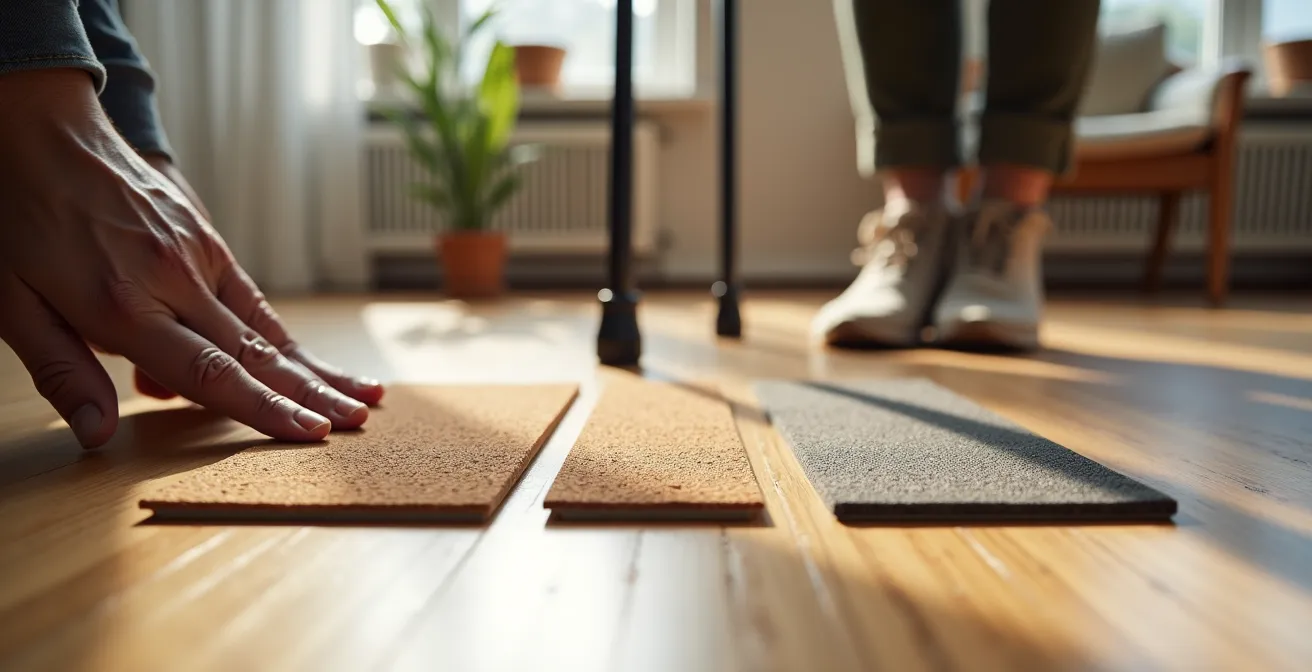
The safest flooring isn’t just the softest; it’s the one with the best scientifically-proven combination of slip resistance and impact energy dissipation.
- A material’s wet Dynamic Coefficient of Friction (DCOF) is the most critical number for preventing slips, far more important than how it feels when dry.
- Materials like cork excel at absorbing impact forces, which can be the difference between a bruise and a fracture in a fall.
Recommendation: Prioritize flooring with a documented wet DCOF of 0.42 or higher and cellular structures (like cork or high-density rubber) that are engineered to absorb and dissipate force.
When considering flooring for a home, aesthetics and durability often lead the conversation. But for seniors, the primary concern shifts to a much more critical factor: safety. A fall can have devastating consequences, and the surface we walk on every day is the first line of defense. The common wisdom suggests choosing something “soft,” like carpet, but this oversimplifies a complex issue. True safety is not just about a cushioned landing; it’s about preventing the slip in the first place and, if a fall does occur, having a material that can scientifically manage and reduce the impact forces on the body.
This isn’t about guesswork or how a material feels to the touch. It’s about material science. The protective qualities of a floor can be measured through metrics like the Dynamic Coefficient of Friction (DCOF), which predicts slip potential on wet surfaces, and its ability to provide force attenuation, or impact absorption. Many homeowners are surprised to learn that some seemingly safe options, like high-pile carpet, can introduce significant trip hazards, while some hard surfaces, if properly engineered, offer superior protection. The key is to look beyond marketing claims and understand the properties that truly safeguard your well-being.
This guide will not just tell you what to buy; it will teach you how to think like an impact safety researcher. We will decode technical specifications, analyze the pros and cons of common materials through the lens of physics, and provide actionable tests you can perform. By understanding the science behind safe flooring, you can make an informed choice that protects your independence and provides genuine peace of mind.
To navigate this crucial decision, we will explore the key aspects of flooring safety, from reading technical specifications to understanding the hidden dangers of seemingly harmless choices. This structured approach will empower you to build a safer home environment from the ground up.
Summary: A Researcher’s Guide to Safer Flooring
- How to Read Tile Specs: What Does “COF > 0.42” Actually Mean for Your Safety?
- Wall-to-Wall Carpet: Is the Fall Cushioning Worth the Allergy and Trip Risks?
- Polished vs. Honed Stone: Why You Should Never Put Marble in a Senior Bathroom?
- How to Create “Invisible” Transitions Between Different Floor Types?
- Why Bamboo Flooring Might Be Too Slippery Despite Being Eco-Friendly?
- How to Perform a “Slide Test” to Check Your Bathtub’s Safety Coating?
- The Invisible Danger of Throw Rugs That Sends 38,000 Seniors to the ER Annually
- Anti-Slip Treatments vs. Mats: Which Solution Is Safer for a Wet Kitchen Floor?
How to Read Tile Specs: What Does “COF > 0.42” Actually Mean for Your Safety?
When you’re looking at tile samples, the most important number for your safety is not the price, but the DCOF rating. The Dynamic Coefficient of Friction (DCOF) measures the slip resistance of a surface when it’s in motion and, most critically, when it’s wet. This simulates a real-world scenario, like walking across a kitchen floor after a spill. The old standard, Static Coefficient of Friction (SCOF), only measured the force needed to start moving from a standstill on a dry surface, which is far less relevant for preventing falls.
The number to remember is 0.42. According to industry standards, a minimum DCOF of 0.42 is required for level interior floors when wet. This isn’t just a suggestion; it’s the baseline for what is considered a reasonably safe walking surface. A tile with a DCOF below this threshold is statistically much more likely to cause a slip-related fall in wet conditions, such as in a bathroom, entryway, or kitchen. For these high-risk areas, a protective approach would be to look for values of 0.50 or even higher.
Relying on a salesperson’s assurance of “non-slip” is not enough. You must be prepared to ask for the specific product data sheet. Here are the key things to look for:
- The Test Method: Ensure the DCOF value was determined using the ANSI A326.3 standard, often called the “AcuTest.”
- The Wet Value: Do not accept a dry COF or SCOF value. The wet DCOF is the only number that matters for predicting real-world slip safety.
- Surface Texture Ratings: In addition to DCOF, look for German “R” ratings like R10 or R11, which indicate a surface with microscopic texturing designed to provide extra grip.
By arming yourself with this knowledge, you shift from a passive customer to an informed safety advocate for your own home. You are no longer choosing a tile; you are specifying a safety surface.
Wall-to-Wall Carpet: Is the Fall Cushioning Worth the Allergy and Trip Risks?
Carpet is the go-to recommendation for “soft” flooring, and for good reason: its ability to provide impact dissipation is significant. In the event of a fall, a high-quality carpet and pad can absorb a substantial amount of energy, potentially reducing the severity of an injury. However, this benefit comes with serious trade-offs that must be carefully weighed. The very features that make carpet soft can also introduce new dangers.
The primary risks are related to mobility and air quality. High-pile or plush carpets create resistance underfoot, making it more difficult for individuals using walkers, canes, or wheelchairs to move freely. This can lead to fatigue and an altered, less stable gait. Furthermore, the edges of thick carpets, especially at transitions to other flooring, can become a significant trip hazard. Over time, carpet fibers can trap dust, pollen, and other allergens, which can be a major concern for respiratory health, a factor often overlooked in the safety equation.
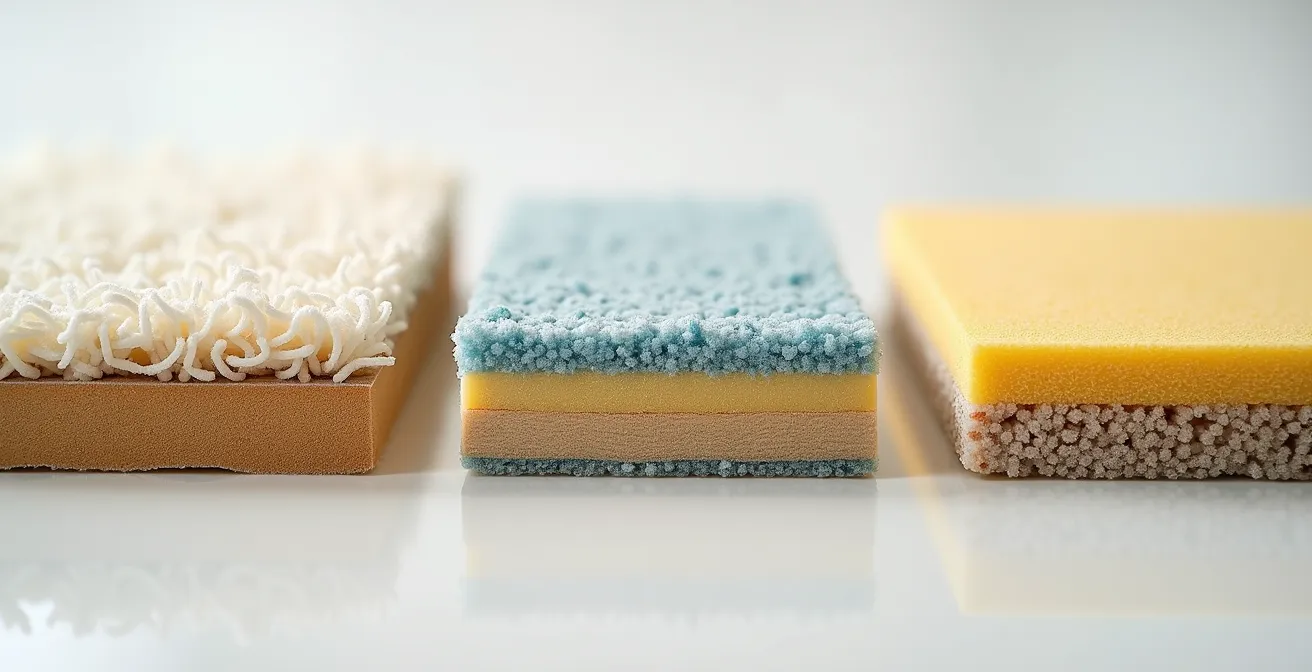
The choice of underpad is just as critical as the carpet itself. As the image above illustrates, different pads offer vastly different levels of compression and energy return. A thick, spongy pad might feel luxurious but can be less stable, while a thinner, denser rubber or frothed foam pad can offer a better balance of cushioning and support for stable footing. The key is finding a balance that cushions a fall without impeding daily movement.
Case Study: The Shift to Low-Pile Carpet in Senior Living
Many senior living communities are moving away from plush carpets in favor of low-pile, commercial-grade options. This choice directly addresses the mobility issue. As a case study from senior living facilities shows, shorter fibers offer less resistance, making it easier for residents with walkers or canes to navigate. These communities often pair low-pile carpets with dense, non-slip underlays, achieving a compromise that maintains significant cushioning benefits while drastically reducing the daily trip hazard and improving accessibility for all residents.
Polished vs. Honed Stone: Why You Should Never Put Marble in a Senior Bathroom?
Natural stone floors like marble, granite, or travertine can add a look of timeless elegance to a home, but this beauty often conceals a serious danger. The distinction between a polished and a honed finish is not merely aesthetic; it is a critical safety determinant, especially in areas prone to moisture like a bathroom. A polished finish creates a smooth, glass-like surface that, when wet, becomes exceptionally treacherous with a dangerously low DCOF.
Polished marble is perhaps the worst offender. Its surface is so smooth that even a few drops of water can eliminate nearly all friction, making a slip almost inevitable. In contrast, a honed finish is created by stopping the polishing process early, leaving the stone with a matte, slightly textured surface. This micro-texture, while subtle, dramatically increases the DCOF, providing more grip for your feet. Even with a honed finish, however, many natural stones do not meet the minimum 0.42 DCOF safety standard when wet.
The following table, based on data from flooring safety experts, starkly illustrates the differences in risk between common floor types.
| Stone Type | Typical DCOF (Wet) | Fall Risk Level | Maintenance Required |
|---|---|---|---|
| Polished Marble | < 0.30 | Very High | Daily squeegee, weekly sealing |
| Honed Stone | 0.35-0.40 | High | Regular cleaning with abrasive cleaner |
| Textured Porcelain (R11) | > 0.60 | Low | Simple mopping |
As the data shows, even a honed stone floor presents a high fall risk. A far safer alternative is a modern textured porcelain tile designed to mimic the look of stone. These engineered products can achieve excellent DCOF ratings while being far less porous and easier to maintain. As the team at Archtoolbox points out when discussing different tile options, some materials are inherently safer. They state:
Quarry tile surfaces can achieve DCOF values as high as 0.60, making them inherently more slip resistant than polished stone.
– Archtoolbox Editorial Team, Floor Slip Resistance: SCOF vs DCOF
This expert insight reinforces the core principle: for wet areas, engineered safety must always take precedence over natural aesthetics.
How to Create “Invisible” Transitions Between Different Floor Types?
A perfectly safe floor can be completely undermined by a single unsafe transition. The small, often overlooked strip that connects two different flooring materials—like tile in the kitchen and hardwood in the hallway—is a notorious trip hazard. For a senior, especially one with a shuffling gait or who uses a walker, a height difference of even a quarter-inch can be enough to catch a foot and cause a serious fall.
The goal is to create “invisible” or “zero-threshold” transitions that are perfectly flush. This requires careful planning during installation. The ideal method is to recess one of the subfloors or use different thicknesses of underlayment to ensure the finished surfaces meet at exactly the same height. When this isn’t possible, the choice of transition strip becomes paramount. Standard, curved aluminum strips are a poor choice as they create a small but definite bump.
Instead, opt for low-profile, beveled transition strips made from a high-friction material like rubber. The beveled edge creates a gentle ramp rather than an abrupt lip, making it easier for feet, walkers, and wheelchairs to pass over. Furthermore, choosing a strip that has a strong color contrast with both adjoining floors provides a crucial visual cue, helping to alert the brain to the change in surface. Finally, always secure these strips with screws rather than just adhesive, as glue can fail over time, causing the edges to curl up and create a new trip hazard.
Auditing your home’s existing transitions is a simple but powerful fall prevention strategy. Get down on your hands and knees and check every doorway and change in flooring. Is it perfectly level? Is the strip securely fastened? Is it visible? Answering these questions can reveal hidden dangers before they cause an accident.
Your Action Plan: Auditing and Creating Safe Floor Transitions
- Identify Contact Points: Walk through your home and list every location where two different flooring types meet (e.g., bathroom tile to hallway carpet, kitchen vinyl to living room wood).
- Assess Existing Elements: For each transition, note the height difference. Is it perfectly flush? Note the material and condition of the transition strip. Is it curved, beveled, loose, or worn?
- Check for Coherence with Safety Principles: Does the transition create a bump? A strip with a DCOF rating of less than 0.42 or a color that blends in with the floor is a safety failure.
- Evaluate Visual & Physical Cues: Is the transition strip in a contrasting color to make it highly visible? Does its texture provide grip, or is it smooth and slippery?
- Create an Action Plan: Prioritize the most dangerous transitions (high traffic areas, uneven strips). Plan to replace them with flush or low-profile, beveled, high-contrast, and screw-secured strips.
Why Bamboo Flooring Might Be Too Slippery Despite Being Eco-Friendly?
Bamboo flooring has gained popularity as a durable and environmentally sustainable alternative to traditional hardwood. While it excels in these areas, it can fall dangerously short in a key area for senior safety: slip resistance. The very feature that makes modern bamboo so durable—its finish—is also what can make it hazardous. This creates a paradox where a seemingly responsible choice could compromise personal safety.
Most high-quality bamboo flooring is of the “strand-woven” variety, which is incredibly dense and hard. To protect this surface from scratches, manufacturers apply multiple layers of an aluminum oxide finish. This factory-cured coating creates an exceptionally smooth, almost glass-like surface. While excellent for resisting wear and tear from furniture or pets, this finish results in a very low coefficient of friction, especially when any moisture is present. The focus on scratch resistance comes at the direct expense of grip.
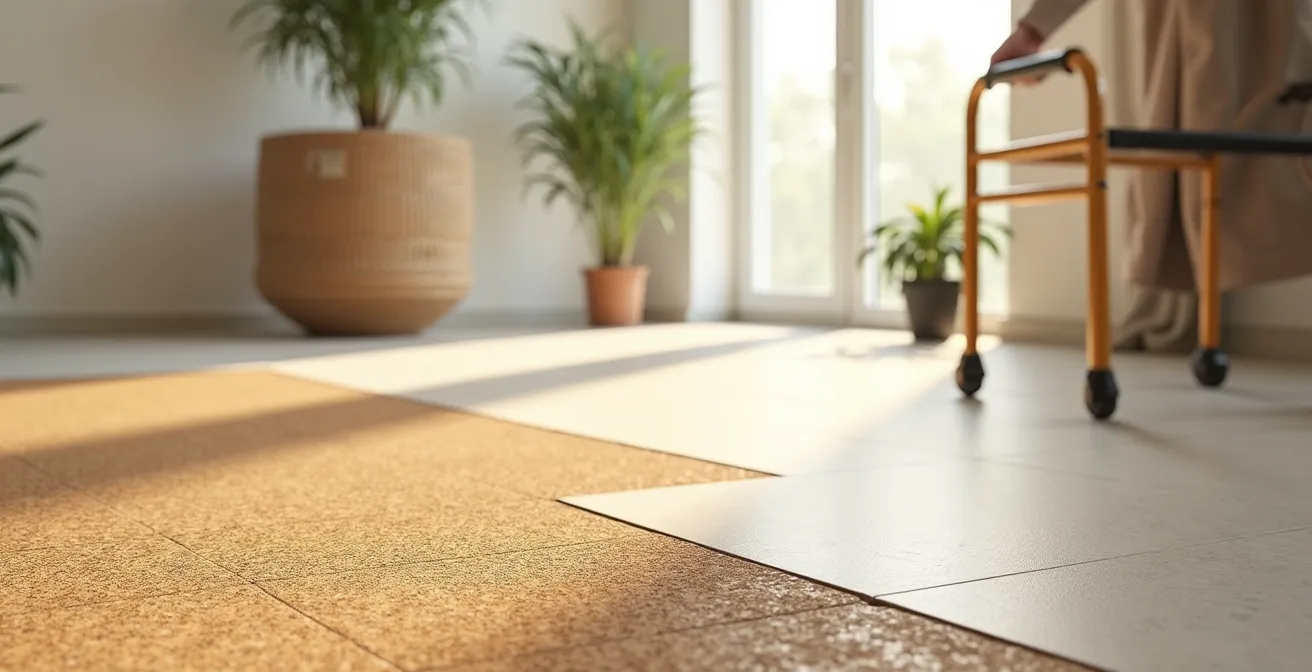
In contrast, another eco-friendly option, cork, offers a completely different safety profile. Its inherent material properties are geared toward protection. Cork’s natural texture and cellular structure provide both shock absorption and inherent slip resistance. This makes it a much more forgiving surface in every sense.
Material Science Showdown: Cork vs. Bamboo
A direct comparison reveals why these two eco-friendly materials perform so differently. As highlighted in an analysis by flooring experts at iCork Floor, cork’s natural cellular structure, which is full of tiny air pockets, provides inherent impact absorption. Its natural Suberin content also makes it water-resistant and provides grip. In contrast, the hard, non-porous aluminum oxide finish on strand-woven bamboo is specifically engineered for hardness, not friction. While both are sustainable, only cork is designed by nature for safety and comfort underfoot.
This doesn’t mean all bamboo is unsafe, but it does mean you must investigate its DCOF rating with extreme scrutiny. If the manufacturer cannot provide a wet DCOF test result that meets the 0.42 minimum, it should be considered a high-risk choice for areas like kitchens or entryways.
How to Perform a “Slide Test” to Check Your Bathtub’s Safety Coating?
The bathroom is statistically one of the most dangerous rooms in the house for falls, and the bathtub or shower floor is ground zero. Many modern tubs come with a built-in textured or anti-slip surface. However, this safety feature is not permanent. Over time, aggressive cleaning agents, abrasive powders, and general wear can smooth down this essential micro-texture, drastically reducing its effectiveness and turning a once-safe surface into a hazard.
You cannot rely on visual inspection alone to assess the condition of your tub’s safety coating. A surface can look textured but have lost its functional grip. A simple, regular “slide test” can give you a tangible measure of its deterioration. This is not a highly scientific test, but it provides a consistent baseline you can use to track changes over time. Performing this check monthly can alert you to a developing risk before it leads to a fall.
Here is a safe, practical method for testing your tub’s surface:
- Sit Safely: Begin by sitting securely on the edge of the tub, ensuring you have a sturdy grab bar or wall to hold onto for support. Never perform this test while standing.
- Wet the Surface: Run a small amount of water to wet the tub floor, mimicking the conditions of a normal shower.
- Foot Test: While seated and holding on, carefully place one wet, bare foot onto the tub floor. Gently apply some pressure and attempt to slide your foot forward and backward. Note the amount of resistance.
- Water Bottle Test: For a more objective measure, take a standard 1-liter plastic water bottle, fill it, and place it on the wet surface. Try to slide it with one finger. A surface with good grip will offer significant resistance, while a worn surface will let the bottle glide easily.
- Observe Water Behavior: Notice how water acts on the surface. If water beads up into distinct droplets, the coating is likely still effective. If the water “sheets” out into a smooth film, it indicates the surface is worn and has lost its texture.
If you notice a significant decrease in resistance or see water sheeting, it is a clear sign that the built-in safety has been compromised. At this point, you must take action, such as applying an after-market anti-slip treatment or using a high-quality, non-slip mat.
The Invisible Danger of Throw Rugs That Sends 38,000 Seniors to the ER Annually
Of all the potential hazards in a home, the seemingly innocent throw rug is one of the most insidious. While the exact number of injuries can be hard to pin down, data frequently attributed to the Consumer Product Safety Commission suggests that throw rugs are a primary culprit in falls, leading to an estimated 38,000 emergency room visits for seniors each year. This is not a random accident; it’s a predictable outcome of introducing a small but profound instability into a walking environment.
The danger of a throw rug is twofold. First and most obviously, a rug without a proper non-slip backing can slide out from underfoot, instantly causing a loss of balance. But the more subtle danger is the trip hazard created by the rug’s edge. For a person with a perfectly smooth, strong gait, lifting the foot over a half-inch edge is automatic. However, for a senior who may have developed a slightly shuffling gait due to age, arthritis, or neurological conditions, that small edge becomes a wall. The toe of the shoe catches, momentum carries the body forward, and a fall is the inevitable result.
From a material science perspective, a throw rug introduces an unpredictable variable into a consistent system. A safe walking path is one where the coefficient of friction and surface height are constant. The brain and body adapt to this consistency. A throw rug abruptly changes both. Your foot moves from a high-friction surface (the rug) to a lower-friction one (the floor around it), and it must navigate an unexpected change in elevation. This disruption is what makes throw rugs so dangerous.
The only truly safe throw rug is one that is removed entirely. If a rug is absolutely necessary for warmth or comfort, it must be secured with high-quality, double-sided carpet tape around its entire perimeter, ensuring it lies perfectly flat and cannot bunch up or slide. Even then, it remains a point of risk. The most protective strategy is to eliminate them, especially in high-traffic areas like hallways, kitchens, and bathrooms.
Key Takeaways
- True flooring safety is determined by measurable data like wet DCOF (aim for >0.42), not by perceived softness.
- Materials with inherent impact absorption, like cork or dense rubber, are superior for reducing fall injury severity.
- Surface finish is critical: honed or textured surfaces are always safer than polished, glass-like finishes, especially in wet areas.
Anti-Slip Treatments vs. Mats: Which Solution Is Safer for a Wet Kitchen Floor?
Once you’ve identified a slippery floor in your home, particularly in a high-risk area like the kitchen, you are faced with a choice: should you use a removable mat or apply a permanent anti-slip treatment? Both options aim to increase the coefficient of friction, but they do so in very different ways, each with its own set of safety pros and cons. The best solution depends on the specific floor type and your tolerance for maintenance.
Anti-slip treatments typically use a mild acid to create microscopic etches in the surface of hard flooring like ceramic or porcelain tile. This process, known as micro-etching, creates a texture that is invisible to the naked eye but dramatically increases the DCOF when the floor is wet. It’s a permanent solution that doesn’t introduce a new trip hazard. However, it must be applied correctly, as over-application can damage the floor’s appearance. In contrast, removable rubber-backed mats are simple, effective, and add a layer of cushioning comfort. Their primary drawback is that they can become a hazard themselves if their edges curl or if water gets trapped underneath, creating a mold risk and a slippery film.
This table compares the solutions to help guide your decision:
| Solution | DCOF Range | Pros | Cons |
|---|---|---|---|
| Anti-slip treatment (micro-etching) | 0.50-0.65 | Permanent solution, no trip hazard | Can damage appearance if overapplied |
| Rubber-backed kitchen mats | 0.45-0.55 | Removable, washable, comfortable | Water can get trapped underneath |
| Hybrid approach (treatment + runners) | 0.50-0.60 | Maximum safety in work triangle | Higher initial cost |
Ultimately, verifying the safety of any surface comes down to reliable testing. As the experts at Safety Direct America note, standardized testing is the foundation of accident prevention.
The pendulum DCOF tester has been in use for 50 years and has an official test method in at least 49 nations, providing reliable floor friction assessment to prevent accidents.
– Safety Direct America, Floor Slip Resistance Testing Standards
For homeowners, this underscores the importance of choosing products and treatments that are backed by documented, standardized test results, providing an objective layer of protection beyond simple marketing claims.
The journey to a safer home environment concludes with informed action. By moving beyond simple notions of “softness” and embracing a protective mindset based on measurable data like DCOF and impact absorption, you transform your role from a homeowner into a personal safety manager. Choosing materials like cork for their energy dissipation or specifying tiles with a verified high DCOF is not just a design choice; it is an investment in your health, independence, and long-term well-being. This proactive approach, grounded in material science, provides the most reliable defense against the life-altering consequences of a fall.